




 On December 18, 2025
 By Rebecca Field
Winter mountain walking in Scotland: how to carry and use crampons and an ice axe
Preparing for winter walking
Winter transforms the Scottish mountains. Familiar paths can quickly become buried, and repeated thaw–freeze cycles can turn an easy summer path into something extremely treacherous. A simple slip can have serious consequences.
For anyone planning winter walking in the Highlands, knowing how to use your crampons and ice axe — and how to carry them properly — is a core part of staying safe.
At Scot Mountain Holidays, we spend a lot of time helping guests build confidence in winter conditions. This blog is not exhaustive, but it outlines some key principles and opinions from our guide, Andy, based on many years of winter experience in the Scottish mountains.
Why winter boots, crampons and an ice axe matter in winter
Winter Boots:
dequately stiff winter boots are the foundation of safe winter movement. In many ways, the boot is just as important a tool as your ice axe.
Stiffness is vital because it:
-
ensures crampons can be fitted securely
-
allows you to concentrate body weight and force through specific areas of the boot
A proper winter mountaineering boot enables efficient execution of step-kicking and crampon techniques. Even without consciously employing these techniques, you will notice that your footing feels significantly more secure on snow-covered terrain.
Winter boots also provide better insulation, improved ankle support, and — critically — the uppers are robust enough to allow crampon straps to be tightened properly without restricting circulation.
B1 winter boots are generally not sufficiently stiff for Scottish winter mountain conditions. When front-pointing, the toe can bend upwards and the heel drop, causing you to lose purchase and potentially fall out of the step.
Underfoot conditions in Scotland’s winter mountains are often more challenging than summer glacier crossings in the Alps or Himalaya. Even a fully rigid B3 boot rarely feels excessive on a hill walk in full winter conditions.
Crampons:
Crampons are strong pieces of equipment, but they are not indestructible. Importantly, stiffness should come from the boot, not the crampon.
An inadequately stiff boot can subject a crampon to repeated cyclical stress over the course of a day, increasing the risk of fatigue or failure. Always choose a crampon that is compatible with your boot — the stiffer the boot, the wider the range of compatible crampon styles.
Ice axe:
Putting aside technical climbing axes, Andy does not favour long-shafted walking axes. While there are occasions where a longer shaft is useful, these are generally outweighed by the disadvantages.
Shaft length is always a compromise. A length of 50–55cm suits most winter walking situations well.
An ice axe leash should not be permanently attached. There have been incidents where people have sustained head and upper-body injuries after losing grip of an axe during a slide, with the axe flailing at the end of a fixed leash.
A simple and safer solution is to put a loop in the end of the leash and larks-foot it through the hole in the head of the axe only when a leash is needed.
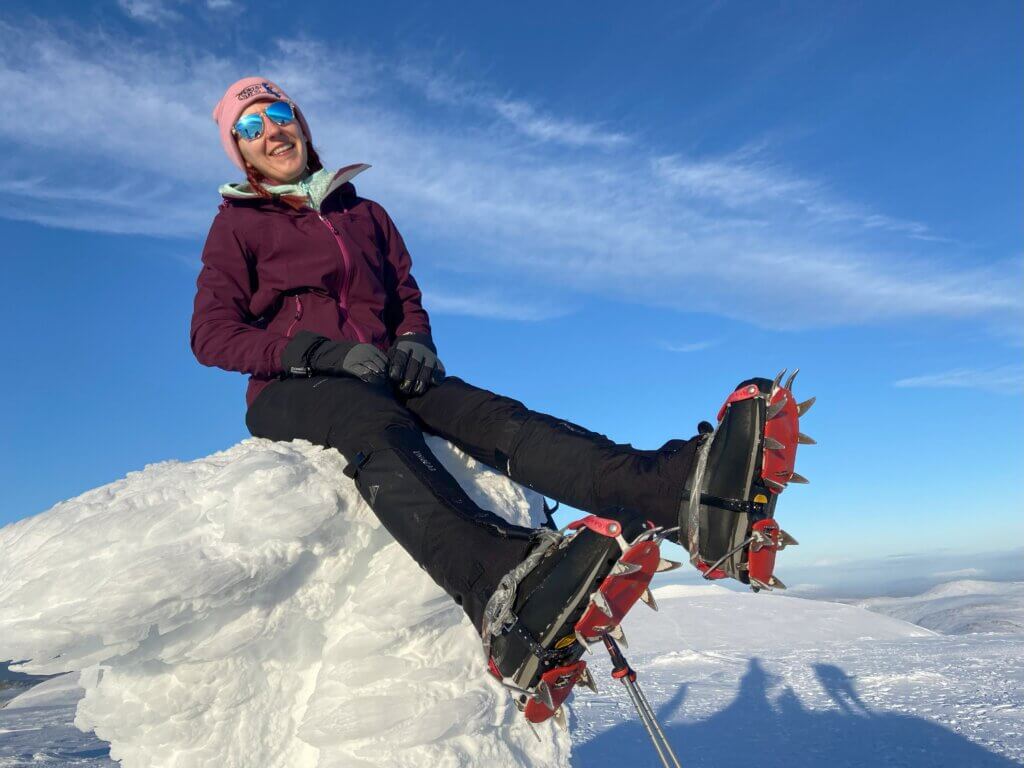
Check out the crampons – New Year Winter Walking 2022 – 2023
How to carry your ice axe
When not in use, your ice axe should be carried securely but remain quickly accessible.
The conventional rucksack attachment — threading the shaft through the axe loop and securing it with the pick pointing upwards — is not ideal. This often leaves the pick exposed at an aggressive angle.
Preferably, the axe should be stowed under the side compression straps of the pack, with the head uppermost and the pick pointing downwards and away from the shoulder.
It is also possible to carry the axe slipped behind a shoulder strap or between your back and the rucksack. This allows rapid deployment when you reach snow without stopping to remove your pack.
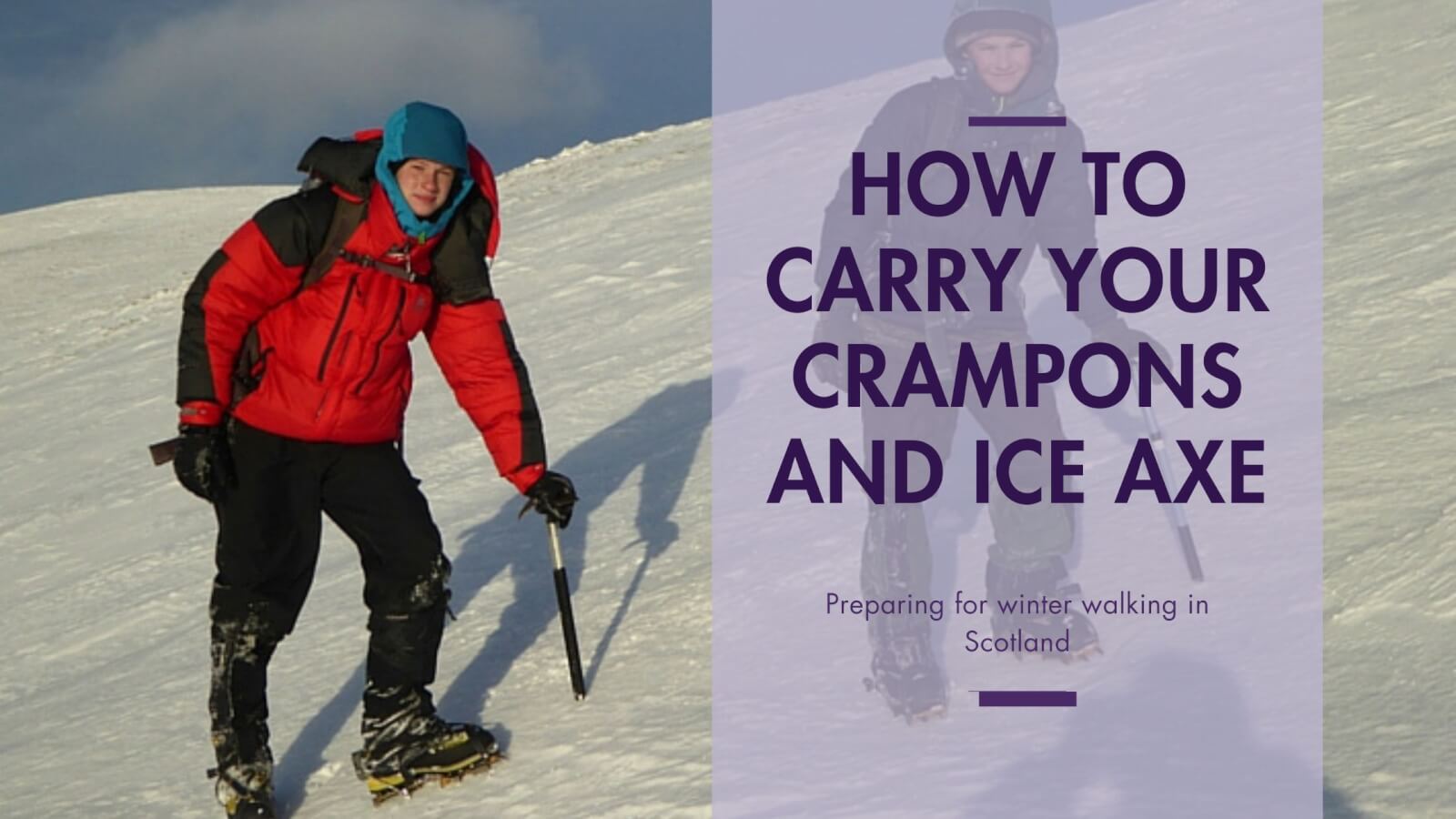
Once on snow or ice-covered slopes, the axe should usually be carried in the hand. Hold it by the head with the pick pointing backwards and the adze forwards.
When traversing a slope, always carry the axe in the uphill hand, enabling self-belay should you lose your footing. Zig-zagging uphill requires frequent hand changes. A permanently attached leash would significantly reduce speed and efficiency in these situations.
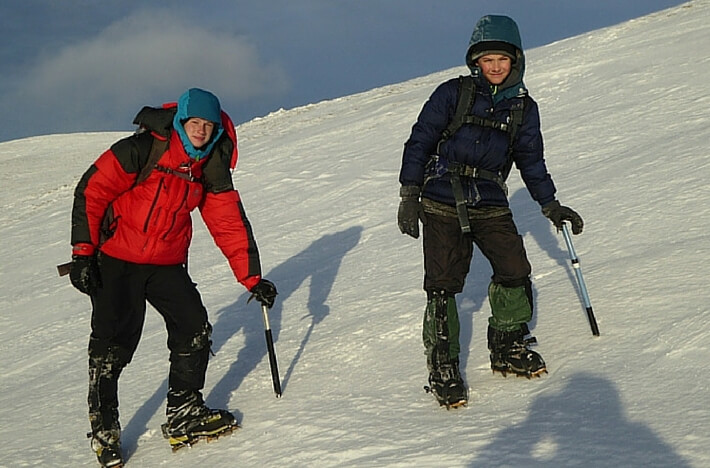
5 day and 2 day winter skills courses in the Cairngorms
How we recommend carrying crampons
At Scot Mountain Holidays, Andy is very clear about how crampons should be carried.
We do not recommend carrying crampons on the outside of a rucksack unless there is an integral, secure crampon pouch. Crampons are heavy and can easily work loose. Unprotected on the outside of a pack, they can also be hazardous — particularly in high winds or crowded environments.
Instead, crampons should be stored in a sturdy crampon bag and carried inside your rucksack. This keeps them secure, protects your pack and other equipment, and prevents accidental loss on the hill or injury to other people.
In winter conditions, place the crampon bag near the top of your pack so it can be accessed quickly without unpacking everything else.
Fitting Crampons
Always adjust and fit your crampons to your boots at home. You should be completely familiar with the process before heading into winter conditions, as cold hands and strong winds make everything more difficult.
Do not put your crampons on while sitting down. You need your full body weight on your feet to ensure proper sole-to-crampon contact.
Choose a flat, stable place — firm snow or a rock platform. Lay the crampons on the ground with all straps clear, step into the crampon, and secure it carefully. Do not wait until you are already on steep or icy ground before fitting them.
Moving Safely With Crampons and an Ice Axe
General winter walking technique is straightforward but requires attention. A slightly wider gait is advisable, and you must lift your feet properly to avoid catching a crampon point.
As slopes steepen, more specific techniques are required. These skills take practice and should ideally be learned and refreshed in appropriate conditions with experienced guidance.
Final Preparation Tips
Winter days are short, so plan conservatively and allow more time than you would in summer. Check mountain weather forecasts and ground conditions carefully, and be prepared to change plans if conditions are unsuitable.
Practise using your winter equipment before your trip, and ensure everyone in your group understands when and how crampons and ice axes should be used.
Learning Winter Skills With Scot Mountain Holidays
Safe winter hill walking represents a genuine step up from summer walking — an expansion of skills and judgement rather than a move into something extreme.
If you are considering developing your winter walking skills, our winter courses and guided winter walking trips are designed to build confidence from the ground up.
On all Scot Mountain Holidays winter courses, we revisit core winter skills, including how to carry and use crampons and an ice axe. Every introduction to winter skills begins with a full equipment check, with Andy personally checking crampon fit and compatibility with boots.
He explains how and why adjustments are made, ensuring guests understand not just what works, but why. This attention to detail helps develop good habits early, avoids common mistakes, and builds long-term confidence in winter terrain.
Good habits learned early make winter walking safer, more enjoyable and far more rewarding.
If you are planning winter walking in Scotland after Christmas and would value experienced guidance while developing these skills, we would be delighted to help you prepare.