





 On January 8, 2026
 By Rebecca Field
Preparing for a group hiking trip to Scotland: it may be more complex than it seems.
“Scotland is not the Rockies” – understanding Scottish terrain and conditions
What Is “True Wilderness”?
How Scottish hiking differs from North American trails and why it can be surprising – even for experienced groups
If you regularly organise hikes in North America — whether in US National Parks, Canadian provincial parks, or established wilderness areas — you’re used to a certain definition of wilderness.
You expect:
-
Clearly defined trails
-
Waymarked junctions
-
Predictable gradients
-
Weather windows that usually hold
-
Infrastructure designed to manage large numbers of hikers
Scotland offers something very different.
And this difference is often what catches even highly experienced North American hiking groups off guard.
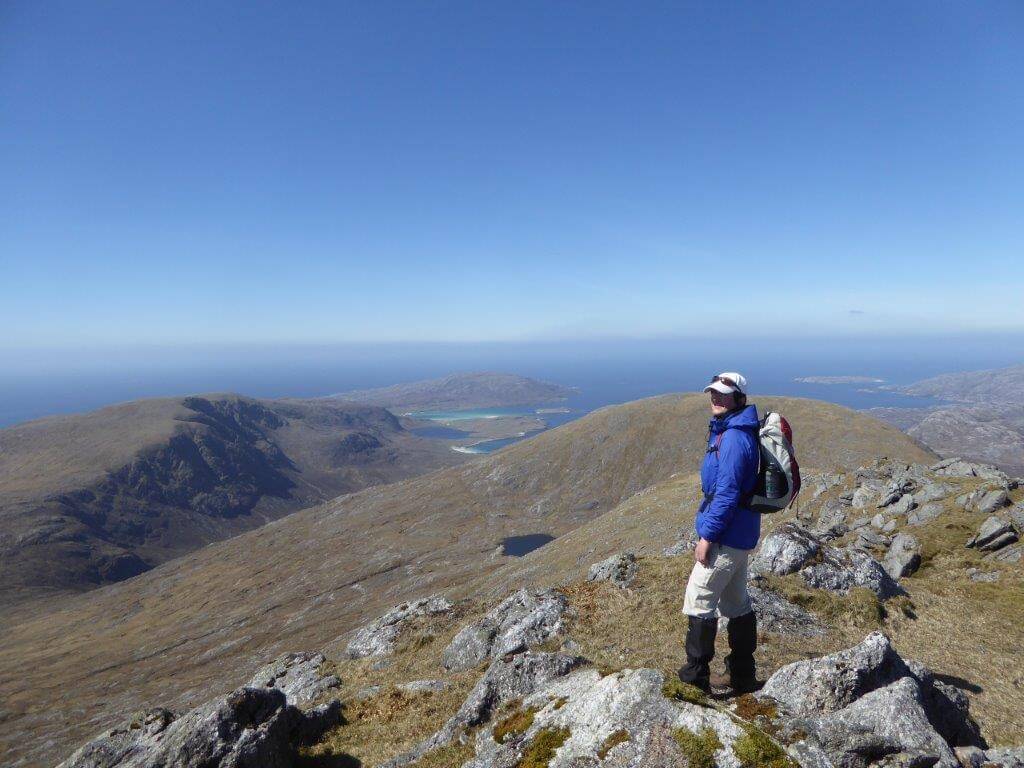
Admiring the seemingly endless wilderness views from the hills of Harris
Wilderness Without Infrastructure
In much of North America, wilderness exists within a managed framework. Trails are built, graded, signed, and maintained. Even in remote areas, the route is usually obvious underfoot.
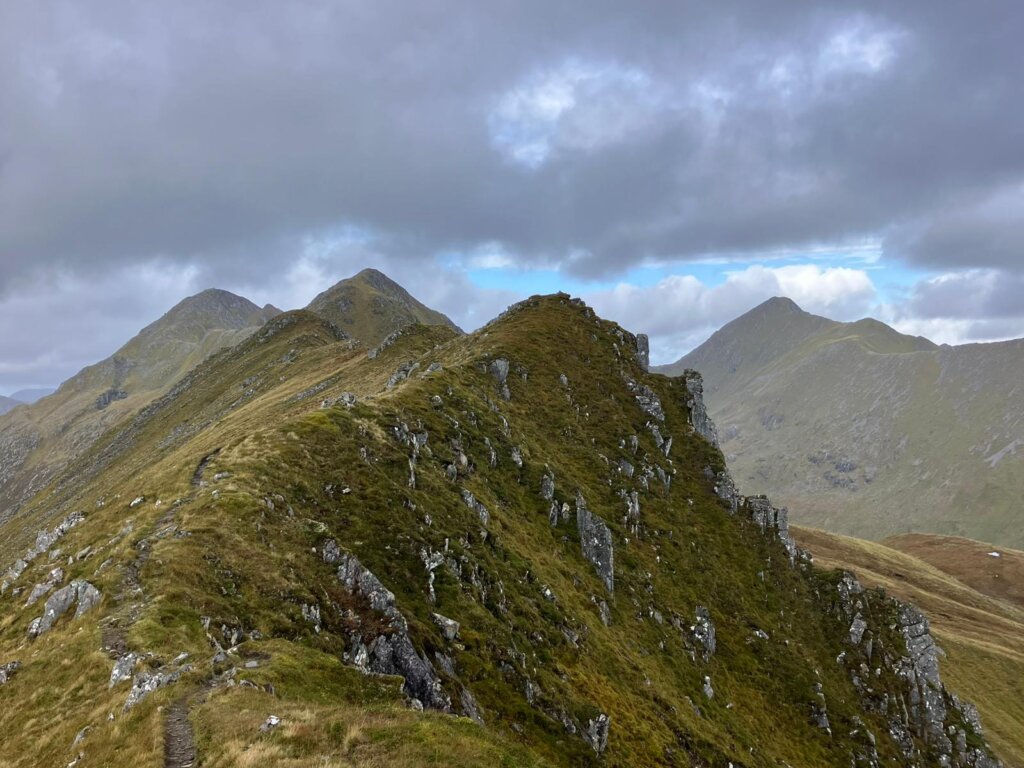
In Scotland, true wilderness often begins where the trail ends.
Paths may:
-
Fade in and out
-
Split unexpectedly
-
Cross bog, heather, rock, and grass with no clear line
-
Exist only because people (or sheep or deer) have walked there before
This doesn’t make Scottish hiking more dangerous — but it does make it fundamentally different.
For group organisers, the key shift is this:
In Scotland, you are often navigating across terrain, not along a trail.
There are organised long distance trails here, the most famous of which is the West Highland Way, but if you really want to experience the best of the Highlands you’ll want to head out into less well known terrain.
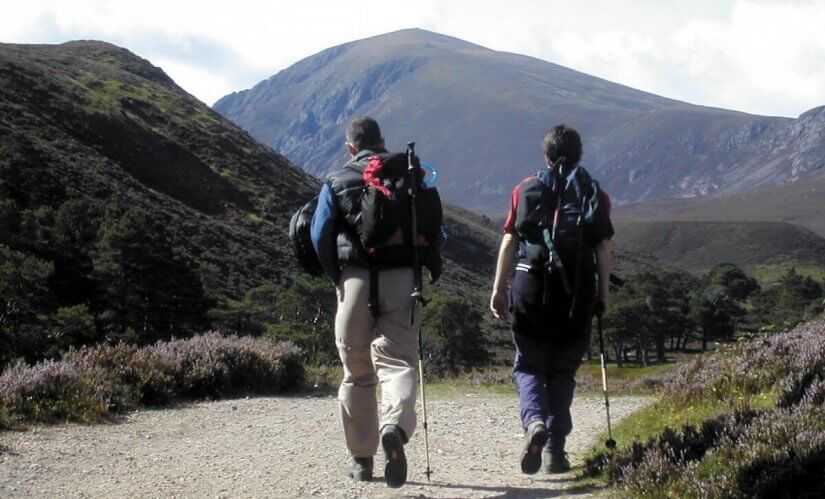
On the way to Britains’s second highest peak, Ben Macdui. Perfect photo opportunity.
Modest elevation, high effort
One of the most common assumptions North American hikers bring to Scotland is that lower elevation equals easier hiking.
On paper, Scotland’s mountains look modest: our highest peak is Ben Nevis: 4,413 ft (1,345 m)
Compared to the Rockies or Sierra Nevada, this doesn’t seem especially demanding. However it is worth remembering that many of our hikes start from sea level. Any day where you ascend 1000m is more than enough for many, especially if the terrain is not the easiest underfoot.
Effort in Scotland comes less from altitude and more from:
-
Rough, uneven ground – for some reason, “heather bashing” is never a highlight guests are begging to repeat!!!
-
Persistent wetness underfoot – boggy ground is never a favourite either. Peat “hags” can make a hike a bit of en endurance event.
-
Steep, direct ascents
-
Constant micro-navigation decisions
A 6–8 mile Scottish hike can feel more strenuous than a much longer North American trail day.
Many experienced North American hikers are surprised by how physically and mentally demanding Scottish walking can be — even at lower elevations.
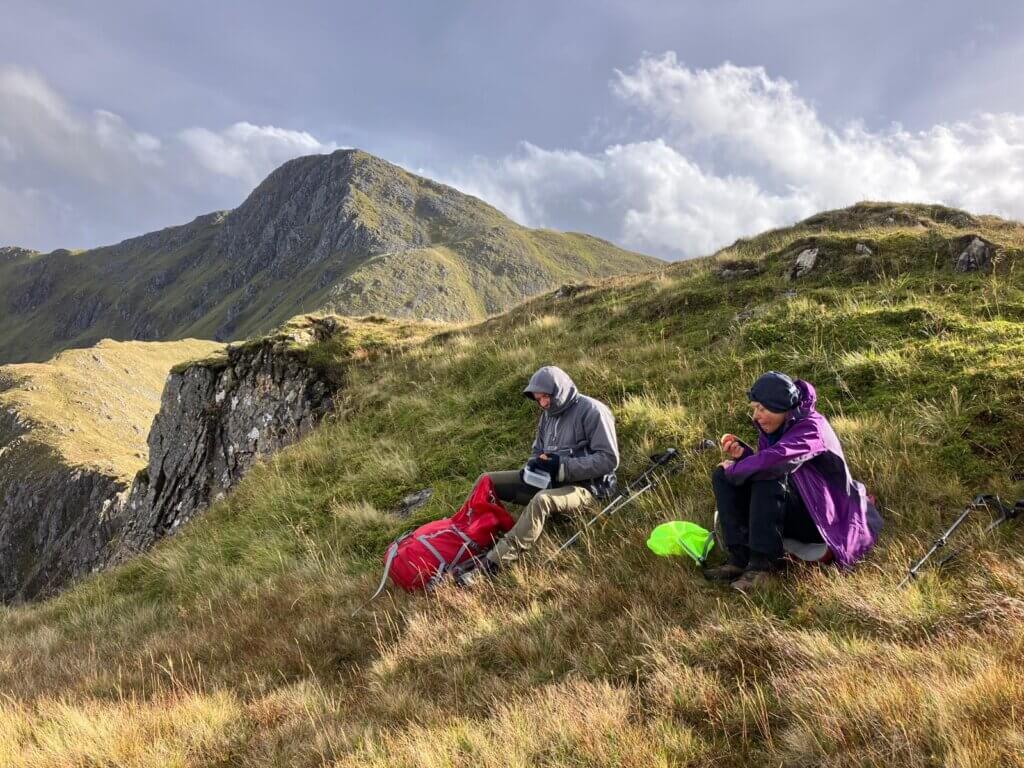
Navigation matters more than mileage
In many North American parks, mileage is the primary planning metric. If your group can comfortably hike 10–12 miles on established trails, the assumption is that they’ll be fine elsewhere.
In Scotland, navigation skill often matters more than distance.
Why?
-
Landmarks can disappear quickly in fog
-
Trails may not be visible from one section to the next
-
GPS and phone signals are unreliable
-
Route choices must be adjusted constantly based on terrain and conditions
This doesn’t mean Scottish hiking is technical — but it is engaged. You’re always reading the landscape.
For group leaders, this adds mental load:
-
Choosing safe lines across open ground
-
Adjusting pace in poor visibility
-
Making conservative decisions without obvious trail cues
Weather Is Not an Interruption — It’s the Default
In many parts of Western North America, weather is something you work around. Storms come and go. Forecasts are reliable enough to plan with confidence.
In Scotland, weather is part of the landscape.
It’s normal to experience:
-
Wind on summits year-round
-
Light rain or mist for extended periods
-
Rapid changes in visibility
-
Cool temperatures even in summer
Fog, wind, and wet ground are not exceptional conditions — they are expected.
The most successful Scottish hiking groups aren’t the ones who avoid poor weather, but the ones who plan with flexibility:
-
Shorter distances
-
Lower-level alternatives
-
Routes chosen on the day, not weeks in advance
Rethinking “True Wilderness”
For many North American hikers, wilderness is defined by distance and scale: long approaches, big trail networks, and a clear sense that once you’re deep in a National Park, you are far from roads, towns, or services.
In Scotland, wilderness works differently — and this is where experienced North American groups are often surprised.
You can be:
-
Two hours into a hike
-
Only 6–8 miles from your start point
-
Technically less than five miles from a public road
…and still be walking across pathless ground, with no visible trail, no signage, no buildings, and no other people in sight.
What creates the sense of wilderness in Scotland isn’t distance — it’s exposure and engagement.
Here’s what that looks like in practice:
-
No constructed trail:
You may be moving across grass, rock, heather, or peat rather than a maintained path. Footing is uneven and often wet, which slows progress and increases fatigue. -
No waymarking or junction signs:
Route choices are made by reading the land — contour lines, slope angles, drainage lines — rather than following posted directions. -
Weather that limits visibility:
Low cloud can reduce visibility to 30–50 metres, even in summer. When this happens, navigation becomes continuous rather than occasional. -
Commitment without obvious exit points:
Once you’re on a ridge or plateau, descent options may be limited by terrain, wind direction, or group ability — even though civilisation is geographically nearby. -
Little or no phone signal:
You cannot rely on real-time weather updates or easy communication, so decisions must be made confidently and conservatively.
For a group organiser, this means the feeling of remoteness comes not from how far you’ve gone, but from how fully you are responsible for the next decision — route, pace, safety, and timing — at every stage of the day.
That’s why groups often describe Scottish hiking as more mentally demanding than expected, even when daily distances are shorter and elevation gain looks modest on paper.
What This Means for Group Organisers
If you’re leading a group that’s confident, capable, and experienced in North American hiking environments, Scotland doesn’t require you to lower your ambitions — but it does require you to reframe expectations.
Successful groups:
-
Plan shorter, more varied days
-
Value navigation and local knowledge over mileage
-
Build in weather flexibility
-
Allow leaders to focus on experience, not constant decision-making
This is why many North American group organisers choose to work with local experts for Scottish trips — not because the hiking is beyond their ability, but because the context is unfamiliar.
Walking Well in a Different Landscape
Walking in a country which isn’t your own always has challenges – many of which might not be considerations when you’re at home. For starters the maps are different. The maps in the UK are very good quality – you need to look out for OS (Ordnance Survey) maps. There is an app but we wouldn’t recommend relying exclusively on your device. You can get waterproof paper maps which would be a good backup for a leader/organiser.
On top of this, as we’ve mentioned we like to keep our “wilderness” in Scotland relatively pristine so you’ll find fewer paths and a noticeable lack of signposts (our European neighbours find this cause for comment too).
If you’re really keen to experience the wildlife, understand the geology, know the local fauna – then working with a local expert would really benefit your group.