




 On August 19, 2026
 By Rebecca Field
Walking in Assynt: What a Guide Notices
Assynt is one of those places that seems to have remained slightly under the radar.
Mention Skye to most visitors to Scotland and you’ll usually get an immediate response. Mention Assynt and, particularly when we’re talking to guests at Fraoch Lodge, we’re often met with a blank look.
And yet many people who have driven the North Coast 500 have already passed through Assynt without necessarily realising quite what they’ve seen. Others have heard of Suilven, perhaps, but haven’t yet discovered the landscape around it.
We’ve always thought that was rather a good thing.
Assynt has some of the most extraordinary mountain scenery in Scotland, but it also has a wild coastline, lochs, beaches, ancient landscapes and a sense of space that is difficult to find elsewhere. For walking, in particular, it is a remarkably rewarding place.
After many years of walking and guiding there, however, I don’t think of Assynt simply as a collection of mountains and walks. Guiding in Assynt is about reading the landscape and making decisions about how best to experience it on any particular day.
The mountains aren’t really the whole story
There are some obvious stars.
Suilven is perhaps the most recognisable, with its distinctive shape visible from miles away. Then there are Canisp, Cul Mor, Cul Beag and Stac Pollaidh, each with its own character.
It would be easy to assume that walking in Assynt is therefore about working your way through a list of summits.
But when we’re guiding, the summit is only part of the decision.
We’re constantly looking at the weather and visibility, the condition of the ground, the wind direction and what the forecast is doing. We’re also considering the people we’re walking with. How is the group feeling? What sort of day are they enjoying? Is everyone up for a longer outing, or would a shorter walk make for a better experience?
And then there’s the landscape itself.
Sometimes a mountain that looked like the obvious choice on the map isn’t the best choice once we’re actually there. At other times, a little patience can transform the day. A mountain may be hidden in cloud in the morning and emerge dramatically later in the day.
That’s one of the things I enjoy about guiding in Assynt. The landscape isn’t a fixed backdrop. It changes constantly.
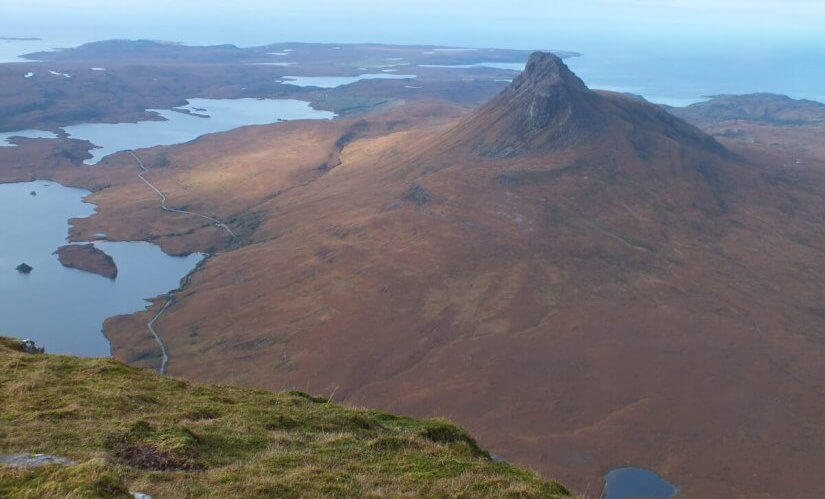
Spectacular Scottish coastline, Assynt (Scotland)
Assynt rewards flexibility
A map can tell you how high a mountain is. It can tell you how far you’re going to walk and how much ascent there is.
It can’t tell you whether the cloud will lift from Suilven at lunchtime.
It can’t tell you whether the wind will make a particular ridge uncomfortable, or whether the light on the mountains across a loch is going to make a lower-level route far more rewarding than climbing higher.
And it certainly can’t tell you how the people you’re walking with are going to feel on the day.
This is why, when we’re guiding in Assynt, we don’t regard an itinerary as something that has to be followed rigidly regardless of circumstances.
We have a plan. But we also have options.
A change in the weather might mean changing the route. A particularly good forecast might make it worth waiting for a particular viewpoint. Or perhaps the conditions simply aren’t right for the mountain we’d originally considered, but there is another walk that will give us a much better day.
That flexibility is particularly important in a place like Assynt, where the weather can change the character of the landscape remarkably quickly.
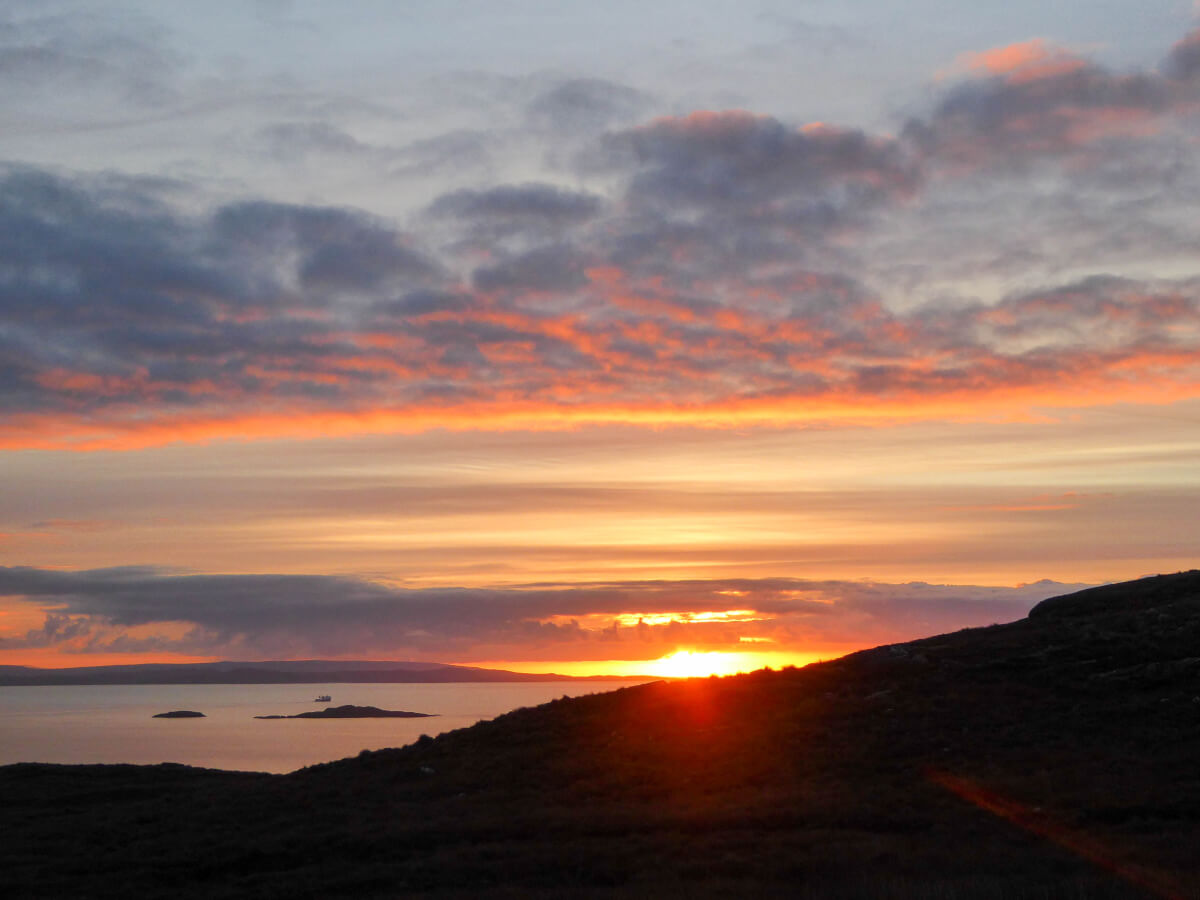
Perfect autumn sunset scenery and light in Assynt, Scotland
Looking at the whole landscape
One of the pleasures of walking with someone who knows an area well is that you start to notice things you might otherwise walk straight past.
We’re not just thinking about where the path goes or where the summit is.
We’re looking at the relationship between the mountains and the lochs, the coastline and the hills behind it. We’re noticing the geology beneath our feet and the way the light is changing. We’re watching for wildlife and looking at how the landscape has been shaped by both natural processes and people.
Sometimes the best route is the one that gives the group the most interesting journey rather than the most impressive tick on a list of summits.
And that’s something that is difficult to convey in a standard walking guide.
You can download a route. You can follow a line on a map. But knowing when to take a different route, stop for a while, change the day’s objective or simply make the most of what is in front of you comes from spending time in the landscape.
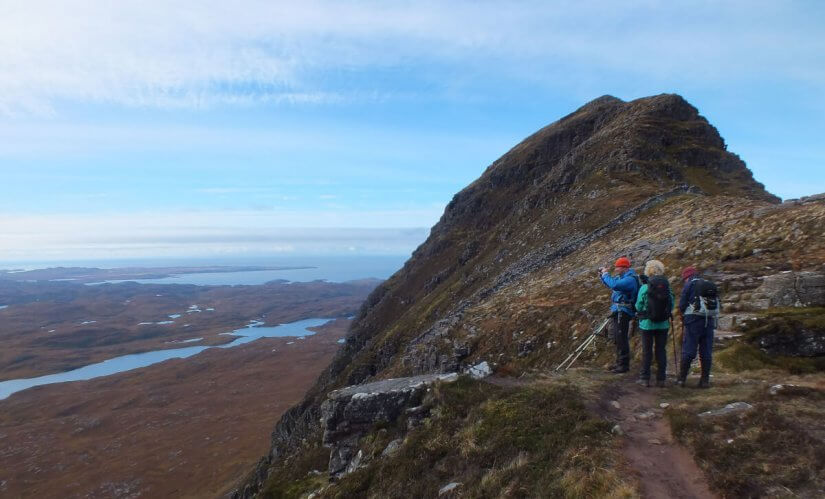
Heading up the ridge, Assynt (Scotland)
The best day isn’t necessarily the hardest day
We love a good mountain day. There is nothing quite like reaching a summit after several hours of walking and seeing the landscape opening out around you.
But I don’t think the quality of a walking day can be measured simply by distance, height gained or the number of summits reached.
Sometimes the memorable day is a big one.
Sometimes it is a shorter walk where the cloud lifts at exactly the right moment.
It might be an unexpected wildlife encounter, an almost deserted beach, the light catching the mountains across a loch, or simply finding a quiet place to stop for lunch with an extraordinary view.
Those are the experiences that stay with people.
And they are one of the reasons we don’t approach every day in the mountains as an endurance test. The aim is to have a great day outside, not simply to come back having walked the greatest number of kilometres.

Spectacular views abound in Assynt even though the mountains are not the grandest in height.
Why we keep going back
We’ve walked in Assynt many times, but that’s precisely why we enjoy returning.
Familiarity doesn’t make the landscape less interesting. If anything, it gives us more possibilities.
We know the routes, but we also know the alternatives. We know where conditions can make a difference and where there are opportunities to change the plan. We have a better understanding of how different walks fit together and how to make the most of whatever the weather decides to give us.
And every visit still produces something unexpected.
That is particularly true when we’re walking with a different group of people. A route that we’ve walked many times can feel completely different when you’re experiencing it through somebody else’s eyes.
This September we’re heading back to Assynt for our Empty Quarter walking holiday. It is one of our favourite areas to guide, and perhaps one of the best examples of why we value local knowledge and flexibility when we’re walking in the Highlands.
Assynt may not have the same fame as Skye.
We’re quite happy about that.
For now, it remains one of Scotland’s great places to discover on foot – and somewhere we think is well worth getting to know.
If you’re new to Assynt, take a look at our guide to [20 reasons to visit Assynt], which introduces some of the area’s highlights. This article is a little different: it’s about how we approach walking there as guides.
Walking in Assynt: frequently asked questions
Is Assynt good for hiking?
Yes. Assynt offers a wide range of walking, from demanding mountain routes to shorter walks around lochs and the coast. The area is particularly rewarding because the landscape combines distinctive mountains, lochs, coastline and beaches.
What are the best walks in Assynt?
Popular mountain walks include Suilven, Stac Pollaidh, Canisp, Cul Mor and Cul Beag. However, the best walk depends on weather, conditions and the experience and interests of the walkers.
Can you walk in Assynt without a car?
Some walks can be accessed by public transport, but having a car gives you considerably more flexibility in this remote area. For a guided walking holiday, transport between walks are usually included as part of the experience.
When is the best time to go walking in Assynt?
Assynt can be walked throughout much of the year, but conditions vary considerably between seasons. Late spring, summer and early autumn generally provide longer daylight hours, while autumn can bring particularly atmospheric conditions and colours. Summer is probably the time we would avoid Assynt (given the choice) but only because of the high possibility of midge infestations.