




 On September 30, 2026
 By Rebecca Field
When we put together a walking holiday, we need to set out the routes, peaks and points of interest we intend to include. After all, most of our guests are not choosing to join us on a trip just because they want to come to Scotland, or because they want to visit a particular area. They usually have particular peaks/walks which they have in mind, particularly on Munro trips. However, though we obviously plan carefully and manage all the foreseeable risks, sometimes there are factors outside our control which mean that plans become flexible. Flexiblity is part of responsible planning.
Scotland doesn’t always follow the plan
No matter how carefully you study the forecast, the weather on the day doesn’t always conform to it. And when you’re planning a walking holiday months, sometimes even years, in advance, you obviously don’t have access to an accurate forecast. You can choose a time of year which is historically a good one for walking, but in Scotland there is rarely, if ever, a guarantee of fine weather.
There is another variable too: every group is different. People walk at different speeds, have different levels of experience and respond differently to conditions underfoot. A route which is straightforward for one group might prove much more tiring for another.
Scottish weather can change quickly
Visitors from abroad are sometimes surprised by just how quickly conditions can change in Scotland. Our maritime climate means that you can have sunshine, showers, wind and cloud all within the same day – sometimes within the same hour. It’s quite possible to put your waterproofs on, take them off again, and then need them back on later.
And conditions at our accommodation aren’t necessarily a good indication of what we’ll find higher up. Mountains can create their own local weather patterns, while the wind is often considerably stronger and more significant at altitude. Understanding how those conditions affect a particular route is an important part of deciding where to walk.
This is where Andy’s experience on the hills matters. It’s not simply a question of asking whether the weather is “good” or “bad”. We need to consider how the forecast will affect the particular route we’re considering and whether there is another option which will give the group a better day.
The ground under your feet matters too
There’s another aspect of Scottish walking which isn’t always obvious to visitors from abroad. In many parts of Europe and North America, walkers are accustomed to following formalised, well-defined and clearly waymarked paths. Scotland’s access rights mean that we’re not restricted to a network of designated paths.
That’s one of the great things about walking here, but it also means that the terrain underfoot can vary considerably. A route might involve rough ground, heather roots, bog, peat hags, scree or sections where there is no obvious path at all.
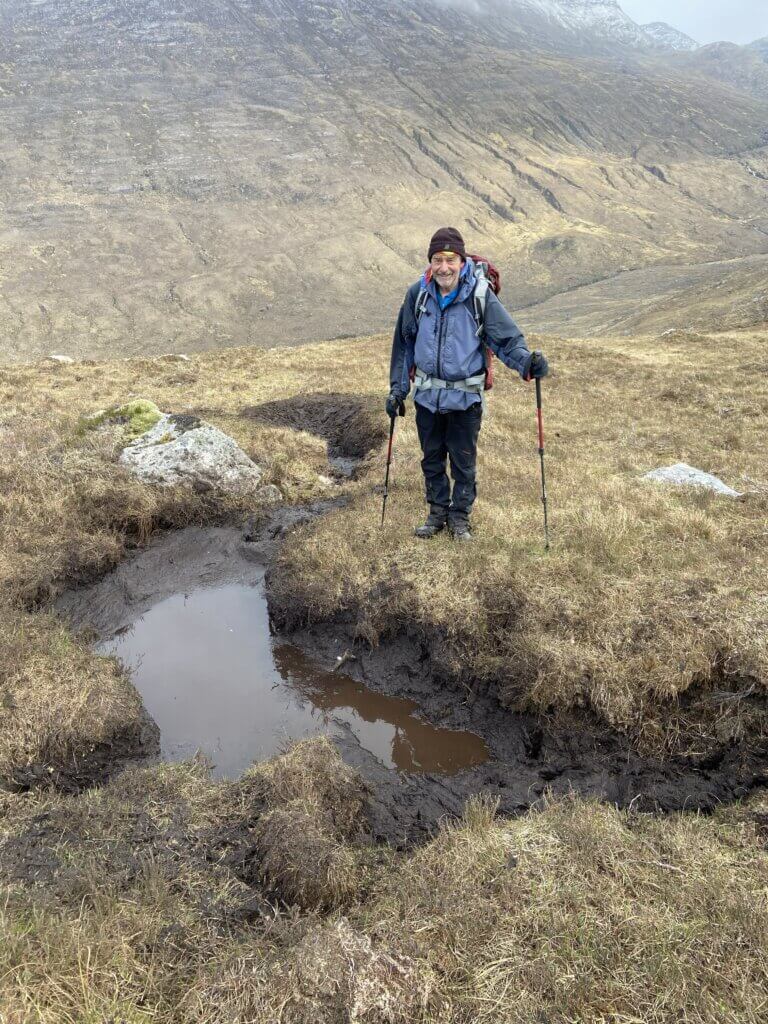
These things affect much more than just the speed of a group. They can influence how tiring a day feels, how long a route takes and, importantly, how much people are enjoying it. A route which looks relatively straightforward on a map can feel very different when you’re picking your way across rough or boggy ground for several hours.
We don’t change a route simply because the weather forecast isn’t perfect. It’s not about never getting wet, as we always take the gear needed to be as comfortable as possible, however we do need to take account of how the group is feeling; the wind speed, the cloud cover & potental visibility, though obviously this can change as the day progresses – experience gives us a good indication as to whether we are likely to have a cloud free summit attempt or not; and we need to consider what the ground conditions are likely to be, given the prevailing weather conditions leading up to the trip. If necessary we will swap proposed routes around or even substitute a more suitable alternative, after all the end objective is to have fun!
The plan is a starting point, not a contract
When we put together a programme, we’re not creating a series of walks which have to be completed in a particular order. It’s quite different from following a long-distance trail, where each day’s destination is largely determined by where you need to reach next.
We aim to deliver as many of the walks we’ve described as we can, and we know that our guests have often chosen a particular holiday because there are specific peaks or routes they want to experience. But we also have the freedom to decide which walk makes most sense on a particular day.
Being based in one location is a big part of that. Rather than having to move on to the next accommodation, we have a choice of walks in different directions and at different elevations. That means we can take account of the prevailing weather and wind direction, as well as the conditions we’re likely to encounter on the ground.
It also means that we can make the most of a change in the weather rather than simply working through a fixed itinerary. If one side of the mountains is being battered by wind and there is a better option elsewhere, we can go there. If conditions aren’t suitable for a particular summit, there may be another walk which gives the group a completely different but equally worthwhile day.
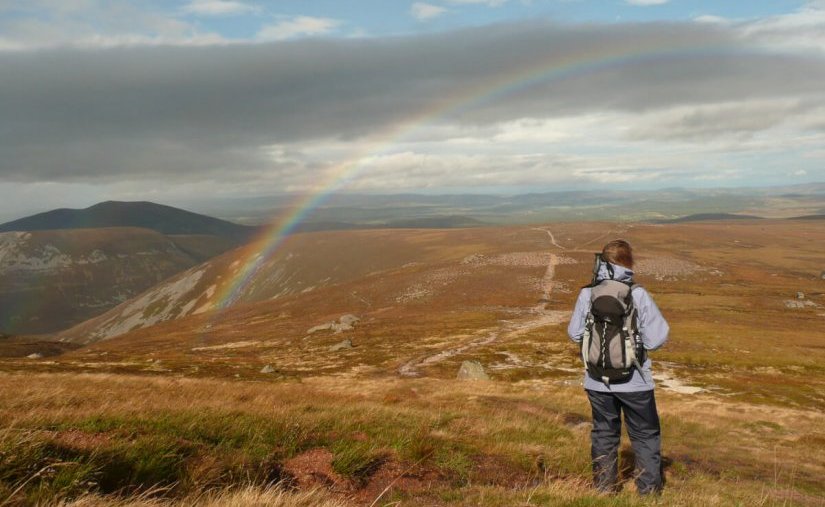
A rainbow over the mountain moorland in the Cairngorms
The result is that the itinerary has some room to breathe. The walks we’ve advertised still give our guests an idea of what they can expect, but we’re not tied to doing them on a particular day regardless of what is happening around us.
When on Mull on year, we discovered a walk on the south coast where we managed to see 7 raptors, just by picking the right day to head down there.
On Skye we were able to adapt to wet weather by discovering the fell spar caves (not part of the original itinerary.
We often more the rest day around to the wettest day forecast, while also changing the order of the walks, which more often than not leads to guest leaving saying “haven’t we been lucky with the weather.
Why this matters even more for a group
There’s another reason why a fixed itinerary doesn’t always work particularly well: a group is made up of individuals.
Even when everyone has chosen the same holiday, people don’t necessarily arrive with exactly the same level of fitness, walking experience or confidence. Some may be used to spending long days in the mountains, while others may be less accustomed to rough ground or steep ascents. Even within a group of experienced walkers, people can have different ideas about what makes a satisfying day’s walking.
And then there is how everyone is feeling on the day. Someone who would normally happily tackle a long mountain day might be tired after several days of walking, while another person may have discovered that they’re enjoying the shorter, more exploratory days just as much as the big objectives they originally had in mind.
This is particularly relevant when we’re putting together private holidays for friends or families. The people who know each other best don’t necessarily want exactly the same thing from their time in the hills. Being able to adapt the programme gives us some room to accommodate those differences, without one person’s idea of a good day having to dictate the experience for everyone else.
For us, a successful walking holiday isn’t measured simply by how many peaks were climbed or how many planned routes were completed. It’s whether, at the end of the week, people feel they’ve had some memorable days in the mountains and enjoyed being there.
Sometimes that means achieving the objective someone has been looking forward to for months. Sometimes it means choosing something a little shorter, quieter or simply different. Having the freedom to make those decisions gives a group a much better chance of having a good week together
Why a local guide makes a difference
Why local knowledge matters
Having alternatives is only useful if you know the area well enough to choose between them.
A map can show you where the paths, summits and valleys are, but it can’t always tell you how a particular route will feel in the conditions you find on the day. Knowing an area means understanding the alternatives and how they fit together: which routes offer shelter from a particular wind direction, where the ground is likely to be difficult after prolonged rain, which hills are exposed, and where there are good options if the cloud comes down.
That knowledge comes from spending a lot of time out on the hills, in different seasons and in all sorts of weather. Andy has been guiding in the Highlands for more than 25 years, and that experience is an important part of how we make decisions during a walking holiday.
It also means that changing the plan doesn’t necessarily mean abandoning what the group came to experience. There may be another approach to the same mountain, a different summit with similar views, or a lower-level route which reveals a completely different side of the landscape.
Good local knowledge isn’t simply knowing where to walk. It’s knowing which walk is likely to make sense on a particular day — and sometimes knowing when a planned route is better left for another time.
What flexibility doesn’t mean
Flexibility doesn’t mean having no plan. Quite the opposite.
Andy will have:
- routes in mind
- alternatives researched
- knowledge of the area
- an understanding of the forecast
- an idea of what different conditions mean for each option
So the group isn’t arriving each morning wondering what happens next. The route might not have been chosen before then, but the guests know that that Andy will be studying the alternatives to choose the best possble option so they can also go home saying “haven’t we been lucky”!
We won’t remember every walk we didn’t do. But we often remember the walks we did instead.
And that’s really the point. A good walking holiday isn’t about forcing a fixed itinerary to happen regardless of the conditions. It’s about making the most of the landscape, the weather and the people you’re walking with.
Sometimes that means climbing the mountain you came for.
Sometimes it means doing something completely different.