








This website uses cookies to improve your experience. We\'ll assume you\'re ok with this, but you can opt-out if you wish. Read More
In case of sale of your personal information, you may opt out by using the link Do Not Sell My Personal Information
Organising an overseas hiking vacation that genuinely works for everyone in a group is one of the biggest challenges facing group leaders. Differences in fitness, hiking experience, personal goals, and travel expectations are present in almost every group — and those differences are often amplified when the destination is unfamiliar.
Scotland’s terrain, weather, and remoteness can add another layer of complexity. Distances may look short on a map, but rough ground, elevation gain, and changeable conditions mean that two walkers with similar fitness at home can have very different experiences on the hill. Careful planning is essential.
Most hiking groups include participants with varying levels of fitness, confidence, and technical experience. Some members may hike regularly in mountainous terrain; others may be strong walkers but unfamiliar with rough trails, boggy ground, or sustained ascents.
As group size increases, these differences become harder to manage. Larger groups tend to fragment naturally, with faster walkers pulling ahead and slower walkers feeling pressure to keep up. From our experience, limiting group size to around eight participants makes a significant difference. Smaller groups are easier to pace, easier to supervise, and tend to function more cohesively — particularly in remote environments where clear communication and decision-making matter.
For organisers, this also simplifies logistics: transport, accommodation, dining, and guiding ratios are all easier to manage at this scale.
Many group members will arrive in Scotland with specific ambitions — often iconic summits or well-known routes they’ve seen in guidebooks or online. These goals can be motivating, but they can also create tension if they are unrealistic for the whole group.
The key is to be explicit early on. Set expectations clearly and base your itinerary on what is achievable for the group as a whole, not the strongest individuals. Consulting with a local guiding company during the planning phase can be invaluable here. They can help assess whether ambitions can be accommodated safely and, crucially, whether it is possible to offer alternative walks on the same day without compromising supervision or safety.
This approach allows stronger walkers to feel challenged while ensuring the rest of the group has a rewarding day, rather than feeling like they are failing to meet someone else’s benchmark.
Not every participant measures success by summits climbed or miles covered. Many are drawn to Scotland for its landscapes, history, wildlife, and sense of place. For first-time visitors, there is often a desire to see “the famous sights” — but this can raise another question: is the goal to tick boxes, or to experience the country more deeply?
Scotland offers exceptional walking that delivers dramatic scenery without technical difficulty, as well as opportunities to weave in cultural elements — historic sites, local stories, food, and landscapes shaped by centuries of human use. These quieter, less commercial experiences often become the most memorable parts of a trip.
Local knowledge makes a real difference here. Routes and locations promoted by large, international operators are often popular for a reason, but they also tend to be busy. Working with a local provider opens up alternatives that offer just as much impact, without the crowds.
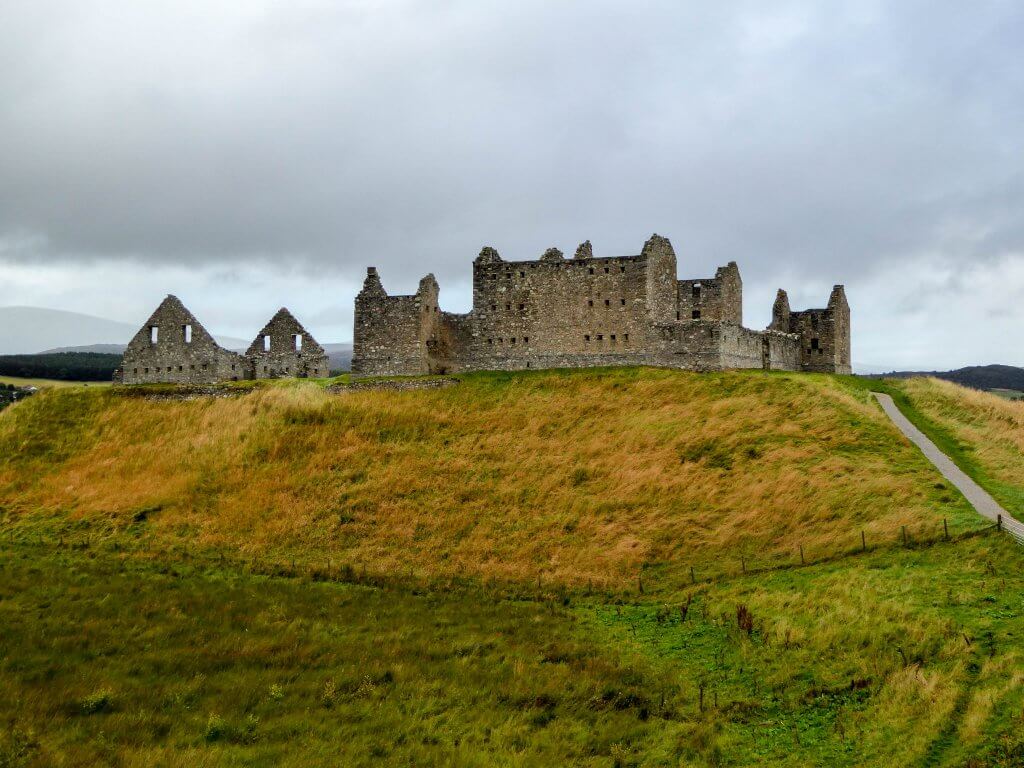
Historical sites in the Scottish countryside
One of the most effective ways to manage mixed ambitions is to build choice-based days into the itinerary. Rather than forcing the entire group onto a single route, days can be structured to offer:
Well-designed shorter walks in Scotland often provide outsized rewards — dramatic glens, lochs, and coastlines — without the sustained effort or exposure of higher summits.
Even with careful planning, the day-to-day experience matters. Guide-led pacing helps ensure that no one feels rushed or left behind, and that breaks, regrouping points, and decision-making are managed calmly and professionally.
When this is done well, the tone of the trip changes. Participants stop comparing themselves to one another and start enjoying the experience.
As we often reassure group leaders:
“No one feels like they’re holding the group back — and no one feels under-challenged.”
Be sure to also check out part 1 of this series where we discuss the kind of terrain you might encounter in Scotland.
If you’re the person everyone looks to when a group trip is proposed, transport is often where the responsibility really starts to feel heavy — especially overseas. Driving on the left, unfamiliar roads, jetlag, and getting a whole group to the right place at the right time can turn what should be an exciting plan into a source of stress.
When trying to organise a group hiking tour in another country, transport is one of the major headaches. This is particularly the case when you’re travelling to a country where you either don’t speak the language, or in this case, where the locals drive on the other side of the road. So when your group is more than an average family in size – what do you do about transport? Do you drive yourselves? Do you book a private hire/driver? Do you go with public transport passes? All valid options with pluses and minuses.
What you’ll need to consider if you’re going to hire a vehicle/vehicles
You may need more than one driver. How many of your group are comfortable driving on the left hand side of the road? Will you need to book automatic transmission vehicles, which are less common in the UK than abroad? For group organisers, this often raises an additional question: who is ultimately responsible if something goes wrong? Can you get all your drivers insured and will this be an additional hassle you could do without. Read the small print carefully – we have had independent travellers who’ve been caught out by small print in hire contracts, particularly relating to foreign credit/debit cards
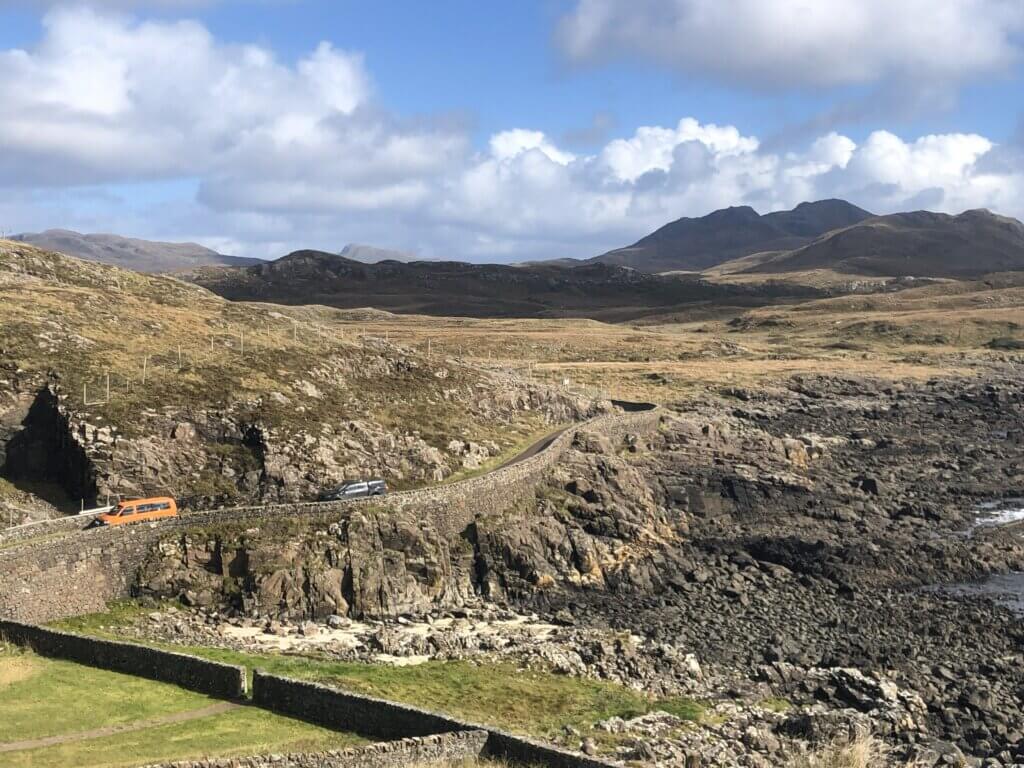
If you’re planning some hiking as all or most of your tour, you will inevitably end up on smaller, more rural roads which are very narrow and often windy; not to be under-estimated especially at the beginning of your trip when the drivers may also be suffering from jetlag. In fact, in more remote areas the roads may not only be narrow, but even be “single track”. There’s a whole separate etiquette for dealing with single track roads.
Single track roads:
always stay on your side of thr road (THE LEFT)
if the passing space is on the right hand side of the road stop on your side and let the oncoming traffic use the passing space to go around you.
These are manageable once you’re used to them — but they can be intimidating for first-time visitors, especially when you’re conscious of a group relying on you
This is not a term which is commonly used in the UK. We’re far more likely to talk about where the parking area is for a particular route. Unlike many US hiking areas, access points in the Highlands aren’t designed for large volumes of cars or groups arriving simultaneously — something that can catch overseas groups by surprise. Some of these parking areas are little bigger than passing spaces or only big enough for small number of vehicles. Again this is something it is worth bearing in mind when planning your trip. Do you want the hassle of searching for parking? And don’t forget the expense as well. Fewer and fewer parking areas are free of charge these days.
If you’re planning to drive, you should plan around jetlag. We do relatively frequently hear news reports of fatal accidents on the Scottish roads due to tourists accidentally driving on the wrong side of the road. This is much more easily done when you’re tired. One way to avoid this would be to plan a couple of days in or around the city of your arrival before starting the hiking part of your vacation. This way you can adjust to the new time zone before taking on the additional challenge of driving on unfamiliar roads and on what is for you the “wrong” side of the road. or volunteer organisers, this is one of the biggest hidden risks: tired drivers, unfamiliar road rules, and the pressure of getting everyone there safely
We have an excellent public transport system in the UK, but where it falls down for hiking groups is that access to the start of the trail is rarely in the same place as the train station/bus stop and many trails, particularly in the Highlands, can only be accessed in a private vehicle. Also multiple tickets on public transport are probably going to work out as expensive, if not more expensive than hiring a vehicle. You might even want to compare the costs with those of arranging private transport, including a driver.
For organisers, the key question is often not ‘is public transport possible?’ but ‘does it reduce stress for the group — or add to it? Co-ordinating tickets could be an additional headache you could do without.

For many hiking groups the solution isn’t doing everything yourselves — or handing everything over — but working with a local partner who understands both the terrain and the realities of group leadership.
If you’re arranging a hiking trip in the Highlands with your friends/hiking club, you might want to consider the following services:
airport transfers
→ Your group arrives together, rested, and oriented — without anyone needing to drive on day one.
hike planning & trailhead transport
→ Walks matched to your group’s ability, with logistics handled quietly in the background. Also worth bearing in mind when trying to select hikes is that we have very different land access rights – something we can help you understand (loads of other articles on our blog which help to understand the Scottish Outdoor Access Code).
arranging hikes from our home base
→ A shared base removes daily packing, reduces decision fatigue, and strengthens the social side of the trip.
You remain the trusted organiser for your group but we can work in partnership with you to make sure you all have a smooth experience and the group’s expectations are met or exceeded.
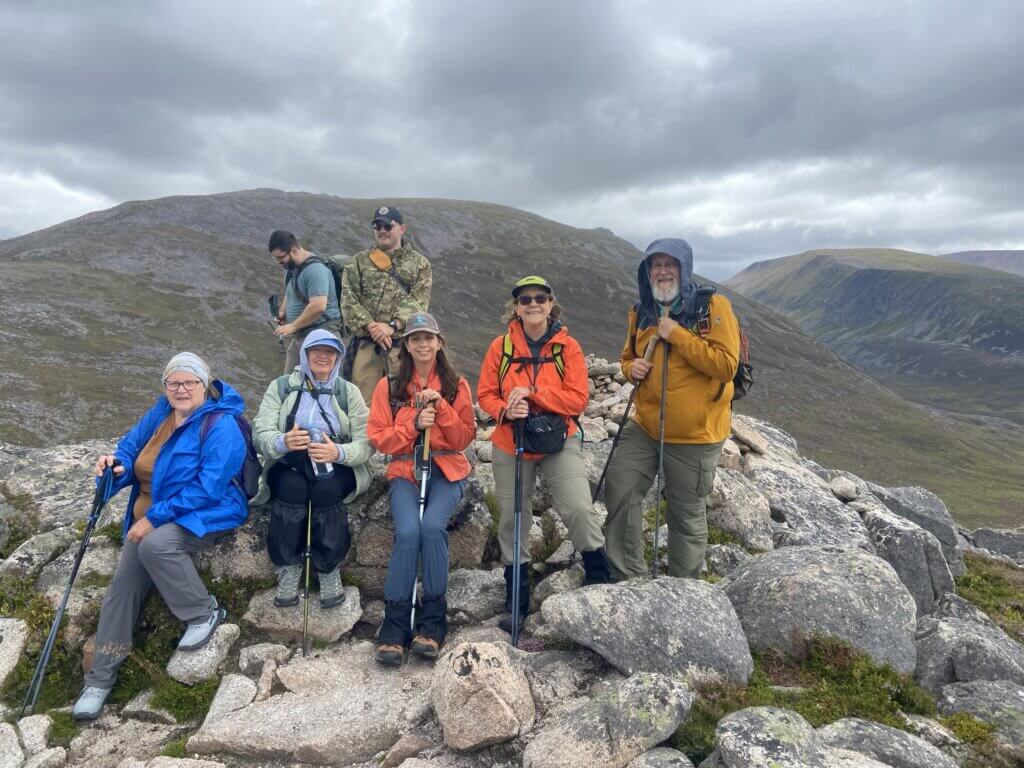
Preparing for a group hiking trip to Scotland: it may be more complex than it seems.
“Scotland is not the Rockies” – understanding Scottish terrain and conditions
If you regularly organise hikes in North America — whether in US National Parks, Canadian provincial parks, or established wilderness areas — you’re used to a certain definition of wilderness.
You expect:
Clearly defined trails
Waymarked junctions
Predictable gradients
Weather windows that usually hold
Infrastructure designed to manage large numbers of hikers
Scotland offers something very different.
And this difference is often what catches even highly experienced North American hiking groups off guard.
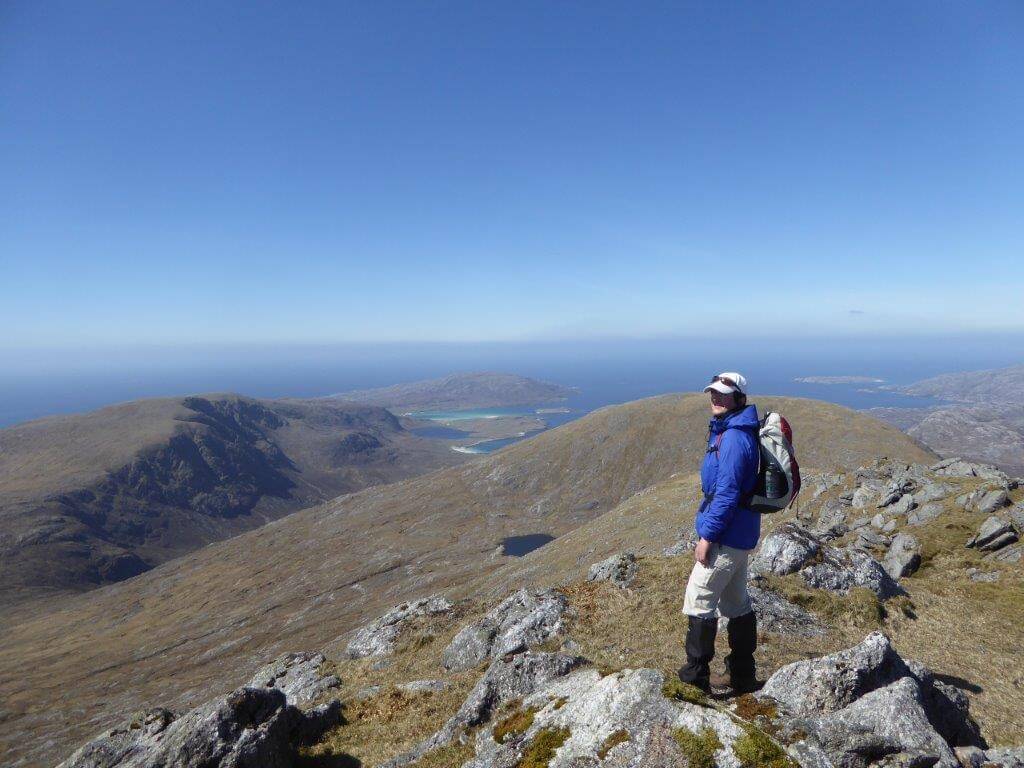
Admiring the seemingly endless wilderness views from the hills of Harris
In much of North America, wilderness exists within a managed framework. Trails are built, graded, signed, and maintained. Even in remote areas, the route is usually obvious underfoot.
In Scotland, true wilderness often begins where the trail ends.
Paths may:
Fade in and out
Split unexpectedly
Cross bog, heather, rock, and grass with no clear line
Exist only because people (or sheep or deer) have walked there before
This doesn’t make Scottish hiking more dangerous — but it does make it fundamentally different.
For group organisers, the key shift is this:
In Scotland, you are often navigating across terrain, not along a trail.
There are organised long distance trails here, the most famous of which is the West Highland Way, but if you really want to experience the best of the Highlands you’ll want to head out into less well known terrain.
On the way to Britains’s second highest peak, Ben Macdui. Perfect photo opportunity.
One of the most common assumptions North American hikers bring to Scotland is that lower elevation equals easier hiking.
On paper, Scotland’s mountains look modest: our highest peak is Ben Nevis: 4,413 ft (1,345 m)
Compared to the Rockies or Sierra Nevada, this doesn’t seem especially demanding. However it is worth remembering that many of our hikes start from sea level. Any day where you ascend 1000m is more than enough for many, especially if the terrain is not the easiest underfoot.
Effort in Scotland comes less from altitude and more from:
Rough, uneven ground – for some reason, “heather bashing” is never a highlight guests are begging to repeat!!!
Persistent wetness underfoot – boggy ground is never a favourite either. Peat “hags” can make a hike a bit of en endurance event.
Steep, direct ascents
Constant micro-navigation decisions
A 6–8 mile Scottish hike can feel more strenuous than a much longer North American trail day.
Many experienced North American hikers are surprised by how physically and mentally demanding Scottish walking can be — even at lower elevations.
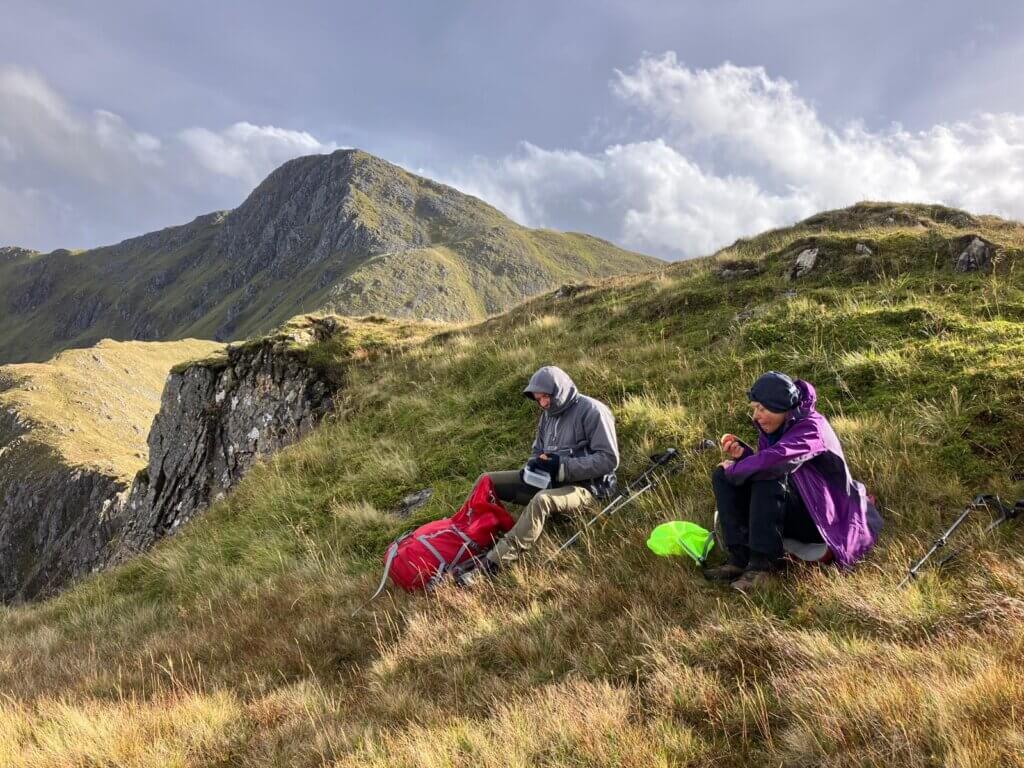
In many North American parks, mileage is the primary planning metric. If your group can comfortably hike 10–12 miles on established trails, the assumption is that they’ll be fine elsewhere.
In Scotland, navigation skill often matters more than distance.
Why?
Landmarks can disappear quickly in fog
Trails may not be visible from one section to the next
GPS and phone signals are unreliable
Route choices must be adjusted constantly based on terrain and conditions
This doesn’t mean Scottish hiking is technical — but it is engaged. You’re always reading the landscape.
For group leaders, this adds mental load:
Choosing safe lines across open ground
Adjusting pace in poor visibility
Making conservative decisions without obvious trail cues
In many parts of Western North America, weather is something you work around. Storms come and go. Forecasts are reliable enough to plan with confidence.
In Scotland, weather is part of the landscape.
It’s normal to experience:
Wind on summits year-round
Light rain or mist for extended periods
Rapid changes in visibility
Cool temperatures even in summer
Fog, wind, and wet ground are not exceptional conditions — they are expected.
The most successful Scottish hiking groups aren’t the ones who avoid poor weather, but the ones who plan with flexibility:
Shorter distances
Lower-level alternatives
Routes chosen on the day, not weeks in advance
For many North American hikers, wilderness is defined by distance and scale: long approaches, big trail networks, and a clear sense that once you’re deep in a National Park, you are far from roads, towns, or services.
In Scotland, wilderness works differently — and this is where experienced North American groups are often surprised.
You can be:
Two hours into a hike
Only 6–8 miles from your start point
Technically less than five miles from a public road
…and still be walking across pathless ground, with no visible trail, no signage, no buildings, and no other people in sight.
What creates the sense of wilderness in Scotland isn’t distance — it’s exposure and engagement.
No constructed trail:
You may be moving across grass, rock, heather, or peat rather than a maintained path. Footing is uneven and often wet, which slows progress and increases fatigue.
No waymarking or junction signs:
Route choices are made by reading the land — contour lines, slope angles, drainage lines — rather than following posted directions.
Weather that limits visibility:
Low cloud can reduce visibility to 30–50 metres, even in summer. When this happens, navigation becomes continuous rather than occasional.
Commitment without obvious exit points:
Once you’re on a ridge or plateau, descent options may be limited by terrain, wind direction, or group ability — even though civilisation is geographically nearby.
Little or no phone signal:
You cannot rely on real-time weather updates or easy communication, so decisions must be made confidently and conservatively.
For a group organiser, this means the feeling of remoteness comes not from how far you’ve gone, but from how fully you are responsible for the next decision — route, pace, safety, and timing — at every stage of the day.
That’s why groups often describe Scottish hiking as more mentally demanding than expected, even when daily distances are shorter and elevation gain looks modest on paper.
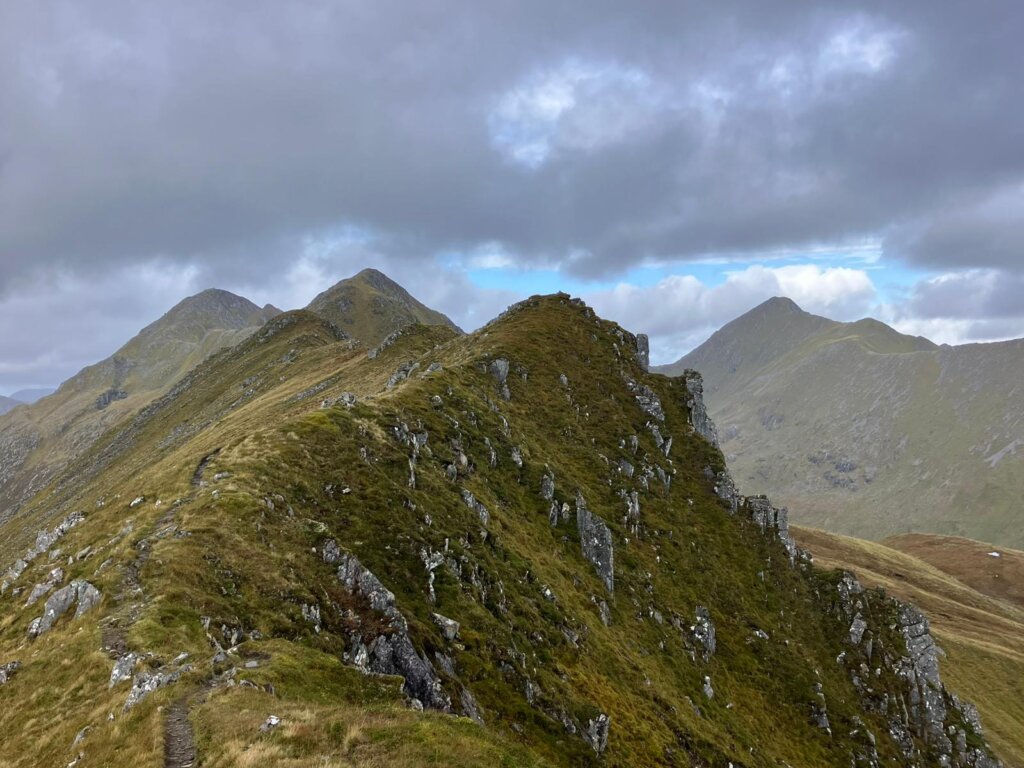
If you’re leading a group that’s confident, capable, and experienced in North American hiking environments, Scotland doesn’t require you to lower your ambitions — but it does require you to reframe expectations.
Successful groups:
Plan shorter, more varied days
Value navigation and local knowledge over mileage
Build in weather flexibility
Allow leaders to focus on experience, not constant decision-making
This is why many North American group organisers choose to work with local experts for Scottish trips — not because the hiking is beyond their ability, but because the context is unfamiliar.
Walking in a country which isn’t your own always has challenges – many of which might not be considerations when you’re at home. For starters the maps are different. The maps in the UK are very good quality – you need to look out for OS (Ordnance Survey) maps. There is an app but we wouldn’t recommend relying exclusively on your device. You can get waterproof paper maps which would be a good backup for a leader/organiser.
On top of this, as we’ve mentioned we like to keep our “wilderness” in Scotland relatively pristine so you’ll find fewer paths and a noticeable lack of signposts (our European neighbours find this cause for comment too).
If you’re really keen to experience the wildlife, understand the geology, know the local fauna – then working with a local expert would really benefit your group.
 Scot Mountain Holidays (Ltd),
Fraoch Lodge, Deshar Road,
Boat of Garten,
PH24 3BN
Scot Mountain Holidays (Ltd),
Fraoch Lodge, Deshar Road,
Boat of Garten,
PH24 3BN




All content © Copyright Scot Mountain Holidays 2026
Responsive web design by Summit Web Solutions
