








This website uses cookies to improve your experience. We\'ll assume you\'re ok with this, but you can opt-out if you wish. Read More
In case of sale of your personal information, you may opt out by using the link Do Not Sell My Personal Information
Spring in the Cairngorms feels like a quiet awakening.
By late March, the Highlands begin to shake off winter. Days stretch longer, wildlife returns, and the landscape softens—yet the mountains still hold that wild, untamed edge that makes this place so special.
For many of our guests at Fraoch Lodge, it’s the perfect time to visit: fewer crowds, crisp air, and a real sense of seasonal change underfoot.
Here are five reasons why spring might just be the best time for your next hiking holiday in the Cairngorms.
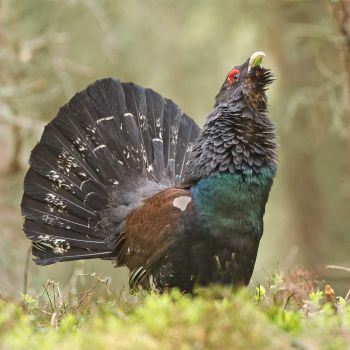
Spring is one of the most exciting times for wildlife in the Cairngorms.
Ospreys return to nearby Loch Garten from their incredible migration to West Africa—often arriving in early April. There’s always a sense of anticipation around their return, and no two seasons are ever quite the same.
Alongside them, you may spot:
With knowledgeable local guides, these moments become part of the story of your walk—not just lucky sightings.
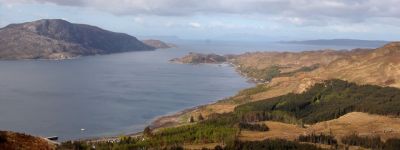
Photo Caption: Wild and remote scenery of Knoydart on a visit in May – Wild Knoydart guided walking holiday
One of the simplest—but most transformative—benefits of spring hiking is daylight.
By the end of March, the Cairngorms enjoys around 13 hours of daylight, giving you far more flexibility to explore at a relaxed pace.
No need for rushed starts or watching the clock. Instead, your day can unfold naturally:
It’s walking as it should be—unhurried and immersive.
Sunrise and sunset times in the Cairngorms
Spring is when many people feel ready to move again.
After the darker winter months, there’s something deeply restorative about being outside—breathing fresh Highland air, stretching your legs, and rediscovering your energy.
In the Cairngorms, that might look like:
Our guided holidays are designed to help you ease back into activity comfortably—no pressure, just the right level of challenge for your group.
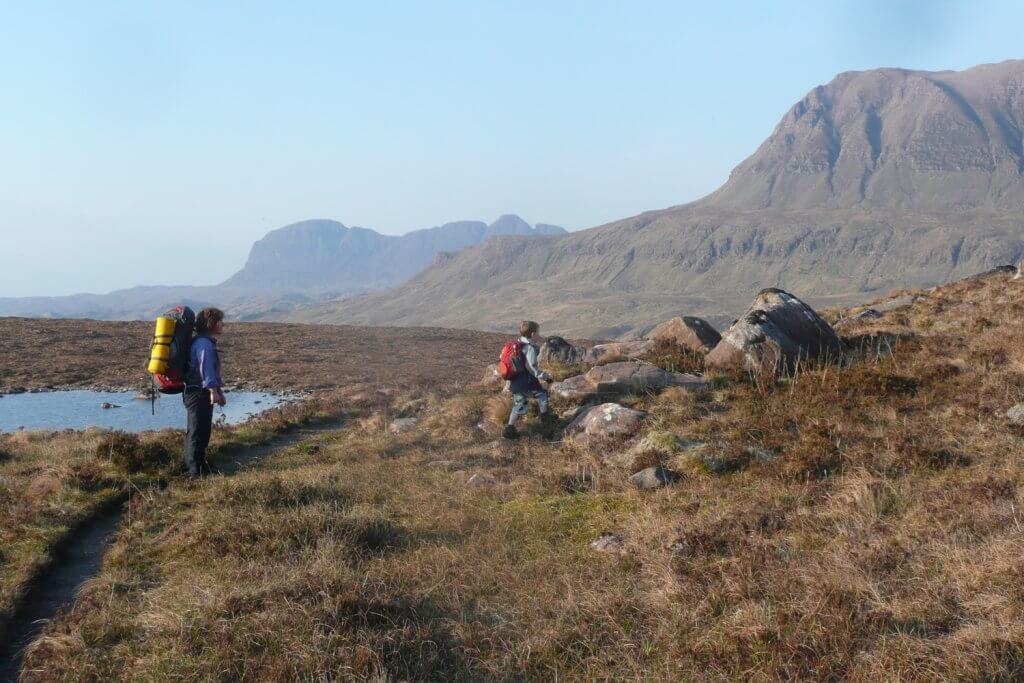
Hiking in to a secret wild camping spot in Assynt
Photo caption: Spring also means that it’s a time the kids can get back outside. You no longer need to wrap them up like Mummies. This photo was taken on a backpack to a wild camp in Assynt in May. If you’d like details of this trip, we can arrange this for small groups and family groups under Andy’s guidance.
Spring offers a unique balance in the mountains.
Higher ground can still hold patches of snow, adding drama and contrast to the landscape—but without the full technical demands of winter mountaineering.
That said, this is still a mountain environment. Conditions can change quickly, especially in early spring.
That’s where walking with experienced local guides makes all the difference:
It’s the Cairngorms at their most accessible—yet still wonderfully wild.
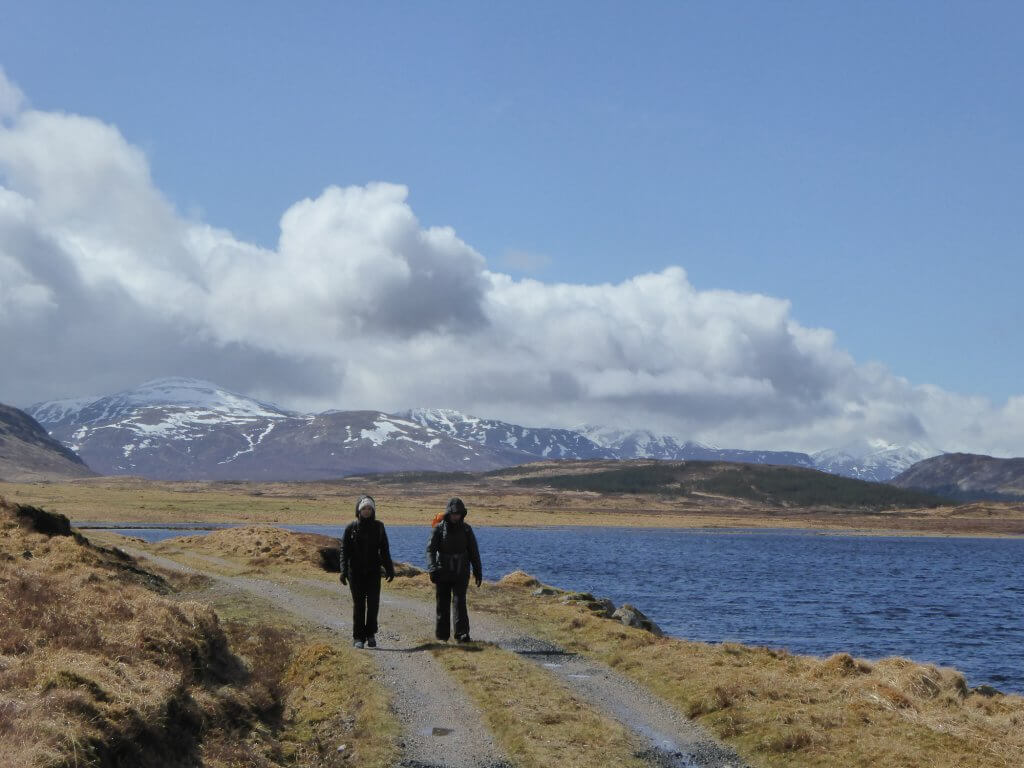
Perfect spring weather for hiking
If you’ve heard about Scottish midges—spring is your window to beat them.
Before the warmer, still days of summer arrive, midge numbers remain very low, especially in the drier climate of the Cairngorms.
Even better:
It’s a chance to experience the Highlands at a gentler pace—without the crowds.
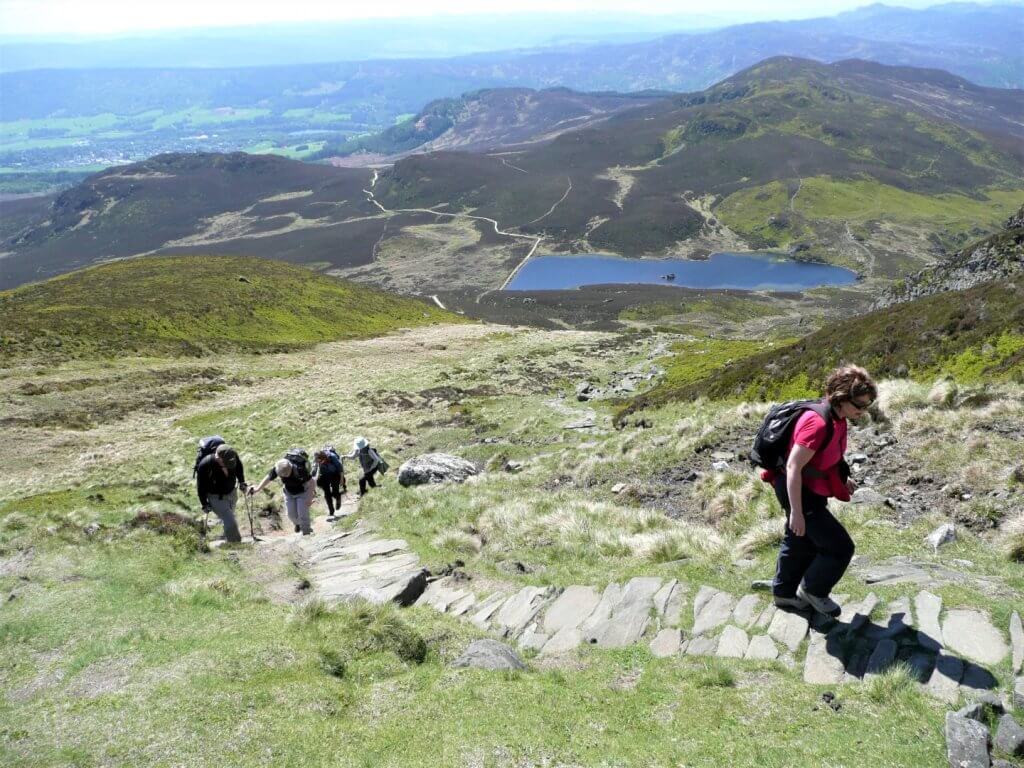
At Scot Mountain Holidays, spring is one of our favourite seasons to share with guests.
From the comfort of Fraoch Lodge, your days are taken care of:
All you need to do is arrive—and step outside.
If you’re looking for fresh air, wide open spaces, and a gentle return to the hills, spring in the Cairngorms might be exactly what you need.
The trouble with planning a hiking vacation in Scotland is that you are almost spoiled for choice. There’s no way you will be able to fit everything in to one vacation.
The scenery on Skye and around the west coast of Scotland is remarkable from the road. It has inspired movies such as “Brave”. The draw is understandable but the disadvantage is that for Scotland it can be “touristy”. It will be unusually busy with other visitors. If you’re looking for a quiet experience of Skye when you have a chance to enjoy the scenery without the crowds, you’ll need to consider taking the time to explore there out of the main tourist season. April, May and September are the best times to head over there. You have a high chance of good weather and a low to non-existent chance of encountering the dreaded midges.
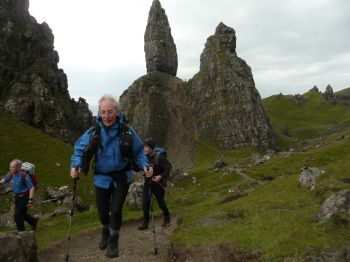
In recent years, particularly since the Land Reform Act (2003), there has been public money available to develop paths across Scotland. This has resulted in a proliferation of way marked long distance routes. The Land Reform Act (2003) formalised the right of access to all land in Scotland, whether privately or publicly owned. Access rights are for outdoor recreation, for crossing land and water, and for some educational and commercial purposes. Exercising access rights, and managing access land, must be done responsibly.
The most well-known of the long distance routes is the the West Highland Way, but there are many others like the Speyside Way (the one to do if you’re in to whisky). Another recently mapped route which is less formally organised is the Cape Wrath Trail. This trail is described by Cameron McNeish as: “It’s the sort of long distance route that most keen walkers dream of. A long tough trek through some of the most majestic, remote and stunningly beautiful landscape you could dare imagine.” You can research more details here: http://www.capewrathtrail.co.uk/foreward.htm There is also a recently published map by Harvey maps covering the area involved.
A full list of long distance paths across Scotland is available here:http://walkhighlands.co.uk/long-distance-routes.shtml They range in length from 338km to 38km. Some can be linked together to make a longer route.
The disadvantage, depending on your point of view, of most long distance paths in Scotland is though they go through mountainous areas most if not all of these routes do not go up the mountains so if you stick to the waymarked route you’ll only be admiring the peaks from afar.
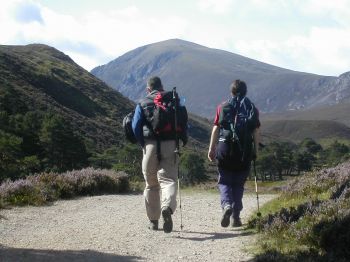
Photo Caption: Long distance path walking in Scotland
There has been quite a lot of investment in path construction and signage in Scotland since the development of the Outdoor Access Code in 2002. There are opportunities virtually everywhere to get out of the car and explore a wee bit to a viewpoint or through spectacular woodlands or around a loch etc. The difficulty is in knowing which option to choose.
WalkHighlands can help with this in that all the walks they list are graded and have an estimated length in distance and time. However, possibly the best way of choosing is to ask your hosts at your accommodation for their recommendation of the best walk to choose and if you have a wee bit more time available take advantage of a guided walk as you will gain so much more insight into the area from the guide’s knowledge. There are ranger guided walks in most areas, particularly in the National Parks like the Cairngorms and the Trossachs which will reduce the cost. Some of these walks are even free. Boat of Garten has it’s own ranger service offering guided walks around the woods behind the village. The RSPB also offer guided walks on the Abernethy reserve.
The advantage of booking a walk with a guide is that you’ll be able to get off the beaten track with confidence. You might even be able to do a longer walk or go higher than you would be confident doing on your own.
A guide will also have extensive knowledge of the local folklore, the environment, the flora and fauna as well as the terrain through which you are hiking. There really is nothing better for bringing the area alive to you. As a student or cash strapped tourist you may consider the cost relatively high. However when you look at the cost of eating in a restaurant or your accommodation for the night, you’ll realise that on an hourly rate your guide is not charging a lot of money. A qualified mountain leader will have invested years of training into his qualification not to mention the cost of the training course itself.
A qualified mountain leader (or accompagnateur) will charge from £150 – £200 for a day out. This fee will be split across the clients in the group. The larger your group of family the less the cost per individual. The rewards of going out with a guide for the day are however beyond price as you will learn so much more about the area which you won’t find in the guidebooks.
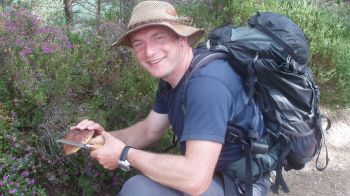
Most organised hiking tours will explore only one area in depth. While this approach is not for everyone (many people visit a country with a tick list of sights they want to visit – which are inevitably the same spots 90% of visitors also want to see, resulting in overcrowding), if you go on an organised vacation you are often more likely to have a more genuine and authentic experience of the country you are visiting.
It is worth checking that the company you book with has a philosophy which appeals to you. Also that the structure of the trip suits your priorities. For example, if you are thinking of booking with Scot Mountain Holidays but it is important to you to have 5 star hotel style accommodation, rather than a home away from home, you will probably look elsewhere for your trip. The philosophy behind our vacations is that our guests stay within our home. They immerse themselves in the atmosphere and feel comfortable discussing all aspects of life in Scotland.
Of course, if you have enough time you could consider a shorter, organised trip as part of your vacation and tour the rest of the country by car/bus.
Think about access – a major consideration as part of the planning. Some areas of the Highlands are more difficult to reach than others. For our organised vacations we have tried to make it as easy as possible for our guest to access them. We offer pick ups from Aviemore station and Inverness airport. In the Cairngorms, we are lucky enough to be near the major route north from Edinburgh – the A9, which makes it very efficient to get here.
It may look like it isn’t far to reach some areas of the Highlands but travelling on narrow, sometimes single track roads, will take longer than anticipated.
When planning your trip bear in mind that reaching some areas by public transport can be time-consuming. Many of the routes used have to go around rather than through the mountains.
We are frequently asked what to pack for a day hike in the Highlands, usually by our guests preparing for their guided walking tour with us. People often ponder on whether they should pack shorts, a sun hat, sunscreen. What gloves to bring etc – the list goes on.
Bear in mind, that if you are planning to head out on your own or at least without a guide, then you will also need to pack the following gear and be familiar with how to use it.
map & compass: you will need a good quality, local, walking map such as Harveys or Ordnance Survey (we stock the 1:50,000 OS map for our area). Do not rely on your mobile phone mapping.
You should also always pack some food (even small snacks) and some water. It is possible to refill your water bottle along the route, but take care if you are following a low level popular path. If there is a lot of livestock in the area, it would be best not to refill your bottle unless you have a water purifier with you.
Always tempting if you happen to strike the good weather to whip out the shorts to go for a hike. It is however worth bearing in mind that Scotland is not without its pests. There are ticks in Scotland which hang on the undergrowth, particularly at low levels waiting for someone or something to come past. Ticks are often carried by deer who rub them off on the vegetation. The ticks wait there for the next host to continue their life cycle. They can wait for years.
If you do pick up a tick it is not the end of the world. There is Lymes Disease in the UK which can be treated with antibiotics – but early removal of the tick is key to the prevention of the disease. We have tick removers here at Fraoch Lodge. Make sure you check yourself over at the end of the day. However, you can minimise the risk of picking up a tick by wearing long trousers and gaiters over the top of your boots. Generally speaking dog walkers and golfers are often at more risk than hikers of returning with ticks.
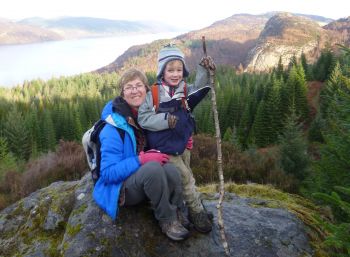
Unless you’re going to be battling through particularly overgrown parts of the countryside, the length of your sleeves is not too vital and the rate at which you get cold will determine whether you think long or short sleeves suitable for the day.
There are not many well graded, smooth paths in the Scottish hills. Most tracks are relatively rough with loose stones and rocks. It is usually sensible to use over the ankle walking boots to protect your ankles from turning and also to keep your feet as dry as possible. Leather boots, though heavier, should provide the best protection and will be generally more waterproof than gortex lined fabric boots.
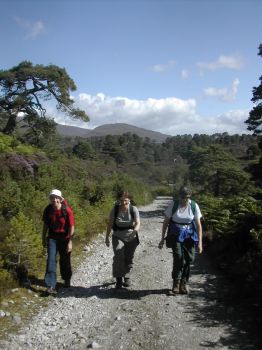
Waterproof shell jackets are by far the most popular. Most shops stock a wide range of jackets designed with gortex fabric. Andy himself prefers to wear Paramo clothing or Cioch direct waterproofs. Both these companies use the same material. Cioch Direct specialise in made to measure clothing. The advantage that the Nikwax analogue material has over gortex is that it is designed to be reproofed after washing so is likely to last you longer. The jackets can also be returned for repairs at little or no cost. The disadvantage is that the material is heavier and can prove to be too warm in the height of the summer – though at an average year round temperature of 0oC, the Paramo jackets are usually suitable for the Cairngorm plateau.
Always useful to include a warm hat and gloves at the bottom of your pack as it can be cool on the hill tops even in August.
The most sensible attitude to your clothing for hiking is to make sure you have several light layers which will provide maximum flexibility rather than one or 2 choices. Make sure that your layers are not cotton options as you could cool off very rapidly, should your cotton layer become damp whereas synthetic or wool layers will either dry more rapidly or stop you from cooling down too much.
The most useful size of packpack to bring with you is a 35 litre pack. This will be large enough to take all excess clothing, camera, packed lunch etc. Smaller than this may mean that you have to limit what you take on the hill, particularly in winter.
Wandering into the Cairngorms
Please don’t hesitate to contact us if you have any queries about the clothing/gear you are intending to bring with you for your Scottish vacation.
If you’d like to book a guide for your day hike, please don’t hesitate to get in touch with us. Andy is extremely knowledgeable about the Highlands of Scotland from history to nature and everything in between. A hike with him is an introduction to everything you wanted to know.
Email: info at scotmountainholidays.com
Tel: +44 1479 831 331
 Scot Mountain Holidays (Ltd),
Fraoch Lodge, Deshar Road,
Boat of Garten,
PH24 3BN
Scot Mountain Holidays (Ltd),
Fraoch Lodge, Deshar Road,
Boat of Garten,
PH24 3BN




All content © Copyright Scot Mountain Holidays 2026
Responsive web design by Summit Web Solutions
