








This website uses cookies to improve your experience. We\'ll assume you\'re ok with this, but you can opt-out if you wish. Read More
In case of sale of your personal information, you may opt out by using the link Do Not Sell My Personal Information
Many first-time visitors arrive with a list of famous places they want to see. Loch Ness, Glen Coe, the Isle of Skye and perhaps Ben Nevis often feature heavily.
What surprises them is how quickly they become attached to places they had never heard of before arriving.
Someone who spends a week in the Cairngorms may leave having discovered favourite glens, forests and viewpoints they had never heard of before arriving. Instead of feeling they’ve “done” the Highlands, they leave with a list of places they’d like to explore next time. Or places they’d like to share with a partner, friends or the kids next time.
One of the things people really learn to appreciate about the Highlands is the lack of crowds; the open spaces; the sheer quantity of terrain to explore and the lack of restrictions due to our outdoor access legislation.
Many of our guests spend their working lives in busy towns and cities. Even those who are fortunate enough to live in beautiful areas are often surprised by the sense of freedom here. Many of our guests comment during their stay about the quality of the water and the air. Some of them notice the lichens on the trees and know that that is a sign of the high quality/freshness of the air. Guests frequently comment that they can walk all day and only meet a handful of other people; if any at all.
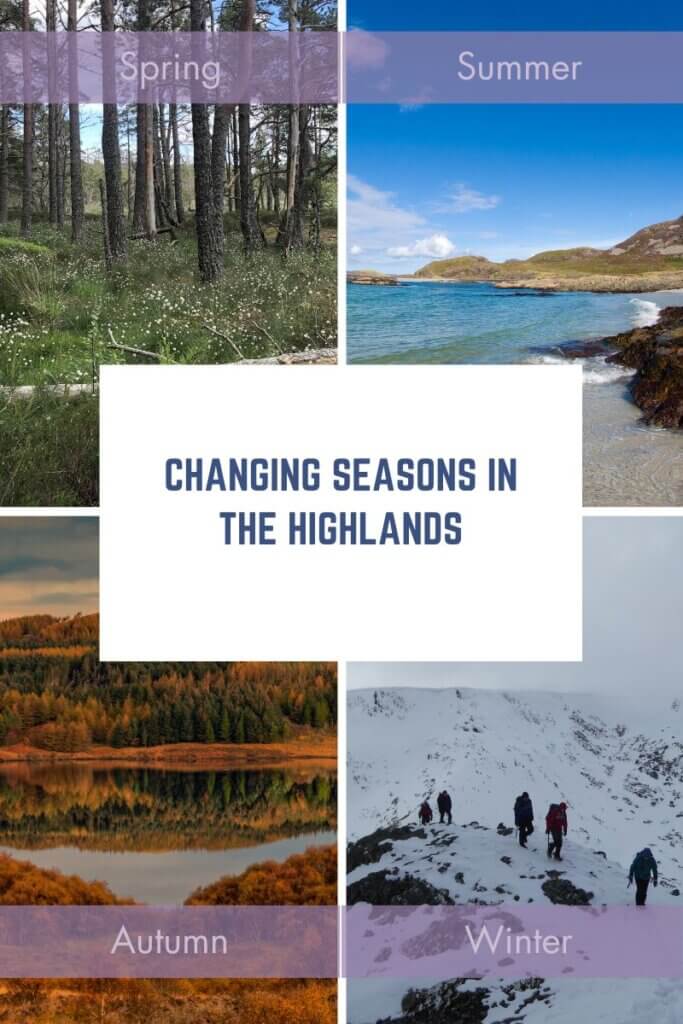
Some guests first discover the Cairngorms in June when the pinewoods are alive with birdsong and the wildflowers are at their best. Then they return in October and can hardly believe it’s the same place. A walk enjoyed among autumn colours can feel like a completely different route when revisited with the spring birdsong or winter snow.
Many guests who first visit in summer later return specifically to experience autumn colours or winter conditions.
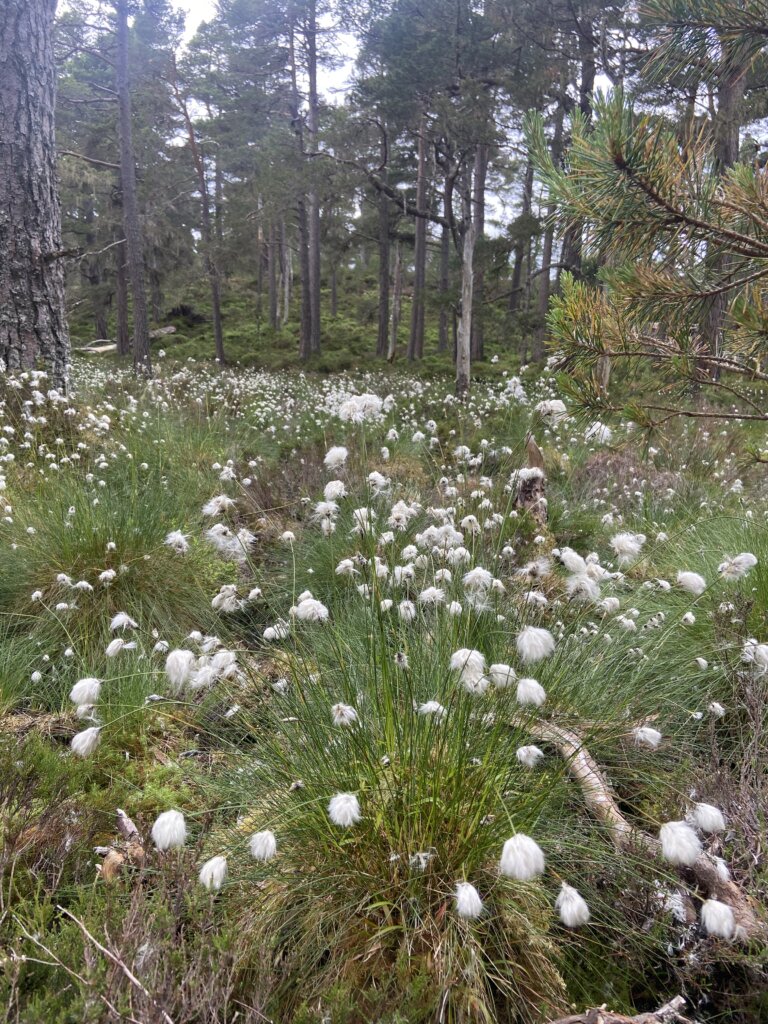
In autumn you have the many varied colours, glorious rainbows and spectacular sunsets/sunrises; in Spring, the birdsong and wildflowers are at their best. (This year – 2026 – the cotton grass on Dava Moor was exceptional.) In summer, people always comment on the long evening hours and are able to enjoy the sound of bagpipes and observe or even participate in the Highland Games. Then in winter, we have the snow. Summer guests always assume this means we are inundated with skiers, but the truth is we see far more winter walkers and people wanting the learn the specialist skills they need for walking in winter.
Many of our guests have ties to Scotland. They might live in Australia or London or Ohio, but they’ve either lived here in their youth or grown up with stories their parents or grandparents have told them about their homes in Scotland.
When it comes to our own repeat guests, not only do many have ties to family in Scotland, but they have been on so many trips with other members of the group that they come back to enjoy another trip with the same guests, with us. Over the years, Andy has developed plenty of itineraries inspired by returning guests and the places they still want to explore. He enjoys the camaraderie of the group and likes to tempt them back time and again to do different hills, different walks, explore different areas; or attempt to complete their Munro list. In fact, Andy is now close enough to completing his own Munro round that he has already identified which summit he hopes will be his last. Several long-standing guests have jokingly suggested they should be there to witness it.
Some guests stay in touch outside of the trip and have even become genuine friends over the years. Often they know who is intending to join that year’s trip before we do.
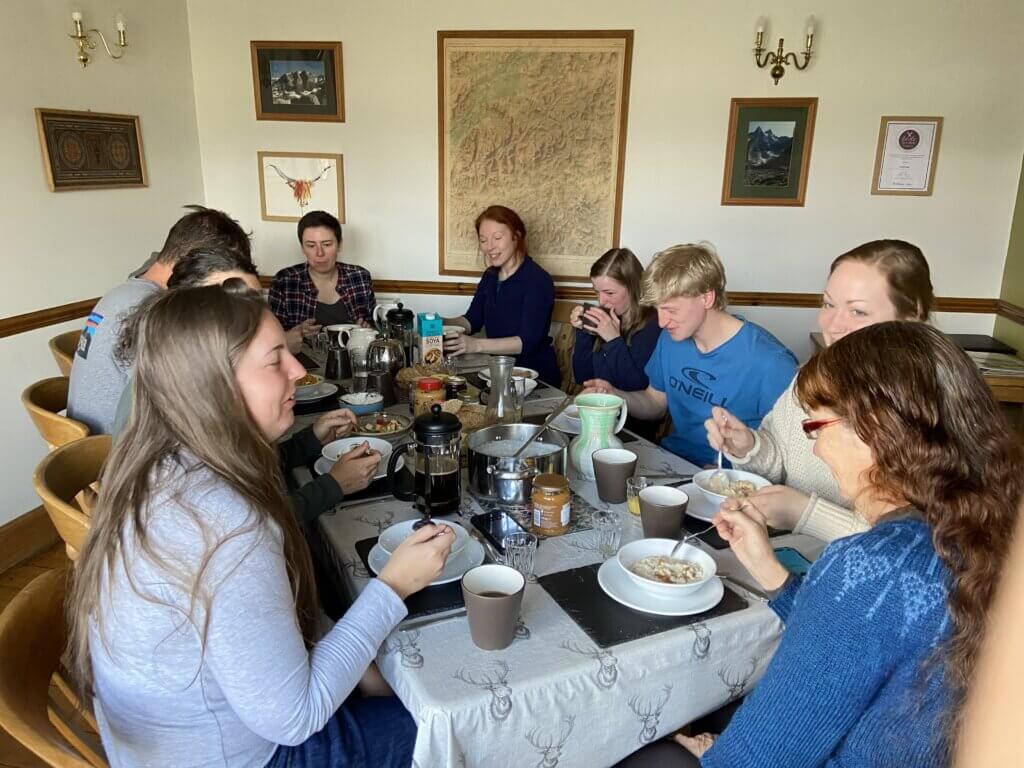
When one of our repeat guests books with us, it’s like a friend is coming to visit. Usually we remember what their preferences are:
coffee or tea at breakfast; who likes their coffee black; who likes sugar; whether we need to pack ketchup or bacon to supplement the breakfasts; who prefers rice or chilli sauce; whether soups or desserts should make up the majority of the menu. Because we are close to the guests during their trip, we can pick up these clues and enhance the holiday along the way with extra little touches.
None of this appears on a booking form. It comes from spending time together and getting to know people over successive visits.
Some guests arrive hoping simply to enjoy a week of walking in the Highlands. A few years later they’re returning for a winter skills course, a Munro week or their first backpacking adventure.
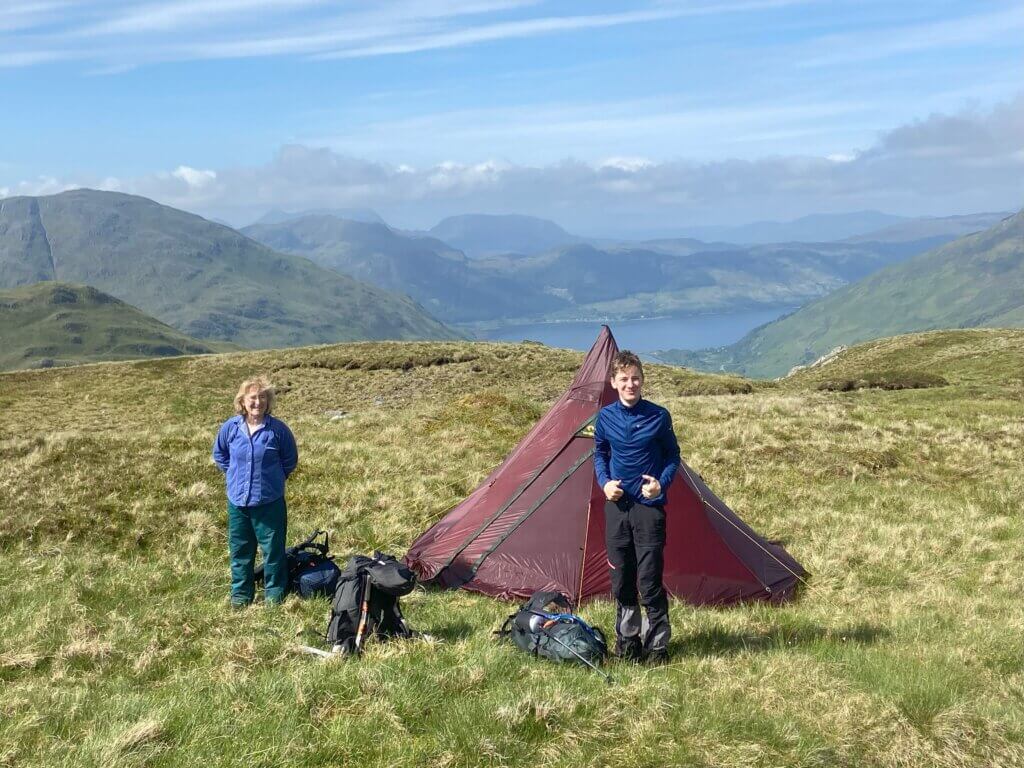
One of the greatest privileges of running Scot Mountain Holidays is welcoming familiar faces back year after year. We started the business here in the Highlands because we love the Highlands and enjoy sharing that with others. We run it the way we do because we love to share the travel experience and camaraderie with our guests.
The Highlands reward repeat visits. A favourite walk looks different in a new season. A glen explored in sunshine invites a return in autumn colours. A guest who once doubted their ability to walk a Munro finds themselves planning the next challenge.
The Highlands are not a “once seen, done” destination. And fortunately for us, many of our guests seem to agree.
Before booking their first walking holiday, many guests wonder what the experience will actually be like. Will they fit in? Will the walking be too difficult? Will there be enough free time? What happens if the weather changes? What can I expect on a walking holiday in the Scottish Highlands? Here’s what a typical day looks like at Fraoch Lodge.One of the questions we are occasionally asked is:
“What does a typical day actually look like?”
The honest answer is that no two days are ever exactly the same.
The weather changes. The seasons change. The group changes. Sometimes the plan changes before breakfast and sometimes it changes after breakfast.
But over the years, a gentle rhythm has developed that most of our walking holidays follow.
The first signs of life usually appear long before breakfast is served.
While guests are still enjoying their first cup of tea or coffee, Andy is already studying weather forecasts. Not just one forecast, but several. Years of guiding in the Highlands have taught him that each forecast model tells part of the story.
Outside, the weather may be doing something entirely different.
By the time guests arrive for breakfast, a tentative plan for the day has usually started to form.
Breakfast itself is never simply breakfast.
It’s where people compare notes on how they slept, discuss yesterday’s walk, swap stories from previous adventures and, quite often, ask Andy what the plan is for the day.
Regular guests know better than to expect a definitive answer too early.
After more than 25 years of guiding in the Highlands, Andy has learned that flexibility is often the key to a successful day. The forecast may change. Cloud levels may lift. Winds may drop. The best route at 7am is not always the best route at 8.30am.
So breakfast conversations often include discussions about weather, route options and what conditions are looking like higher up.
Once the day’s route has been agreed, the practical preparations begin.
Water bottles are filled.
Lunches are collected.
Extra waterproofs are packed.
Someone usually discovers they have left something in their room and makes a quick dash upstairs.
Meanwhile Andy is checking maps, timings, transport arrangements and any last-minute route adjustments.
Most of this preparation happens quietly in the background.
Guests simply see a walk that appears to run smoothly. Behind the scenes there is usually a fair amount of thought and planning helping to make that happen.
Every day unfolds differently.
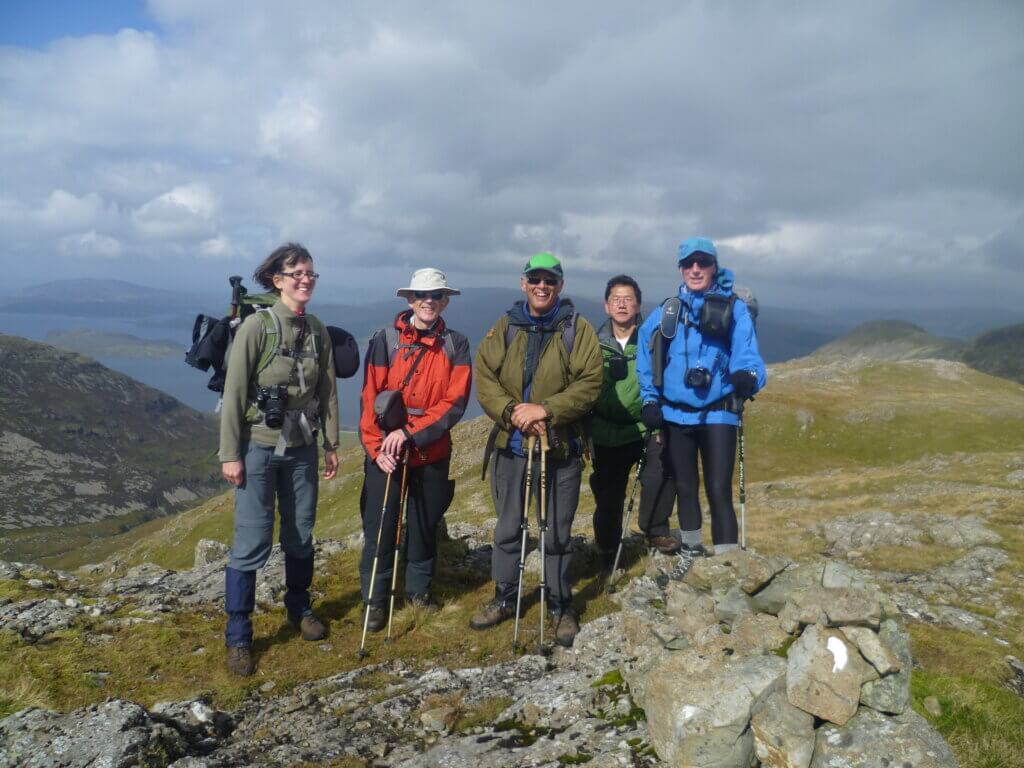
Some days involve high mountain ridges and expansive views stretching across the Highlands.
Other days focus on forests, rivers and quieter glens.
Sometimes wildlife becomes the highlight of the day. Occasionally the weather steals the show. More often, it is the combination of landscape, company and shared experience that people remember most.
One thing we have learned over the years is that good guiding is not just about knowing where to go.
It is about reading the group.
Some groups like plenty of time for photographs. Others prefer to keep moving. Some guests are interested in wildlife, others in local history or geology.
Small groups allow us to adapt naturally throughout the day.
One of our favourite moments comes at the end of the walk.
Boots are removed.
Waterproofs are hung up.
There is usually a collective sigh of satisfaction as people return from a day outdoors.
The drying room springs into action if the weather has been particularly Scottish.
Then comes one of the most anticipated parts of the day.
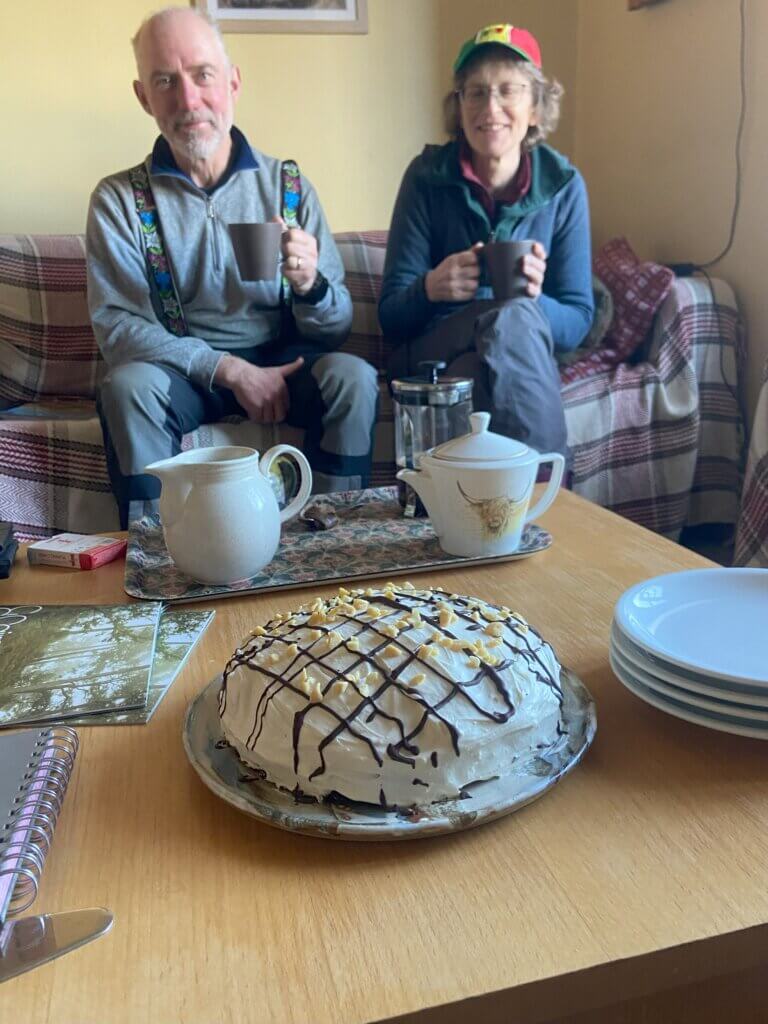
Tea and cake.
It is remarkable how much better cake tastes after a day spent walking in the Highlands.
The conversation often starts with discussions about the day’s highlights but quickly drifts into other subjects. Books. Gardens. Travel plans. Families. Wildlife sightings.
By this stage of the week, people who arrived as strangers are often beginning to feel like old friends.
While guests are relaxing, there is still plenty happening behind the scenes.
Rooms need attention.
Dinner preparations continue.
The next day’s forecasts are checked again.
Alternative plans are considered.
The reality of running a small owner-operated lodge is that there is always another job waiting.
Most guests never see much of this activity and that is exactly as it should be.
The aim is not to make people aware of everything that is being done. The aim is simply to make their holiday feel easy.
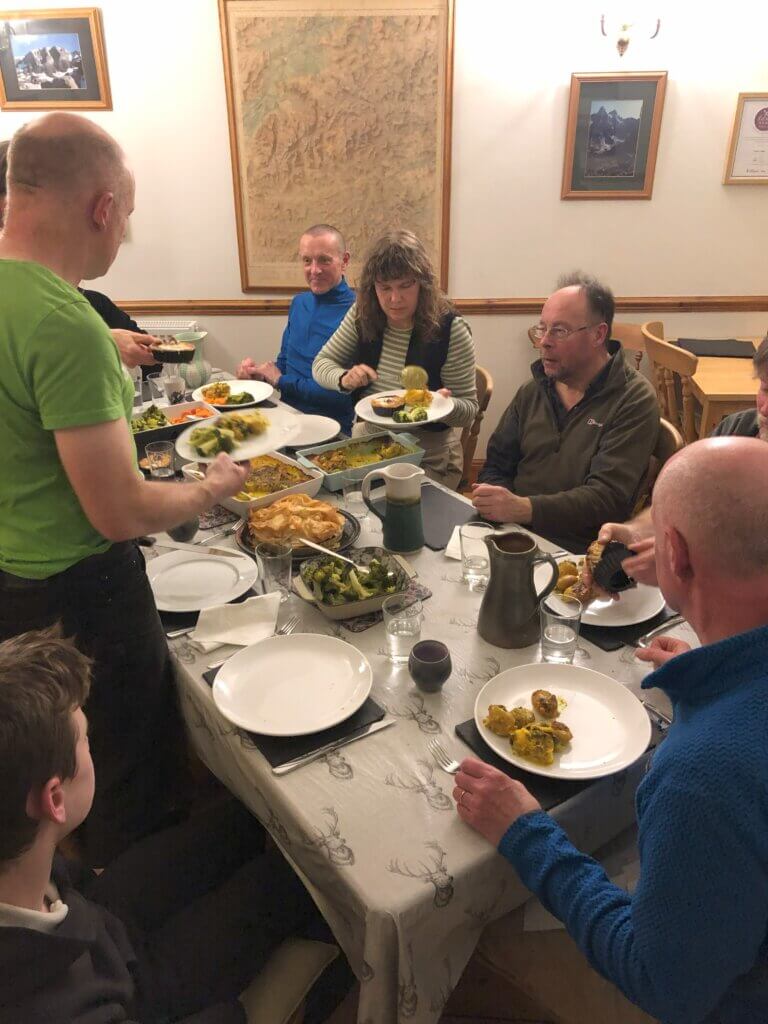
Evening meals are often the social heart of the day.
Everyone gathers around one table to enjoy good food and reflect on the day’s adventures.
The atmosphere changes noticeably as the week progresses.
Conversations become more relaxed.
People discover shared interests.
Stories become longer.
Laughter becomes more frequent.
The discussion eventually turns to tomorrow.
Andy will explain what the forecasts are suggesting, outline possible route options and answer any questions.
Guests often contribute their own thoughts too.
The final decision may not be made until the morning, but everyone finishes the evening with a sense of anticipation for what comes next.
After years of running walking holidays, we’ve realised that much of what makes a good week happens quietly in the background.
The route adjustment that avoids poor weather.
The alternative plan when conditions change.
The dietary requirement remembered without needing to ask again.
The extra blanket left in a room.
The cup of tea waiting after a wet day.
The lunch stop chosen because it offers shelter from the wind.
These small details rarely appear in holiday photographs, but they often shape how people feel about their week.
A walking holiday at Fraoch Lodge is not simply about accommodation, meals or guided walks.
It is about creating an environment where guests can relax, switch off from everyday responsibilities and spend time outdoors knowing that someone else is quietly taking care of the details.
By the end of the week, many guests tell us they feel as though they have been staying with friends rather than simply staying in a lodge.
For us, that is perhaps the greatest compliment we can receive.
Because while the mountains and landscapes may bring people to the Highlands, it is often the warmth of the welcome and the care they receive during their stay that brings them back.
One of the questions we are often asked is what makes our holidays different from other guided walking holidays.
The answer is surprisingly difficult because many of the things that make the biggest difference aren’t listed on an itinerary.
It’s not the number of miles walked. It’s not how many summits are climbed. It’s not even the spectacular scenery, although we are fortunate to have plenty of that.
The real difference is often how people feel during the week.
After more than 25 years of running walking holidays in the Highlands, we’ve noticed that guests rarely talk about individual routes when they write to us afterwards. Instead, they remember the atmosphere, the people they met, the conversations they had and the feeling of being part of something rather than simply participating in an activity.
For many guests, particularly those travelling alone, the first evening can feel slightly daunting.
Will I fit in?
Will everyone else know each other already?
Will I be able to keep up?
Will I have anything in common with the rest of the group?
These are completely normal concerns and, in reality, they usually disappear remarkably quickly.
One of the advantages of a walking holiday is that conversations develop naturally. There is no pressure to make small talk. Walking side by side through beautiful landscapes has a way of helping people relax.
By the end of the first day, people have usually discovered shared interests, similar experiences or mutual friends. By the end of the week, many are exchanging contact details and making plans to meet again.
Over the years we have seen countless friendships develop around our dining table.
Food has always been an important part of our holidays.
Partly because a good meal is one of life’s pleasures, but also because sharing meals creates opportunities for connection.
Each evening, guests gather around one table to eat together, reflect on the day and discuss plans for tomorrow. Conversations range widely. Sometimes people compare walking experiences from different parts of the world. Sometimes they swap gardening tips, discuss books they have enjoyed or talk about places they still hope to visit.
There is no need to sit with the same people every evening and no separate tables. Everyone is part of the same conversation.
For us, these meals are just as important as the walking itself.
Some of our guests arrive knowing nobody. They leave feeling as though they have spent a week among friends.
One of the biggest advantages of small groups is flexibility.
When people imagine guided holidays, they sometimes picture rigid itineraries that must be followed regardless of conditions.
Our experience has taught us that the Highlands rarely reward that approach.
Weather changes. Energy levels vary. Unexpected opportunities arise.
A wildlife sighting may encourage us to spend a little longer in one location. A forecast may suggest swapping the order of two walks. Someone in the group may be particularly interested in geology, history or wildlife and a short detour suddenly becomes one of the highlights of the day.
Small groups allow us to adapt the week as conditions and interests change — something that’s difficult to achieve at scale.
Guests often tell us that this flexibility is one of the things they appreciate most.
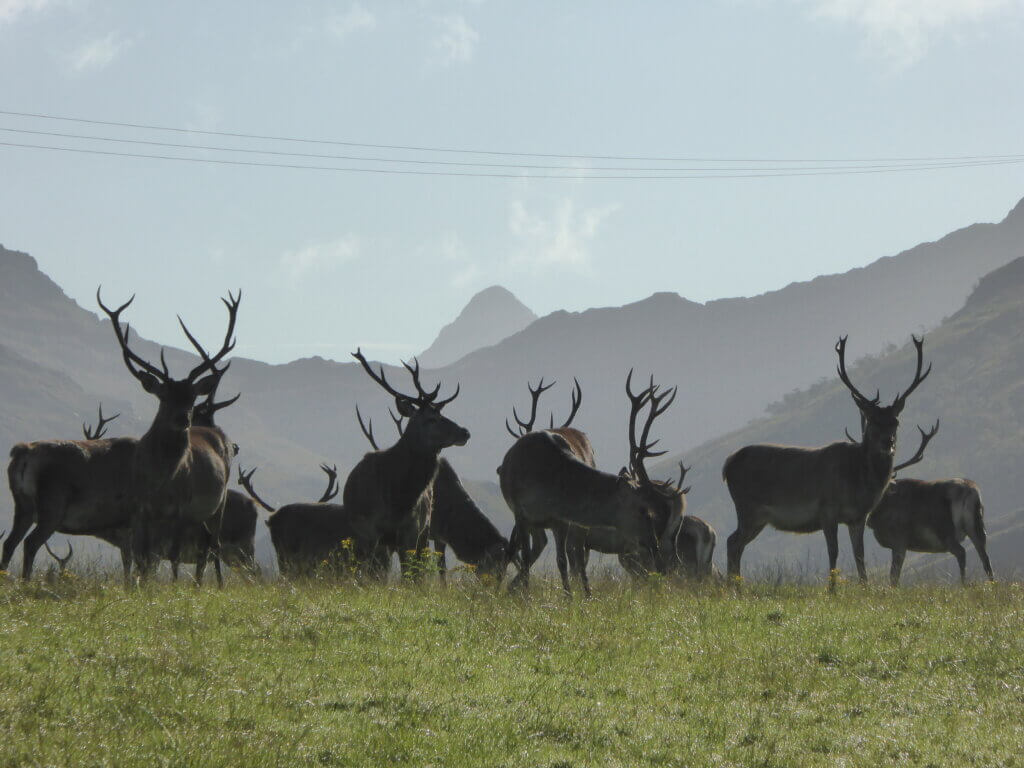
One concern many people have before joining a guided walking holiday is whether they will slow the group down.
In practice, this is rarely an issue.
Because our groups are small, guides can quickly understand the rhythm of the group and adjust accordingly. Some days naturally involve more photography stops. Other days involve longer lunches, wildlife watching or simply pausing to appreciate a particularly beautiful view.
Walking is not a race.
Our aim is not to move as quickly as possible from one point to another. It is to help people enjoy the landscape, challenge themselves appropriately and finish the day feeling satisfied rather than exhausted.
The right pace is often the pace that allows people to notice what is around them.
Some of the most memorable moments on a walking holiday are the ones nobody planned.
A golden eagle appearing overhead.
A mountain hare unexpectedly crossing the path.
The first sighting of a rare wildflower.
A perfect lunch spot discovered beside a river.
A patch of sunshine arriving just as the cloud begins to lift from a summit.
These moments are often impossible to predict, but they become more meaningful when shared.
Long after the details of a particular route have faded, guests often remember these unexpected discoveries.
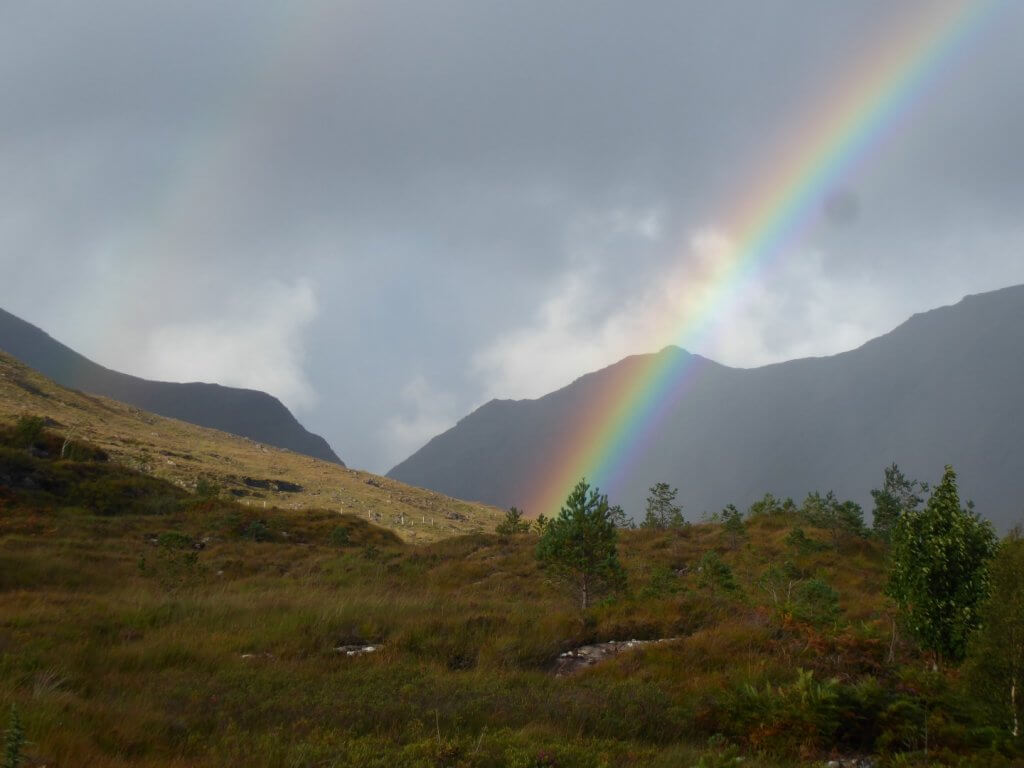
Rainbow in Torridon,September 2021
There are undoubtedly easier ways to run a walking holiday business.
Keeping groups small means more personal communication before a trip, more flexibility during the week and more attention to individual guests.
It also means that behind the scenes there is always plenty to do. While Andy is planning routes, checking forecasts and guiding walks, there is still the catering, housekeeping, cleaning, administration, bookings, marketing and blogging that keep everything running.
At times it can feel slightly overwhelming.
And yet, it is also the reason we continue to operate the way we do.
Because staying small allows us to know our guests as people rather than simply as bookings.
We learn about their interests, their aspirations and often their families. We have celebrated significant birthdays with them, welcomed returning guests back year after year and sometimes watched friendships develop between people who met for the first time around our dining table. We’ve even had people meet here with us and then end up getting married and having their own family (and brought the kids here to meet us.)
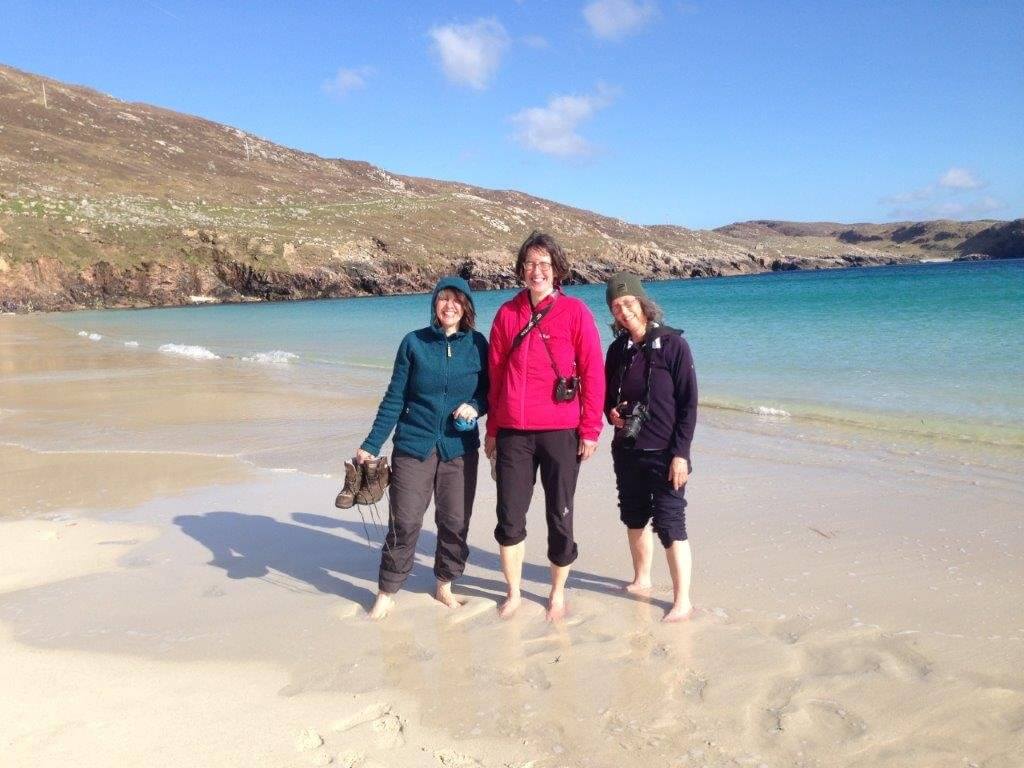
Paddling on the beach at Harris
Perhaps that is the biggest difference of all.
A good walking holiday is never just about the walking.
It is about sharing experiences, spending time with like-minded people, discovering new places and returning home with stories that stay with you long after the boots have been cleaned and put away.
The Highlands provide the setting.
The people provide the memories.
And after all these years, seeing guests arrive as strangers and leave as friends remains one of the most rewarding parts of what we do.
Every season has its champions in the Cairngorms. June as a bridge between spring and summer is one of our favourite times to walk in the Cairngormss
Some people love the crisp mornings and golden colours of autumn. Others wait all year for winter snow or the first signs of spring returning to the glens. After more than 25 years of living and working in the Cairngorms, we can find something to appreciate in every month of the year.
And yet June still stands out.
Perhaps it is because June feels like a month full of possibility. Winter is finally behind us, summer is stretching ahead and the landscape seems to burst into life all at once. The days are long, the hills are green, wildlife is busy raising young and every week brings a noticeable change to the landscape.
For walkers, it is one of the most rewarding times of year to visit the Highlands.
By June, the threat of frost has largely retreated and everything seems determined to make the most of the long daylight hours.
The cotton grass is beginning to fluff up across the moorland, creating drifts of white that catch the breeze. Lupins start adding splashes of colour to roadsides and riverbanks. Meadows are filled with wildflowers and fresh growth appears almost daily.
One of the pleasures of spending so much time outdoors is noticing how quickly things change during June. A route walked at the beginning of the month can feel surprisingly different just a couple of weeks later as flowers emerge, grasses grow taller and woodland fills out.
The landscape feels full of energy.
June is also one of the best months for birds.
Swallows and swifts are back after their long migrations and their arrival always feels like a milestone in the year. Ring ouzels have returned to the uplands to nest and the unmistakable call of the cuckoo can often be heard echoing across the glens.
Many visitors are surprised by how much birdsong accompanies a walk at this time of year. In the forests, particularly in the quieter corners of the Cairngorms, the soundtrack of a June morning can be every bit as memorable as the views.
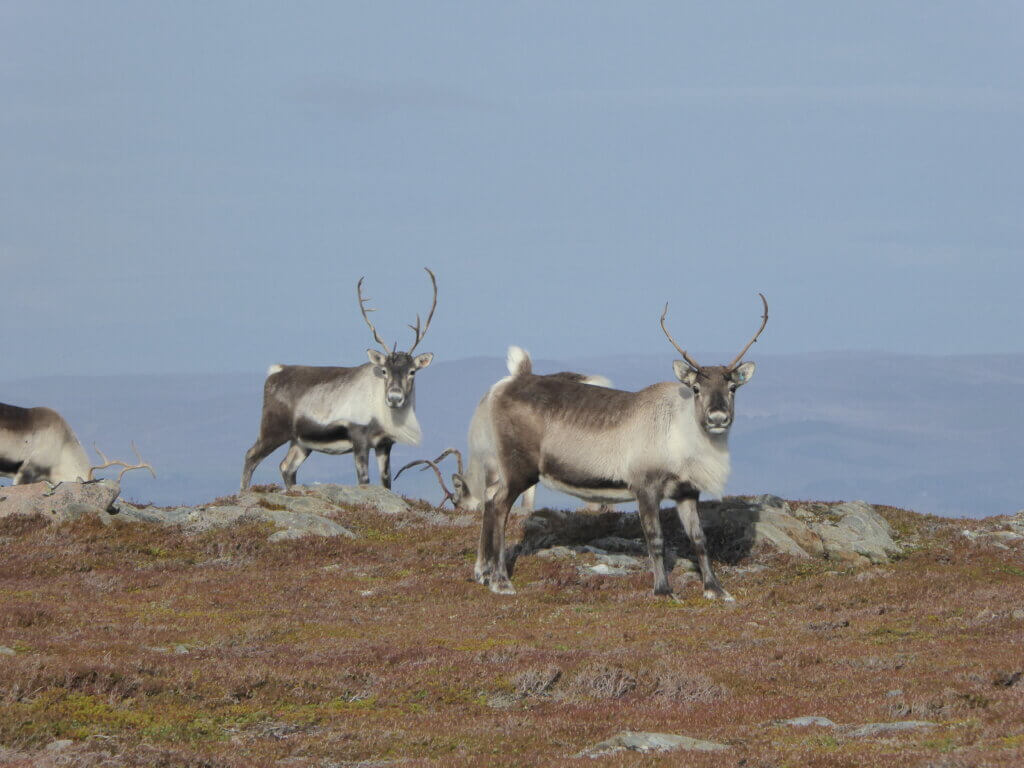
Wildlife is busy too. The reindeer have just calved. Lambs are becoming increasingly adventurous in the fields, while many animals are focused on raising young and taking advantage of the abundance of food available during the longest days of the year.
One of the greatest advantages of visiting in June is the amount of daylight available.
Long evenings create a wonderful sense of freedom. There is rarely any need to rush and walks can be planned at a relaxed pace, with plenty of time to stop, take photographs, enjoy a picnic lunch or simply sit and appreciate the surroundings.
Many visitors from overseas are amazed by just how late it stays light in the Highlands. Around the longest day, darkness barely seems to arrive at all.
June also falls into a sweet spot before the main school holiday season begins. Popular routes are generally quieter than they will be later in the summer, making it easier to find the sense of peace and space that many people come to the Highlands seeking.
If we had to choose one favourite place to visit in June, it would probably be Glen Feshie.
There is something particularly uplifting about the glen at this time of year. The woodland is alive with birdsong and the regeneration taking place throughout the estate becomes especially apparent. Thanks to long-term deer management, young trees are establishing themselves naturally across large areas of the glen, creating a landscape that feels increasingly wild and vibrant.
Each year there seems to be something new to notice.
The mountains provide a magnificent backdrop, but it is often the smaller details that capture our attention: fresh growth along the riverbanks, wildflowers appearing beside the path, or the constant soundtrack of birds hidden among the trees.
It is a place that rewards slowing down.
There is one thing worth mentioning for anyone planning a June visit.
If you suffer from hay fever, be prepared for pine pollen season.
Every year there comes a point when a fine yellow dust seems to settle over cars, windowsills, outdoor tables and almost anything else left outside. It is a sign that the pinewoods are doing exactly what they should be doing, but it can come as a surprise to visitors who have never experienced it before.
Fortunately, it is usually a short-lived phenomenon and a small price to pay for spending time among some of Scotland’s finest native forests.
What makes June special is not any single feature.
It is the combination of long days, fresh growth, active wildlife, quieter trails and the feeling that the whole landscape is operating at full speed.
For walkers, it offers some of the best opportunities of the year to experience the Cairngorms at their most vibrant. Whether you are exploring ancient pinewoods, wandering through flower-filled glens or simply sitting outside after dinner watching the light linger over the hills, June has a way of reminding you why so many people fall in love with the Highlands.
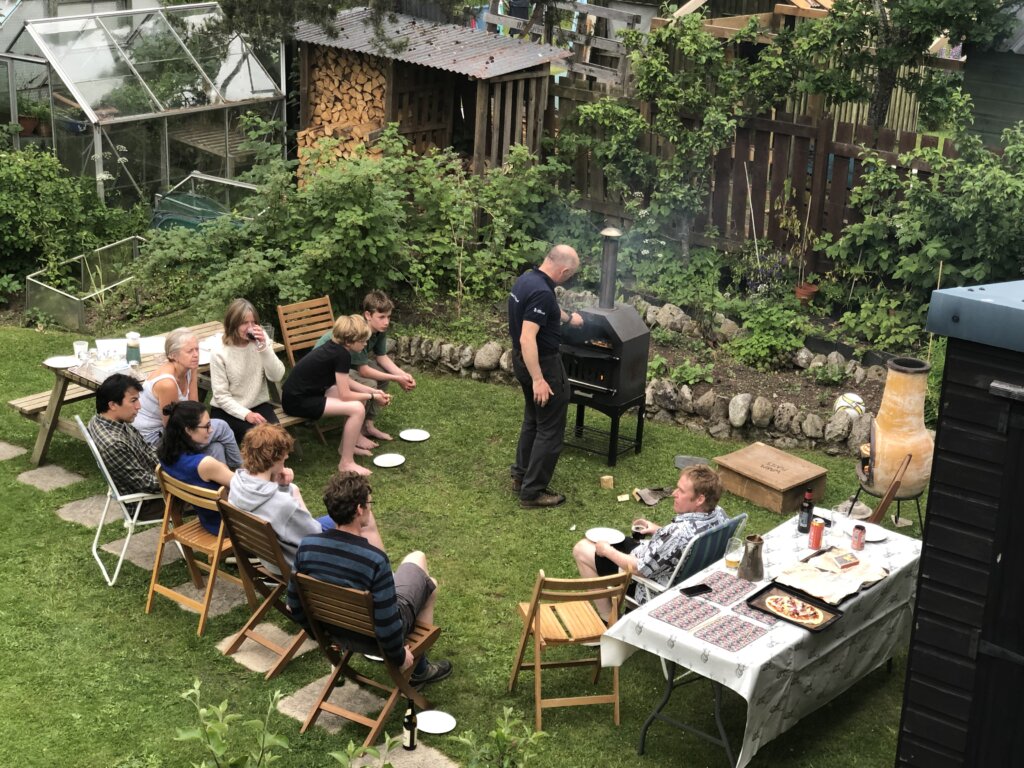
And after all these years, it is still one of the months we look forward to most, especially as June can signify the time when we can start to eat outdoors!
 Scot Mountain Holidays (Ltd),
Fraoch Lodge, Deshar Road,
Boat of Garten,
PH24 3BN
Scot Mountain Holidays (Ltd),
Fraoch Lodge, Deshar Road,
Boat of Garten,
PH24 3BN




All content © Copyright Scot Mountain Holidays 2026
Responsive web design by Summit Web Solutions
