









This website uses cookies to improve your experience. We\'ll assume you\'re ok with this, but you can opt-out if you wish. Read More
In case of sale of your personal information, you may opt out by using the link Do Not Sell My Personal Information
Making the most of the weather when planing a group hike is not always easy in Scotland. When people from North America think about Scottish weather, a couple of expectations often come up:
Weather forecasts will be reliable
Plans will stick exactly as scheduled
But anyone who’s spent real time in the Highlands knows that Scottish weather has its own rhythms, and the best walking days often come from planning with that uncertainty — not hoping it won’t happen. At Scot Mountain Holidays, we help you enjoy the best of the Highlands without letting weather become a worry.
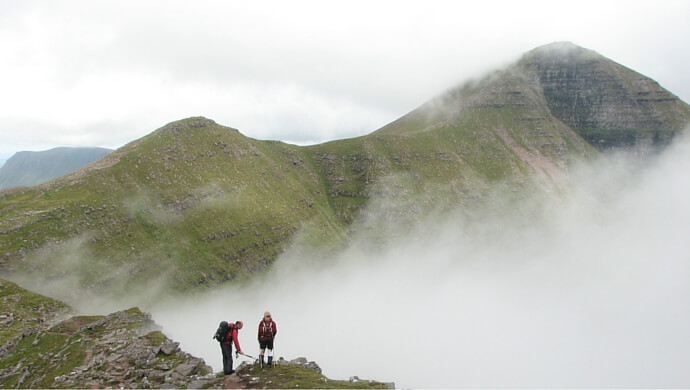
Above the clouds in spectacular mountain scenery
One of the most important things to understand about Scottish weather is the dramatic east–west rainfall gradient.
🔹 The western Highlands, buffeted directly by Atlantic weather systems and steep mountains, are amongst the wettest places in the UK — with annual rainfall up to around 3,000–4,500 mm in places.
🔹 In contrast, much of eastern Scotland sees much lower rainfall — often less than ~800 mm a year — and places like the northeast coast can be considerably drier than the west.
This means:
Coastal and eastern Highland routes often have fewer persistent wet days.
Sunshine, clearer skies, and lighter showers are more common there than in the west.
Sometimes the difference can be striking — extreme rainfall in western areas can contrast with much lower totals on the east coast over the same period.
This east–west split is one of the reasons we base many of our routes and daily options on microclimates rather than rigid forecasts.
“Midges” — the tiny biting flies that are famous in Scotland — are a seasonal talking point for many walkers. Here’s what’s useful to know:
Midges are most active when it’s damp, calm, and humid — especially in sheltered woods or near water.
They’re much more prevalent in the wet west and north, where the conditions suit them best.
Eastern and coastal areas — and breezier ridge routes — tend to have far fewer midges.
That doesn’t mean you’ll never see one — but when we plan routes and alternatives each day, midge conditions are part of the picture. The result? You’re far more likely to enjoy calm sunshine or breezy conditions than slogging through wet, midgy woodlands.

Many hikers expect that:
✔️ The forecast is set in stone
✔️ Plans must never change
✔️ A “good day” means following the original itinerary exactly
But in the Scottish Highlands, the magic often comes from flexibility.
Here’s the truth:
Forecasts give guidance — but not guarantees. Scottish weather can change rapidly.
Instead of rigid plans, the best experiences come from being ready to adapt routes and timing.
A day that looked grey in the forecast can become one of your favourites — and that happens because plans are flexible.
This is weather-based planning — and it’s how we make great days happen.
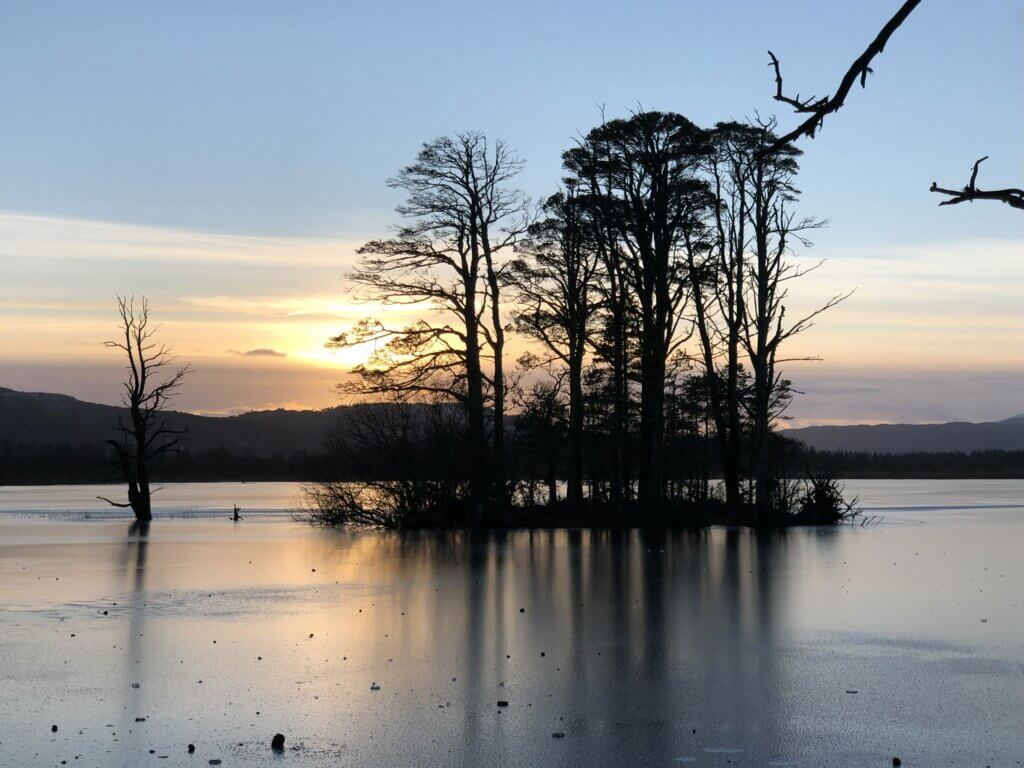
At Scot Mountain Holidays, we blend local knowledge with flexible planning so your group never “loses” a day — the plan simply changes in smart ways.
Here’s how:
We use real-time conditions — not generic forecasts — when choosing your route for the day.
That means we might suggest:
A morning forest walk if wind and rain are moving in from the west
A coastal or east-leaning ridge route if showers hit the interior
A late afternoon high pass if the sun breaks early
You enjoy the best conditions available, not the original itinerary regardless of weather.
Instead of one fixed plan, we build in Plan A • Plan B • Plan C for every day. We always try to stick as close as we can to the advertised itinerary but sometimes getting the best out of your week, just means altering the order of the activities we’re planned; or being flexible with the timing. Often this means we’re not fully committed to the next day’s plan until the day starts as we want you to have the best possible time here in Scotland
Options may include:
Sheltered forest trails when winds and showers are strong
East-facing coastal paths when inland skies are unsettled
High ridge or summit walks when weather windows open
Cultural routes, distillery visits, or scenic drives if the weather turns truly wet
This keeps your holiday full, varied, and weather-smart.
Here’s the bottom line:
You won’t lose a day because of weather — the plan simply changes to use the best of what the day offers.
We take the guesswork out of changeable weather, so you can relax, explore, and enjoy the Highlands — in comfort, in beauty, and often in sunshine — even if the forecast looked uncertain.
What is it really like to spend a night snow-holing in the Cairngorms?
For many of our guests, a guided winter expedition in Scotland is something they’ve dreamt about for years. Sleeping in a snow-hole, digging into a drift high on the plateau, cooking a hot meal by candlelight — it sounds adventurous (and it is). But it’s also carefully planned, methodical and rooted in decades of experience.
Here’s what expedition day actually looks like.
Expedition day starts early.
The radio goes on at 6:30am and the first task — before tea is even finished — is checking the mountain weather forecast. In the Cairngorms, conditions can shift dramatically overnight. A promising forecast can tighten into a narrow weather window. A calm day can gain edge.
Key questions shape the plan:
Is the forecast holding?
Are wind speeds within safe limits for the plateau?
Do we head further for a wilder feel?
Or do we choose a nearer site with easier retreat options?
Winter skills guiding in Scotland is about flexibility. The plan is never rigid. Even once we leave the lodge, we continue assessing the weather and snow conditions throughout the day.
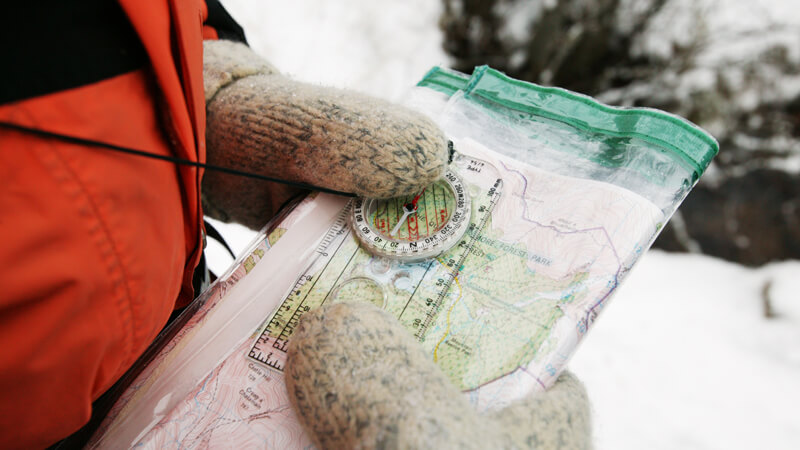
Winter walking in the Cairngorm Mountains, Aviemore, Scotland. Photograph shows Andy Bateman, a professional mountain guide who runs a holiday walking company called Scot Mountain Holidays. Walkers are taught winter mountain skills such as navigation, using an ice axe and walking across ice using crampons.
map reading using a compass
photograph by David Mansell.
Over breakfast we talk through the day. Guests check gloves, sleeping mats and personal kit. In winter, small details matter.
Before we leave, there’s a briefing on snow-holing technique — and design.
Snow-holes in Scotland are different from the textbook alpine versions you may have seen online.
The Cairngorms are often cold, but perhaps not in the way people expect. While valley bottoms have recorded temperatures approaching -30°C, the Cairngorm summit record is closer to -16°C. At typical snow-holing height on the plateau, seasonal lows might reach -10°C, but most winter nights are nearer -5°C or above.
So Scottish snow-hole design is not about trapping heat at all costs.
It’s about:
Efficient digging
Strong structural integrity
Good ventilation
Managing condensation
Avoiding unnecessary complexity
There’s no need for elaborate sleeping platforms or deep cold-air drains. Instead, we focus on airflow and safety. Ventilation is critical. So is keeping the build time realistic in winter conditions.
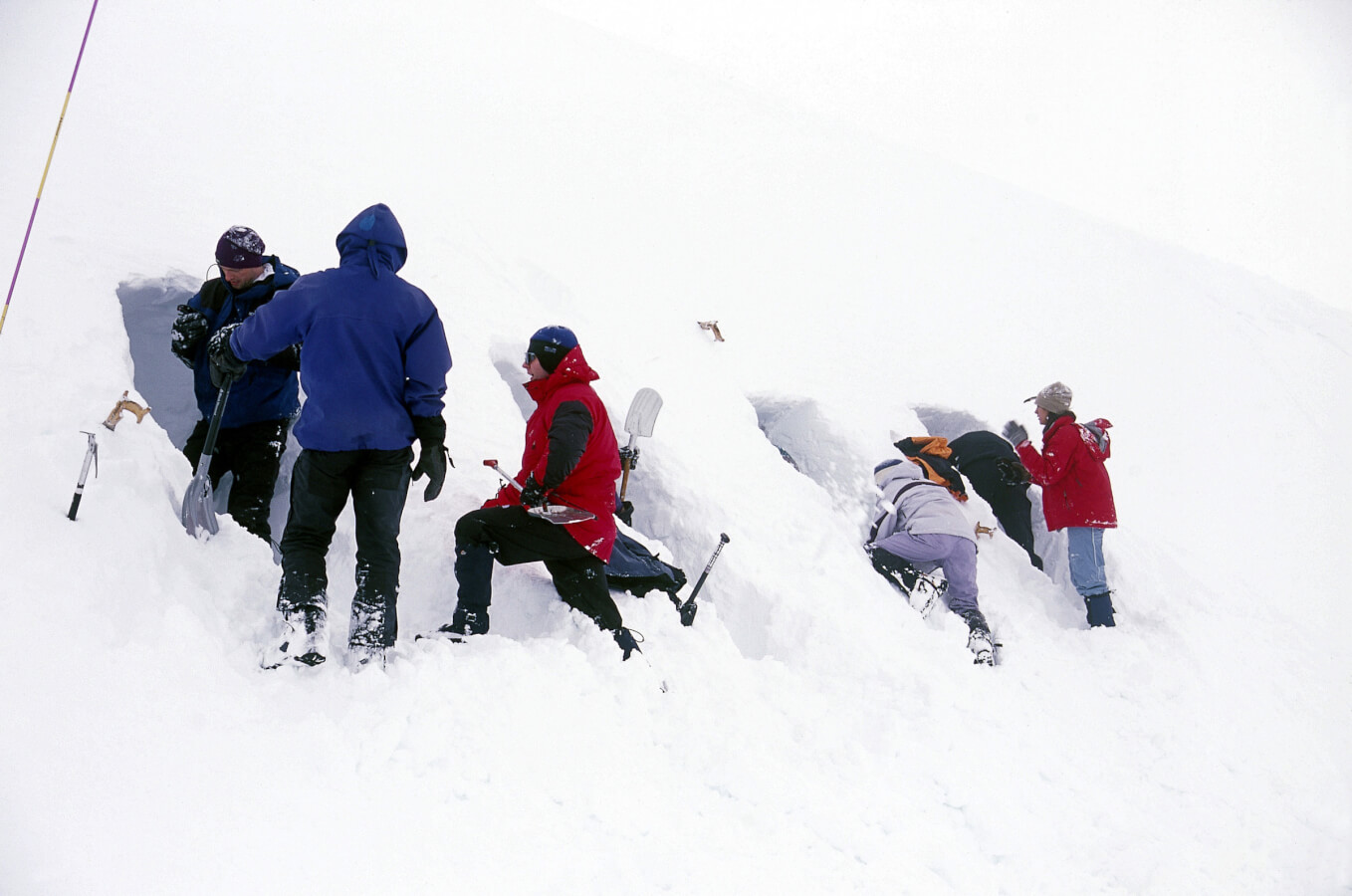
Digging in for a snow hole overnight in the Cairngorms
Each person carries a shovel. Snow saws are shared — and in Scottish snow they need to be robust. Our winter snow can range from light powder to what I can only describe as “alabaster marble.” A weak saw doesn’t survive long.
Alongside digging tools, we carry:
Cooking stoves and fuel
Candles
Camping pots and pans
Dehydrated homemade meals (weight matters)
Group safety equipment
With packs loaded, we head up and out onto the Cairngorm plateau — often towards the Ben Macdui massif — into a true winter landscape.
On arrival at a potential site, the group rests while I assess:
Snow depth
Snow stability
Wind loading
Angle of slope
Ideally, we dig into a deep, stable bank. A steeper face reduces digging time. But if there are any concerns about wind slab or structure, we move to a gentler gradient — which means more work, but greater safety.
Once the site is confirmed, entrances are marked out.
Guests pair up — two to a doorway. I’m not a fan of isolated two-person snow-holes. Snow absorbs sound remarkably well. Separate holes can leave people feeling disconnected from the wider group. A communal design provides both psychological comfort and practical awareness.
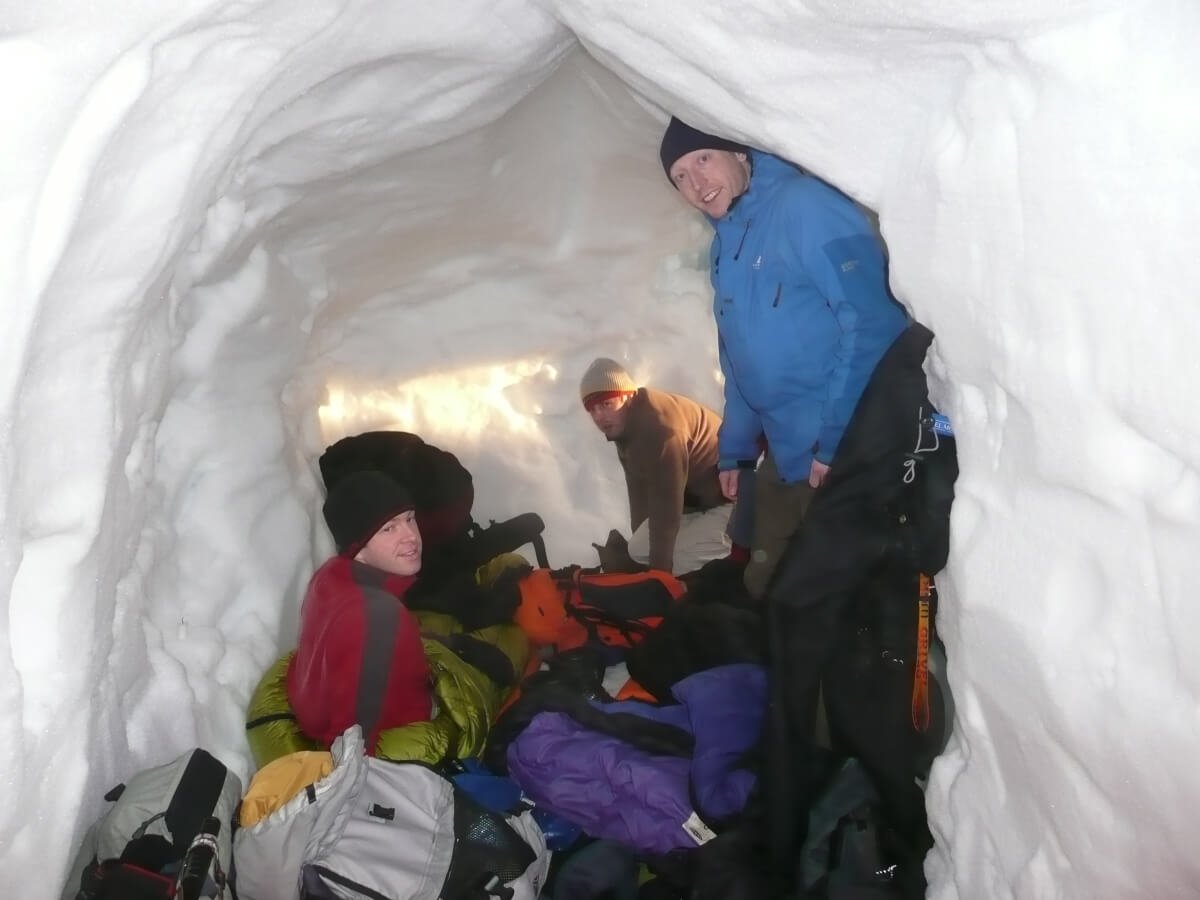
Here you can see quite clearly the shape of the apex centre for our snowhole.
The first metre is about strength.
Each entrance is driven in at least a metre before we widen the chamber. This maintains a solid front wall — critical for structural integrity.
At first, progress feels slow.
You dig forward 1.5 metres. There’s no sense of space yet — just compact snow and the steady crunch of shovels. You turn sideways and begin cutting toward the neighbouring team. The only sound is your own effort.
Then — faintly — you hear another crunch.
Not yours.
Another. Louder this time.
Momentum builds. Suddenly there’s the unmistakable clash of blades as the two tunnels meet. Relief. Laughter. Energy returns.
Now the chamber opens quickly. Snow is removed from three sides. Walls are squared. The floor is levelled. The apex of the roof is shaped carefully for strength. Ventilation holes are angled upward at high points.
Doorways are partially blocked with snow blocks — but never without ensuring airflow remains sufficient.
Ventilation is checked. Then checked again.
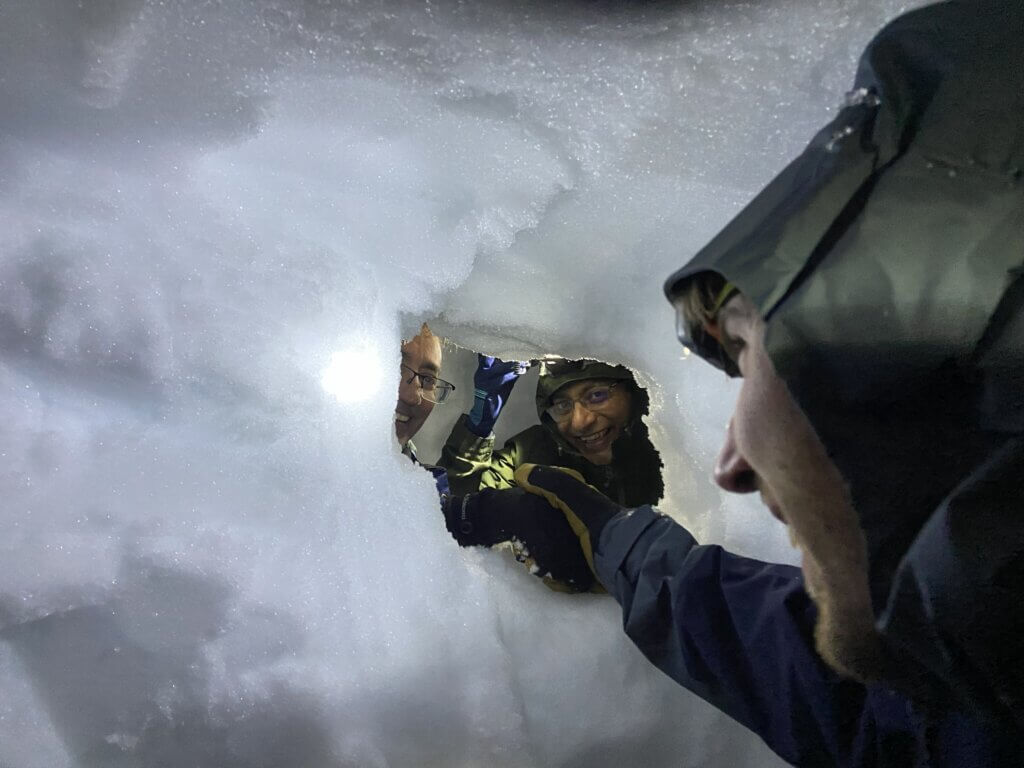
Once complete, the transformation is remarkable.
Outside: wind, spindrift, shifting cloud.
Inside: stillness.
Guests change into dry layers and settle into sleeping bags while I set up the cooking area. Stoves are lit. Candles glow against snow walls. Steam rises quickly in the cold air.
Dinner is simple but deeply satisfying after a full day of digging:
Homemade carrot and cardamom soup
Chorizo and vegetable casserole with couscous
Apricots and custard
Everything is prepared in advance and dehydrated to keep pack weight manageable — a key principle in winter expedition planning.
There’s conversation. The occasional dram appears. The sense of achievement is palpable.
By around 10pm, the stoves are off. Candles extinguished. The plateau falls silent again.
And finally, I zip into my own sleeping bag.
It’s been a long day. But it’s also one of the most rewarding experiences winter in the Cairngorms can offer.
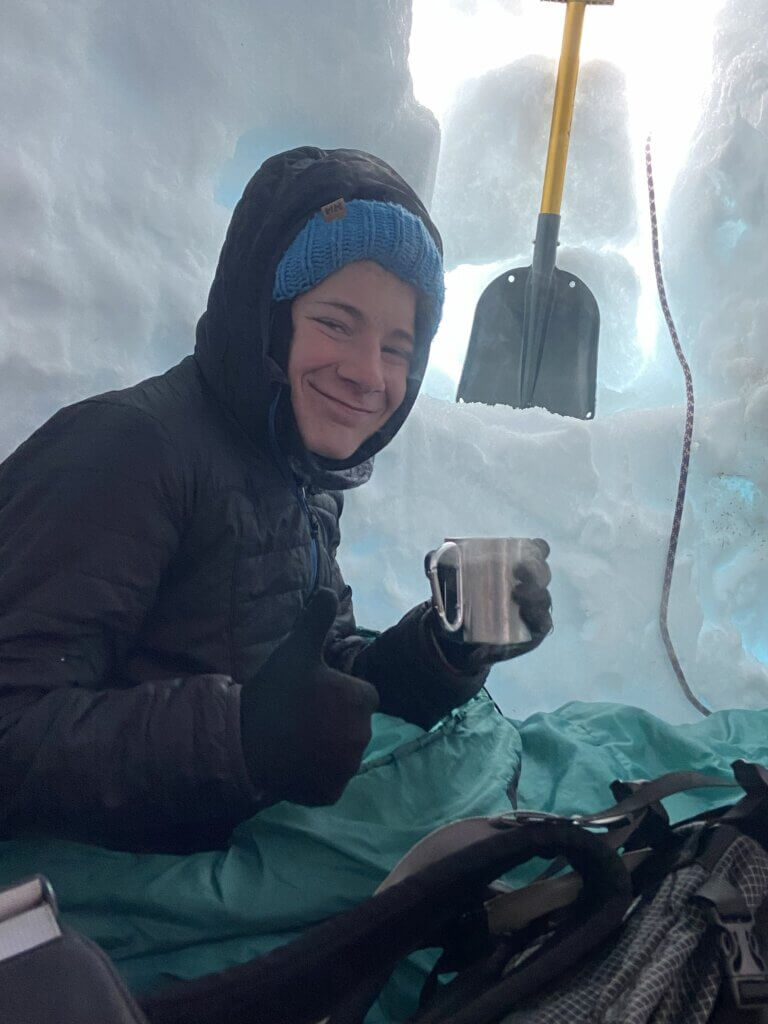
Snow-holing isn’t just about survival skills. It’s about:
Understanding winter mountain conditions
Working as a team
Reading snow and terrain
Experiencing true self-sufficiency
Spending a night immersed in the Highland winter landscape
For many guests, it becomes the highlight of their winter skills course or guided expedition in Scotland.
There’s something uniquely satisfying about creating your own shelter in the snow — and sleeping safely inside it.
An essential decision when your planning your hiking vacation, is where your group will stay. If you’re used to planning walking trips in the US or Canada, you might picture booking a hotel close to each trailhead. Perhaps you’re used to national park lodges, roadside inns, or moving on every night to stay near the next hike. You probably expect an ensuite room, good food at the end of the day, and not too much hassle.
And you should expect comfort. After a long travel day — often a transatlantic flight followed by a drive north — you need somewhere welcoming to land.
But in the Scottish Highlands, especially in the Cairngorms, where you stay isn’t just about comfort. It shapes the entire experience.
In North America, it makes sense to stay as close as possible to the trailhead. Distances are vast. Roads can be long and quiet. If you’re hiking in the Rockies, the Adirondacks, or the Appalachians, you often base yourself near a specific park or move between regions.
So naturally, many of our enquiries from the States and Canada assume that hiking inn to inn is the way to go. Or alternatively the assumption is we’ll be driving significant distances each day to reach our walks.
In reality, we’ve designed things differently — and very deliberately.
Fraoch Lodge sits in a very convenient location, near to some excellent roads to reach multiple routes not only in the Cairngorms but also in surrounding regions. It makes our location very central for hiking in most Highland regions.
That central location is not accidental. It means:
We can reach a huge variety of walks within a relatively short drive.
We can adapt plans to suit weather conditions.
We can vary terrain and scenery without packing up and moving house.
Instead of spending hours in the car each day, we keep transfers sensible and purposeful – no more than 90 minutes. That flexibility is especially important in Scotland, where weather and light can change quickly. If the forecast shifts, we simply adjust the walk — not the whole holiday.
Guests are often surprised by how much variety we access from one base: ancient Caledonian pine forest one day, open moorland the next, a high summit when conditions are right, perhaps a coastal walk or lochside path later in the week.
You unpack once. You settle in. And the landscape unfolds from there.
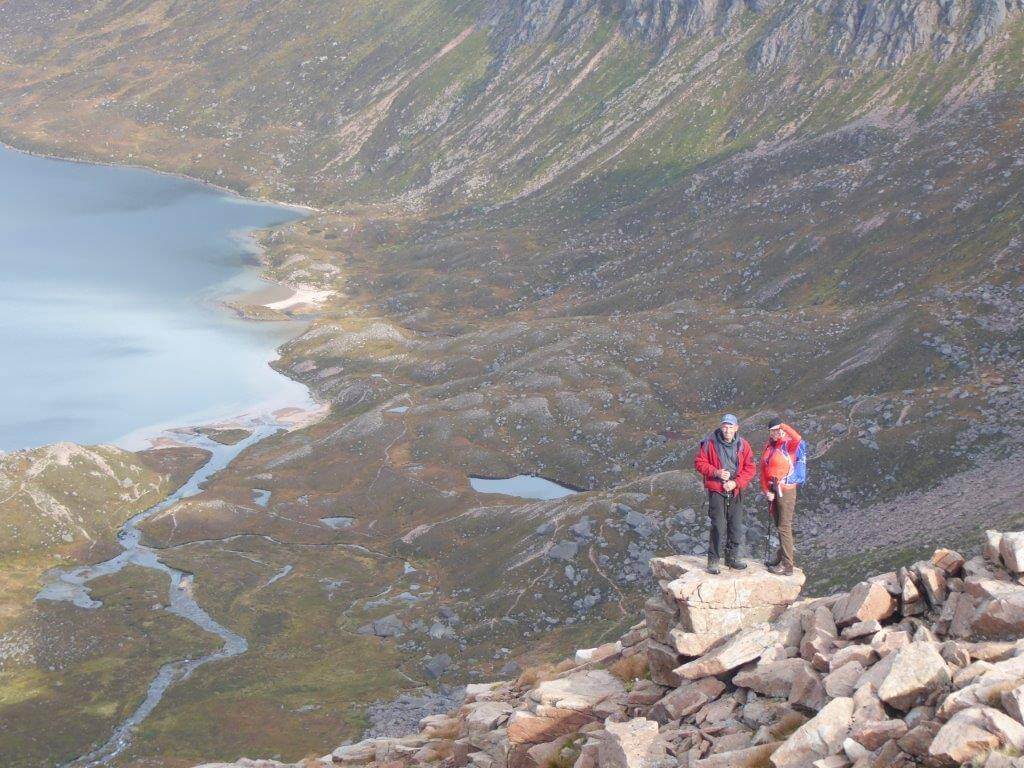
Posing for the photo op – perfect view over Loch A’an
Another difference from the hotel model: we don’t mix multiple independent parties together in a big anonymous building.
At Fraoch Lodge (or our alternative Lodge base if we put together an alternative , guests are part of a small group — and the lodge becomes theirs for the week.
That changes the atmosphere completely.
Instead of dispersing to separate hotel rooms and separate restaurant tables, the group naturally gathers in shared spaces:
Around the dining table
In the sitting room with maps spread out
Over tea and cake after a walk
By the fire on a cool evening
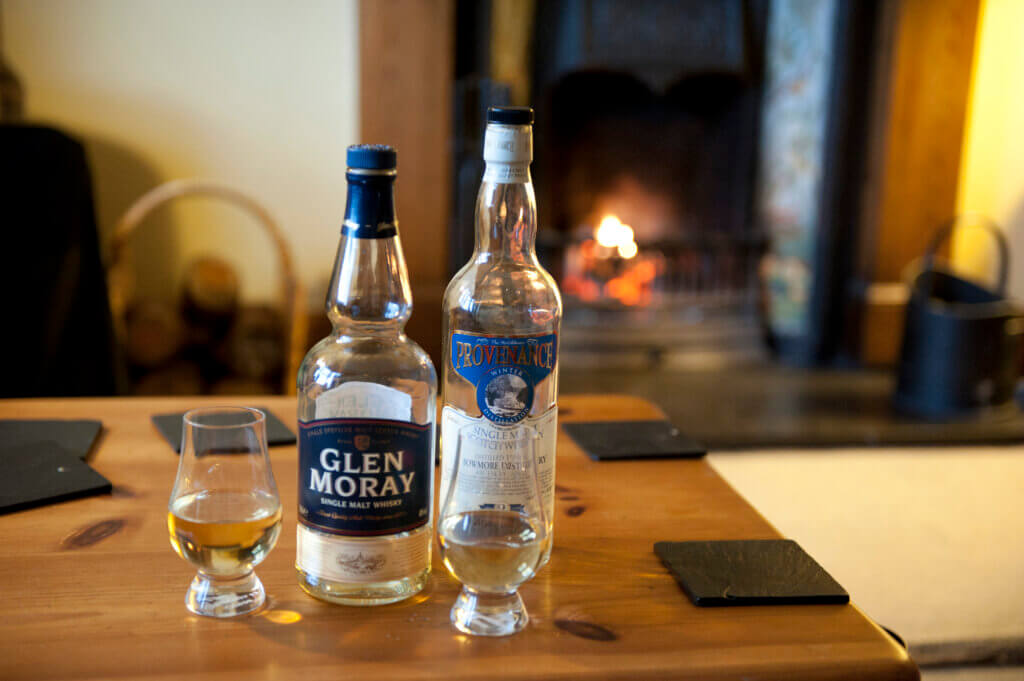
For private groups — walking clubs, extended families, groups of friends — exclusive use creates something even more powerful: a sense of shared journey.
There’s no negotiating with hotel reception. No competing with outside guests for space. No rushing to make restaurant bookings.
It’s simple. It’s contained. It’s yours.
For many of our guests, this becomes one of the most memorable aspects of the trip — the conversations, the laughter, the swapping of stories from home, the quiet companionship that builds over several days of shared walking.
After an overnight flight from North America, even seasoned travellers feel it.
You land. You navigate a new country. You drive on the left. You adjust to the light (which in summer barely fades). By the time you arrive in the Highlands, you don’t want to search for dinner. Of course some of this hassle can be saved if you book a package including a driver/guide so you can all relax and not worry about the unfamiliar drive.
You want to sit down.
You want a cup of tea (or coffee) in your hand.
You want someone else to have thought about what’s for supper.
That’s why our holidays are fully inclusive (excluding alcohol and travel to Scotland). Breakfast. Packed lunches. Two-course evening meals. Home baking.
It’s not about “fine dining” or elaborate presentation. It’s about:
Reliable, nourishing food after a long day outdoors
No decision fatigue
No organising taxis or reservations in rural areas
No splitting bills
Guests often tell us how much they appreciate not having to think about meals — especially in the first couple of days when their body clock is still somewhere over the Atlantic.
Food becomes part of the rhythm of the week: a solid breakfast before heading out, a well-earned lunch stop in the hills, and a relaxed dinner where the day’s stories are shared.
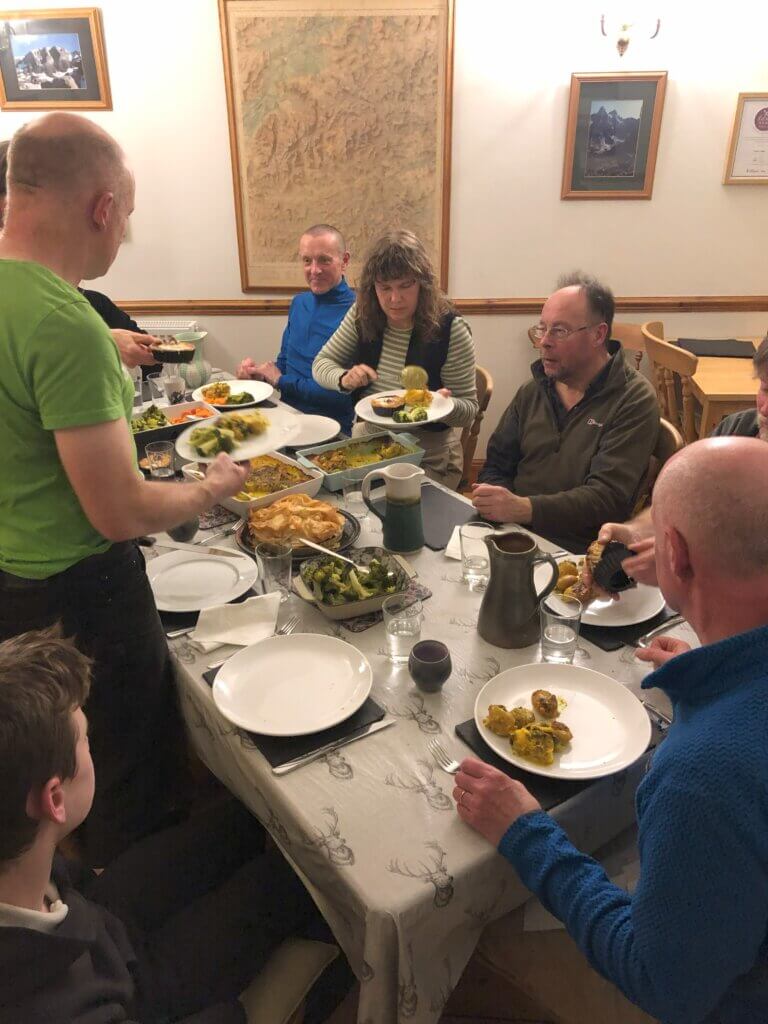
We don’t describe Fraoch Lodge as “luxury.” That word suggests something polished and distant.
Instead, think of it as a basecamp.
It’s the place you return to each afternoon with wind in your hair and stories to tell.
Boots come off in the drying room. Waterproofs hang up. There’s usually tea and something homemade waiting. Maps appear on the table. The next day’s plan is talked through.
The lodge is also a social hub.
Walking holidays are as much about people as they are about landscapes. When you share a path, a climb, a viewpoint — you naturally share conversation. By the end of the week, many groups feel like old friends.
And just as importantly, it’s a recovery space.
After a full day on Highland trails, your body needs warmth, food, rest. You don’t want to commute to your accommodation or navigate a busy hotel lobby. You want ease.
Fraoch Lodge offers that ease.
A comfortable room.
A hot shower.
A quiet corner to read.
A sitting room where others drift in and out.
A dining table where everyone gathers again.
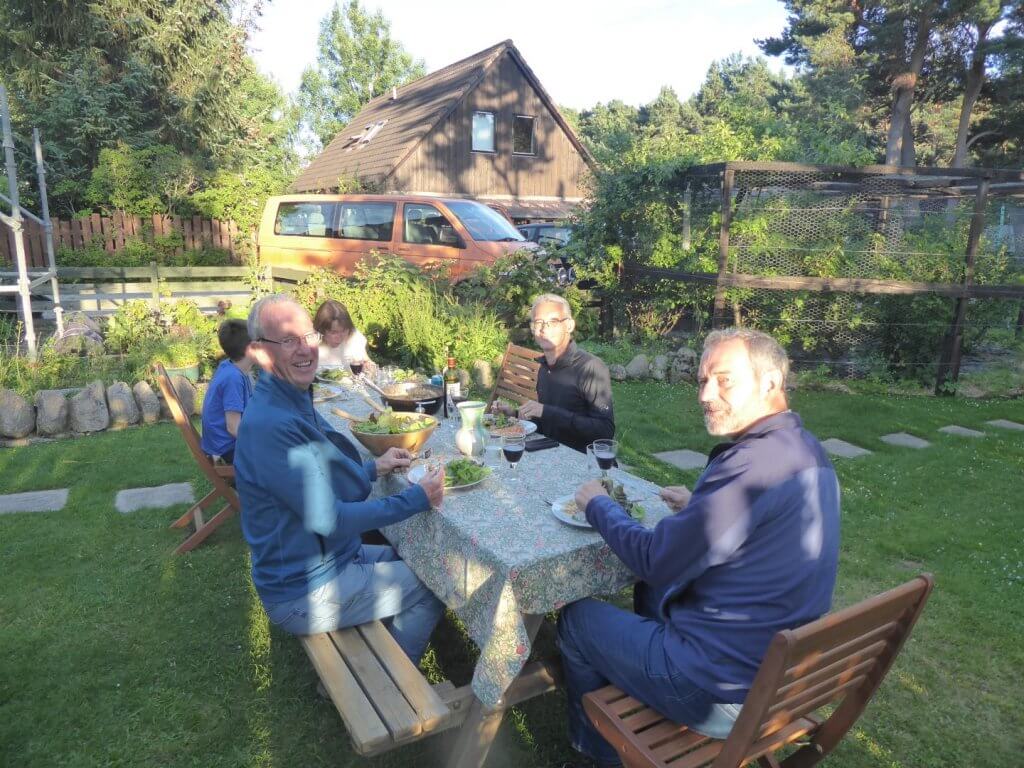
Al fresco dinner at Fraoch Lodge
When guests first ask, “Where will we stay?” they’re usually thinking about beds and bathrooms.
By the end of the week, they realise the real answer was this:
We stayed in the heart of the Highlands.
We stayed in one place that allowed us to explore many landscapes.
We stayed somewhere that made the week feel simple and shared.
Location matters because it affects:
How much time you spend driving versus walking.
How flexible your itinerary can be.
How connected your group feels.
How restorative your evenings are.
In a place like the Cairngorms, a well-chosen base is the difference between a collection of day hikes and a genuinely cohesive Highland experience.
And that’s why we’ve chosen ours carefully.
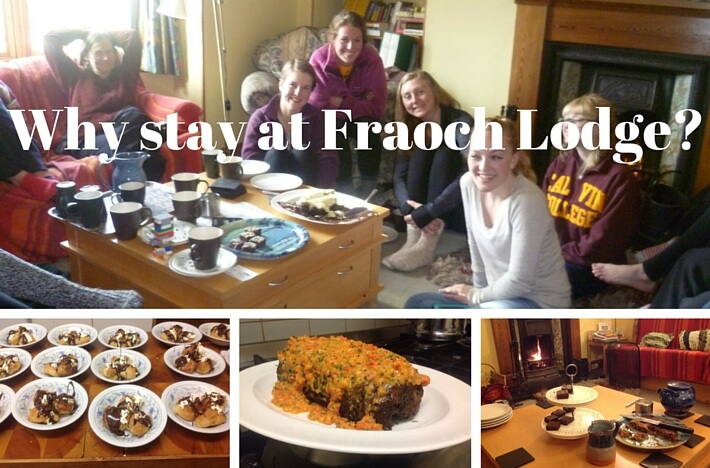
Enjoy top class family friendly and freshly prepared food.
One of the quiet joys of hiking is the headspace it gives you.
Hours of steady movement, the rhythm of your breath, boots on the path — and suddenly the noise of everyday life fades. Out on the hill, you can solve the problems of the world (at least to your own satisfaction), replay conversations, plan the future, or simply enjoy the rare luxury of thinking one thought at a time.
And when the legs get tired, most of us have something in mind that keeps us moving forward.
Over the years, we’ve asked our guests what motivates them on a long day out walking. The answers are as varied as the people themselves — but a few themes come up again and again.
For many walkers, a clear goal makes all the difference.
For some, it’s the chance to finally tick a Munro.
For others, it’s standing on the highest point in a new area.
Sometimes it’s a long-planned route, or even being the first to explore a lesser-known line.
Whatever the goal, having a plan focuses the mind and gives purpose to each step. Of course, we’re always careful to remind our guests that the day isn’t over when you reach the top — the walk only truly ends when you’re back home, boots off and feet up.
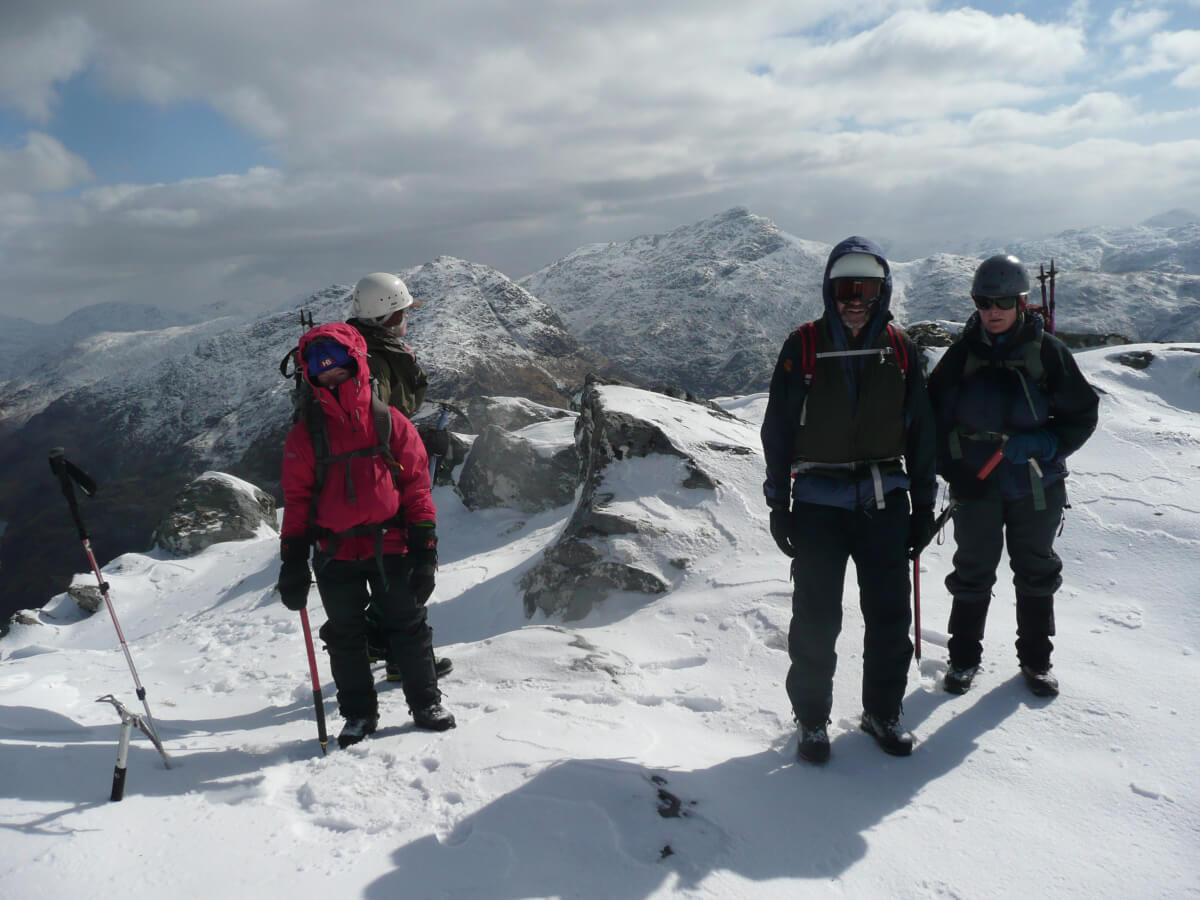
Up on a summit on the remote peninsula of Knoydart with no sign of habitation for miles around
Never underestimate the motivational power of a packed lunch.
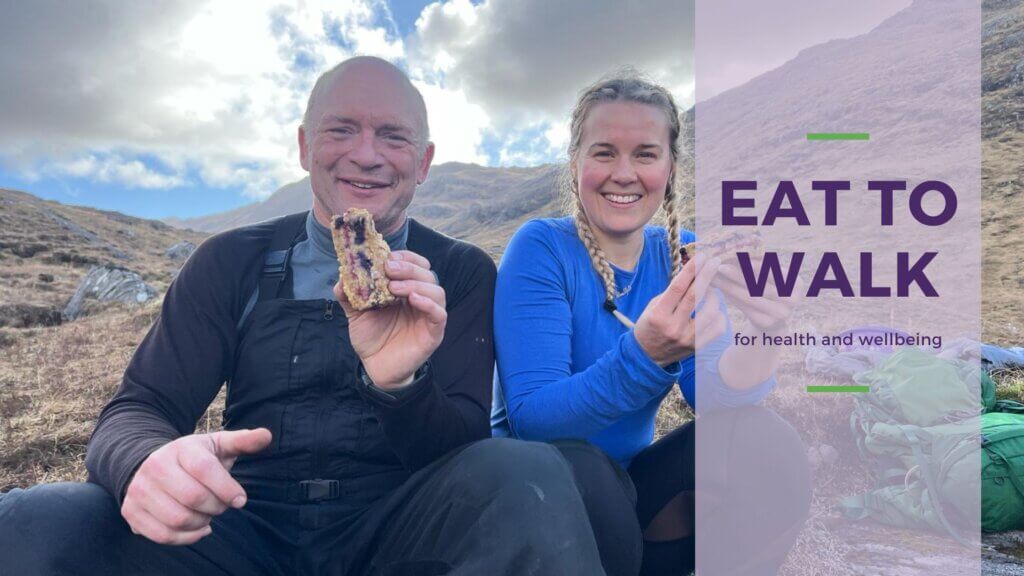
Everyone has their own favourites, but a well-timed treat can transform a tough stretch of path. On our trips, we like to keep things varied: home-baked goodies alongside trail mix and savoury snacks.
Guests often tell us that knowing there’s something special waiting in their lunch box makes the miles pass that bit more easily — whether it’s gingerbread, raspberry and pine-nut bars, or a classic vanilla streusel square.
Food tastes better outdoors. That’s just a fact.
Dinner is another powerful incentive — and one that sparks a surprising amount of speculation.
Sometimes we keep it a surprise; sometimes guests ask outright. Either way, there’s often a good deal of guessing on the walk back. More often than not, we manage to hit someone’s favourite during the course of the week, which is always deeply satisfying.
After a full day on the hill, the thought of a warm, well-cooked meal can be enough to carry you through the final climb.
It won’t surprise anyone that a fair number of our guests are highly motivated by the idea of a pub at the end of the day.
For some, it’s almost a mirage — that imagined first sip that gets you through the final, toughest section of the route. Amazing how much faster everyone walks when there’s time for a beer before dinner.
Andy is particularly good at highlighting walks that just happen to finish near one of his favourite watering holes.
Pure coincidence, of course.
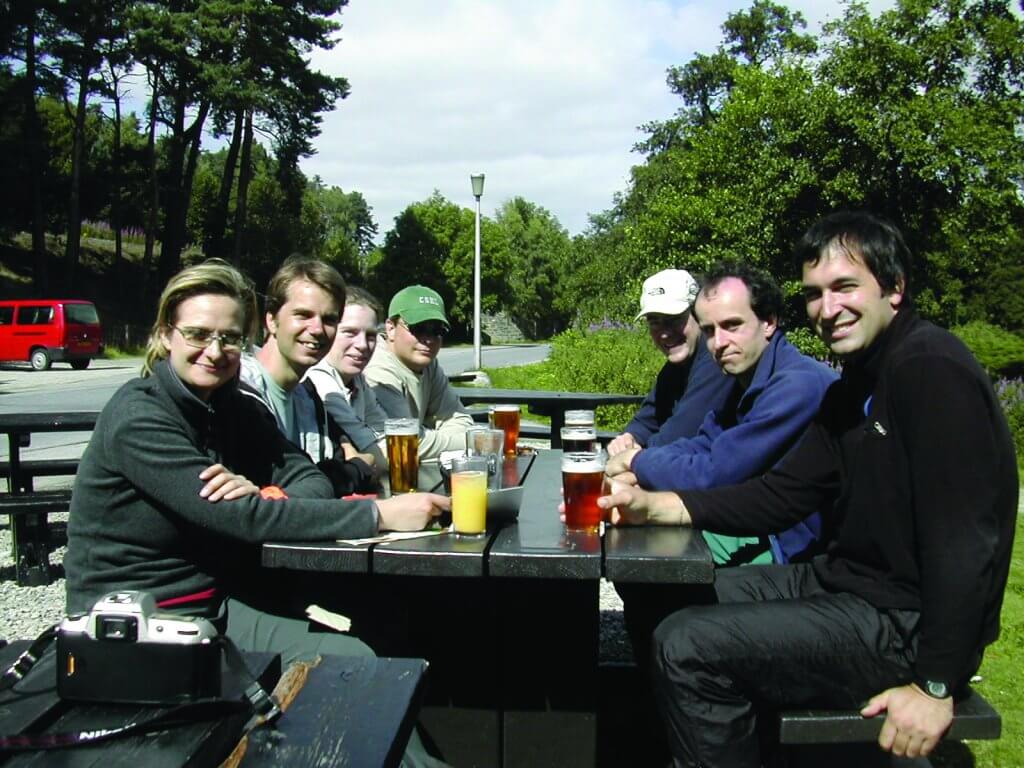
The best way of relaxing after a walk, no matter how hard or easy it may have been
Back indoors, the motivations become wonderfully basic:
A hot shower, especially after a long or wet day, is hard to beat. Some guests will happily skip tea and cake in favour of getting straight under the water.
An open fire turns tired legs into relaxed ones, especially after winter walks or blustery Highland days.
A proper pint of tea — how British are you?
Cake, always cake. One of the great joys of hiking is knowing you’ve earned it. Low-calorie options rarely feature on the request list.
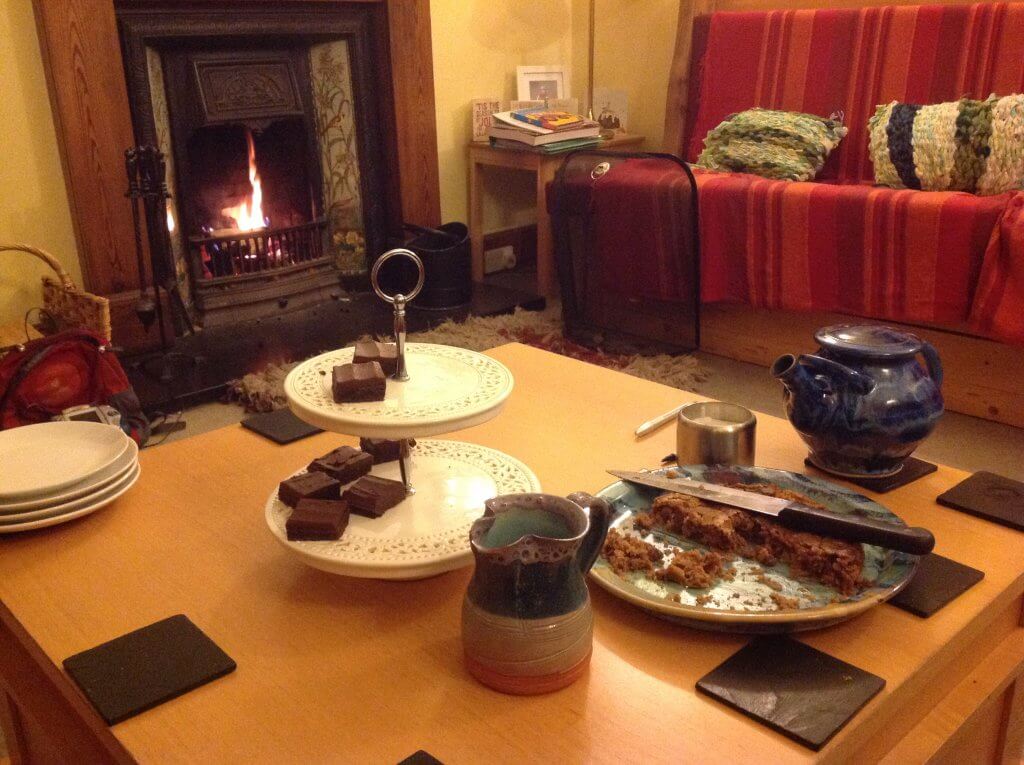
What’s striking is that nearly all these motivators boil down to the basics: food, warmth, shelter and rest.
Hiking strips life back to essentials. Out on the hill, the complicated becomes simple, priorities shift, and small comforts take on a new importance. It’s one of the reasons walking holidays are so restorative — they remind us how little we actually need to feel content.
If you’re dreaming of long days on the trail, good food, warm fires and welcoming places to rest at the end of it all, we offer a wide range of guided walking holidays and hiking vacations across the Cairngorms and the wider Highlands of Scotland.
We’d love to help you plan your next adventure — just get in touch for full details.
 Scot Mountain Holidays (Ltd),
Fraoch Lodge, Deshar Road,
Boat of Garten,
PH24 3BN
Scot Mountain Holidays (Ltd),
Fraoch Lodge, Deshar Road,
Boat of Garten,
PH24 3BN




All content © Copyright Scot Mountain Holidays 2026
Responsive web design by Summit Web Solutions
