








This website uses cookies to improve your experience. We\'ll assume you\'re ok with this, but you can opt-out if you wish. Read More
In case of sale of your personal information, you may opt out by using the link Do Not Sell My Personal Information
Deciding to book a winter skills course is a matter of safety in the hills. You definitely don’t want to be the one who’s on the wrong end of a call to mountain rescue. Most rescue callouts stem from navigational error, but not being prepared for the wild conditions can be a contributing factor. The Cairngorms offer some of the most consistent full-on winter conditions for the aspiring winter walker. Learning here under the expert tutelage of experienced, qualified guides is an experience which will stand you in good stead for the rest of your life.
Andy Bateman of Scot Mountain Holidays gives you some of his experience as a result of 20 years of coaching winter skills and navigation in the Cairngorms.
As the first snows arrive on the mountains many hang up their hiking boots. They wait until spring to go out again. Yet if you continue to head out throughout the winter, you could have some sensational days out. Cold air holds less moisture so on a clear day the views go in forever, the horizon crystal clear. The wonderful Jack Frost creation that is rime ice marks the air flow aroundevery stone and boulder. This is all the result of freezing hill fog on the wind. Older lying snow is scoured by the wind to produce the wonderful flutings. These are called Sustrugi. All these natural sculptures interplay with the soft light of a winters day.
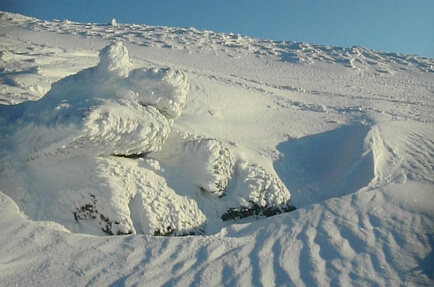
All kinds of natural sculptures appear in the hills during winter
Photo caption & credit: The snow turns the Cairngorm plateau into a place of beauty (taken by Andy Bateman, Scot Mountain Holidays)
Of course this environment isn’t without its hazards. It is no place for the ill prepared. Once trained in the essential winter skills there’s a very special sense of privilege. This comes from being able to exist confidently and comfortably in this hostile yet pristine and beautiful winter wonderland.
The conditions on the British mountains in winter are often as varied as the weather that’s created them. You need a good variety of skills at your disposal. Your winter boot is just as much a tool as your axe or crampons. It needs to be of adequate stiffness. On steep snow and ice covered ground good footwork is the watchword. Your approach should be from the perspective of prevention rather than cure. You should try step kicking and cutting or crampon techniques before resoring to the techniques of self-belay and self-arrest.
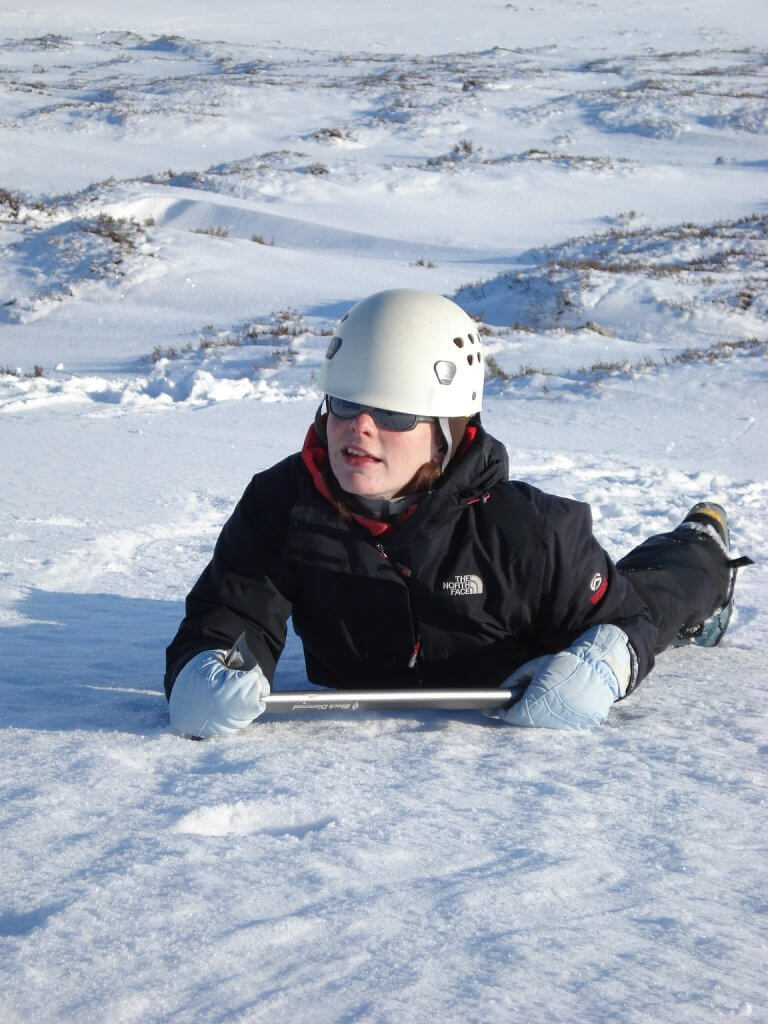
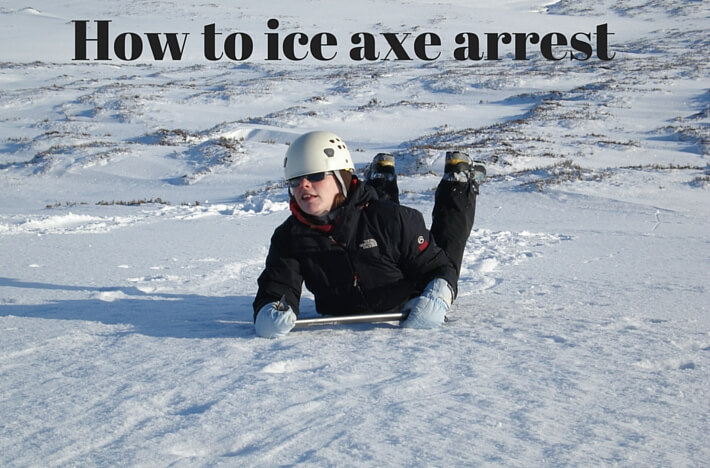
Self-arresting on a winter skills course in the Cairngorms
Photo caption: Practising winter skills in the Cairngorms – the classic feet first on your front self-arrest (5 day winter skills course with Scot Mountain Holidays)
Knowing though, that when all else fails, you can confidently and quickly stop a sliding fall, with or without an axe is a fantastic fillet to your confidence. Some of the self-arrest techniques are straight forward enough but others are not; sliding head first on your back is a case in point. Understanding the body position that is required for the forces of gravity to work in your favour is all important; in one fluent move you flip you’re yourself onto your front whilst swinging your legs beneath you – easy when the dynamics and body posture have been clearly explained.
For many the step up in navigation standard that’s demanded by the winter mountains is often the biggest challenge of all. Here the right approach is crucial and accuracy comes in a number of forms and levels. Being totally reliant on the absolute accuracy in your compass bearings and dead reckoning techniques (timing and pacing) has been the unravelling of many an aspiring Mountain Leader. In the often flat light conditions of winter, contour interpretation becomes even more imperative yet perceived poor visibility encourages folk to abandon this vital skill.
Many good mountain navigation techniques come in under the heading of “error management”. Some of these techniques will be familiar to the experienced: aiming off, collection features and attach points but these are just a few of the techniques that can be used to make life easier in the winter mountains. Good winter navigation skills could be the difference between stay on safe ground and straying onto that that is prone to a slide.
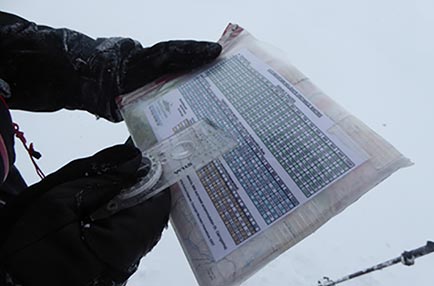
Highly skilled micro-navigation in practice
Photo Caption: Winter micro-navigation using Andy’s patented timing and pacing chart (winter navigation course with Scot Mountain Holidays)
Evaluating Avalanche hazard is another subject difficult to get a handle on. There are though pertinent points that, when borne in mind at the planning stage, can already be starting to reduce your chances of ever being caught in an avalanche. Yes, you could start avalanche hazard evaluation in the summer months long before the snow has arrived! It is of course though, an ongoing process of monitoring right through to the end of the trip and not least of which is viewing and understanding the avalanche forecast.
If you would like to discuss any of the points Andy raises in his article, please don’t hesitate to call him on 01479 831 331
Remember that Andy’s experience has been gained over 17 years of living and working in the Cairngorms. He aims to give you as much knowledge as he can while you’re here but it’s only in practicing the skills he introduces that you’ll gain proficiency yourself.
Which winter boots to choose for winter skills and winter hiking?
How to choose a walking ice axe for a winter skills course?
Why go walking in winter in Scotland?
How do I prepare for a winter skills course?
There are several factors to consider when choosing an ice axe.
There are 2 reasons why you might need to buy an ice axe:
Your reason will define the type of axe you are looking for
How do you know if the axe you are looking at is designed for walking or climbing? Traditionally, one of the defining features is the length of the shaft.
The traditional method of choosing a walking ice axe
The traditional mantra: hold the axe by the head with the shaft pointing downwards. The point should be about 2 inches (5cm) from the ground.
Andy’s tip: I never really warmed to this line of thinking. After many years experience as a winter skills instructor, it quickly became apparent to me that this method was outdated.
A walking axe is very much a multi purpose tool with the user asking it to perform a whole number of tasks in a single outing. Some tasks may well be better served by having a longer shaft whilst others are not. It is therefore going to boil down to a bit of a compromise but I would suggest the shaft length for a walking axe should be no longer than 55 cm.
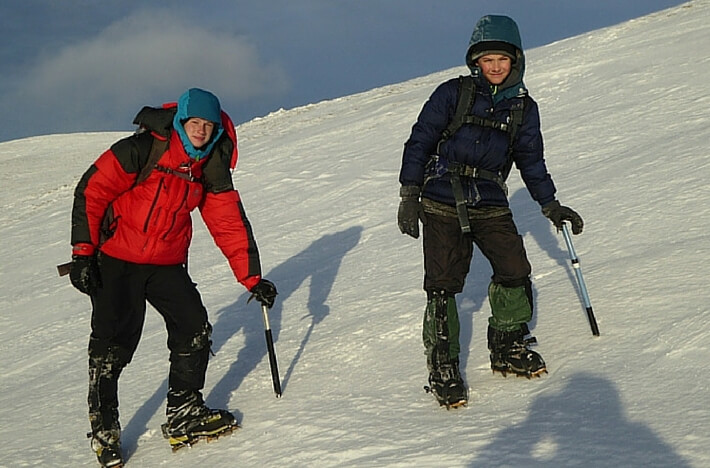
Techniques where a shaft length of over 55 cm is advantageous:
Techniques where a shaft length of 55 cm and under is advantageous:
I’ve found an axe with a long shaft is often ungainly to swing
Andrew Bateman
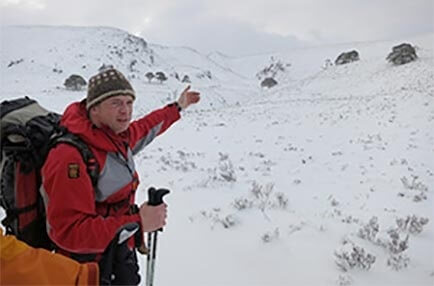
When you’re thinking about visiting the Pyrenees or the Alps or even the Andes, it would be a good idea before you go to give yourself a bit of a safety head start by learning basic safe movement in winter conditions – try a 2 day winter skills trip.
If you’re going on a guided trip a 2 Day winter skills course should give you enough skills to be safe with your instructor who will take care of the navigation and group management for you.
However you’d like to be more independent in the hills you may want to consider the full 5 day Winter Skills and Navigation course. You’ll learn how to deal with “whiteout” conditions as well as technical safety skills so that you can remain calm no matter what nature throws at you.
For more tips please check out our: Top 10 tips for winter skills or consider why you should want to book a winter skills course
For further guided walking holiday options try our main home page
Walking is one of the best forms of exercise being gentle, easy and free. It’s something everyone can do, and extremely beneficial to your wellbeing. So, it’s no wonder masses of people are beginning to introduce walking to their daily lives. But to keep the habit up it’s important to ensure you’re not letting your walking become a chore. So to avoid this, try these easy steps to turn a walk into an adventure.
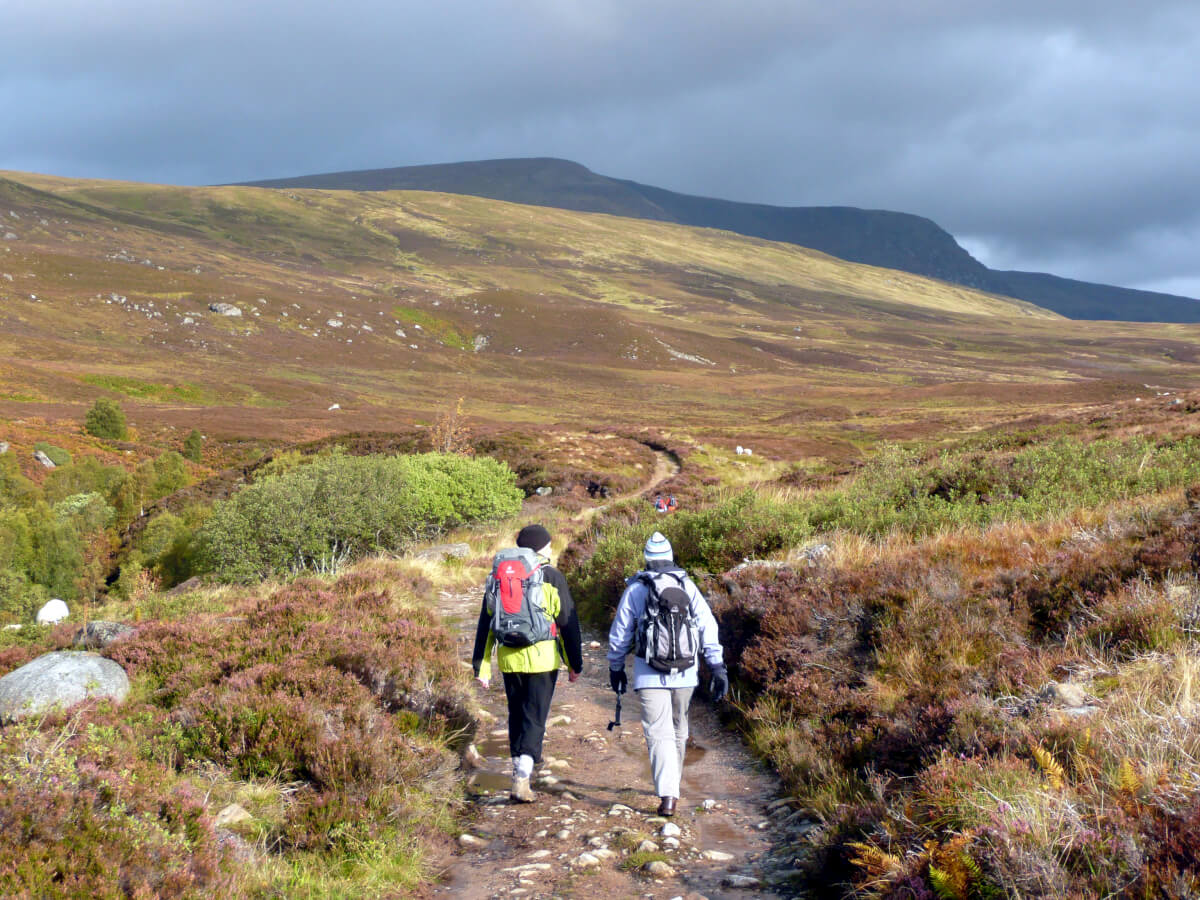
Walking has been proven to assist you in maintaining a healthy weight, prevent or manage various conditions including heart disease and high blood pressure and additionally, it strengthens your bones and muscles. Not only this, but it’s extremely positive to your mental wellbeing. And, it’s a great excuse to take some time for yourself.
Firstly, it’s time to get off the beaten path. Head away from the pavement and hit the trails. The Cairngorm National Park is full of gorgeous forest, river and mountain walking so you’re rich for choice.
Once you’re away from the roads, and traffic of the world, take some time away from technology. Leave your phone at home, turn the music off and appreciate the beauty of nature. This will not only be a refreshing break and an opportunity for you to restart. But, you will find yourself so much more connected to nature, and you’re much more likely to spot wildlife and fauna. This will add a level of appreciation, and excitement to your walks.
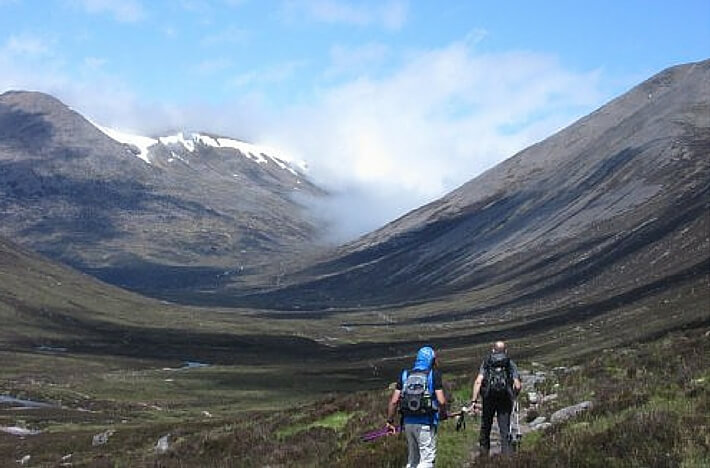
This goes hand in hand with switching off. If you have some sense of direction, try to avoid planning out your route prior to your walk. Follow your instinct, keep things fresh and go somewhere new each day. Making a split second decision at each fork you come to, will add a sense of exhilaration to your walking adventures.
These three easy to do steps will be just the thing to turn your walking into memorable adventures.
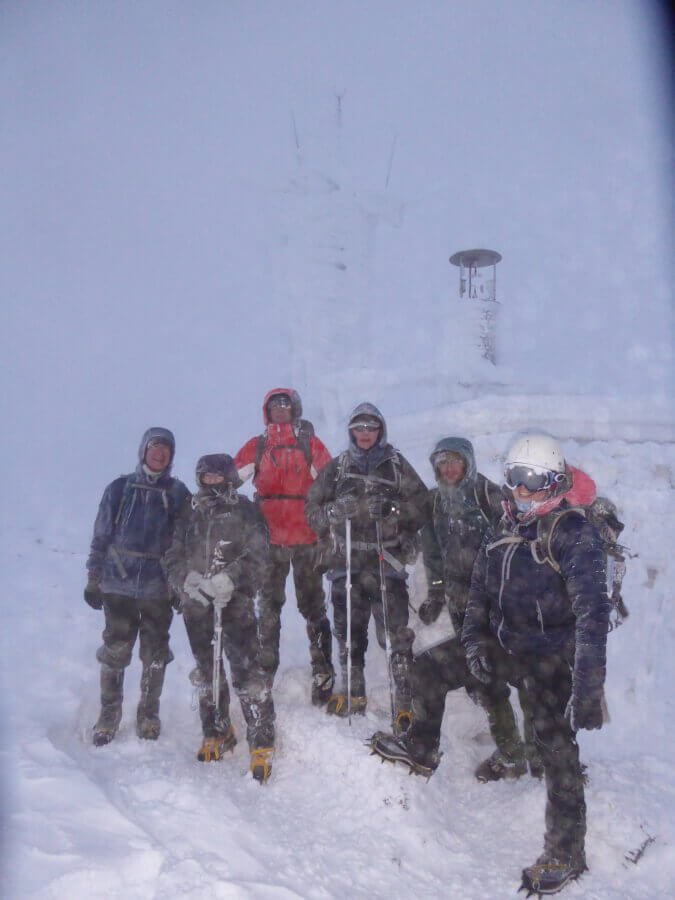
What a week of Guided winter walking in Scotland – almost 4 seasons in one week! From full whiteout blizzard to stunning views for miles from the summit of Braeriach, enhanced by a broken spectre with 2 silhouettes in the middle.
From conditions like this:
To glorious views like this:
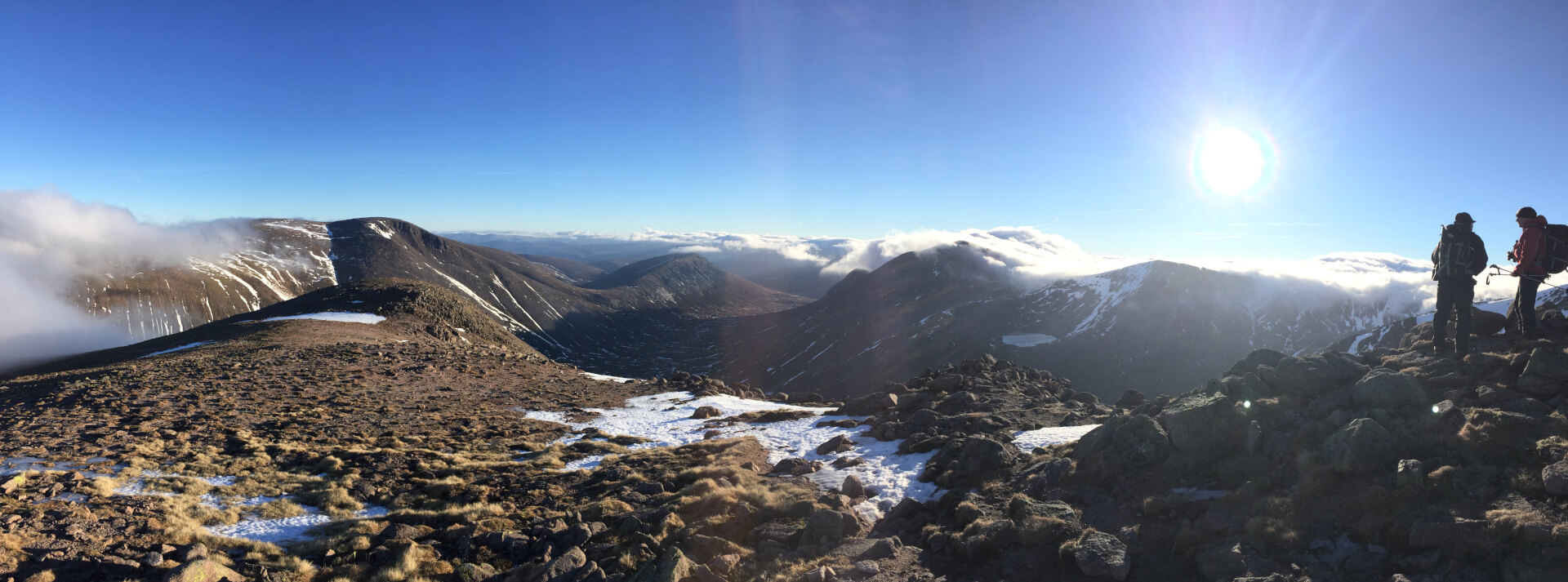
The weekend at the beginning of the trip offered the worst of the weather, but unfortunately if you have to get back to work … maybe next time those who couldn’t stay on will be treated to views similar to those from Braeriach at the end of the week.
“Thank you again for a very enjoyable week. Andy’s knowledge of the mountains and of the geology, flora and fauna, together with the welcoming and homely atmosphere and Rebecca’s cooking makes for a great combination”
These are just a selection of some of the points which have made the week so memorable and will hopefully serve as talking points when everyone gets home.
Group:
included
– a diverse group of individuals (including one couple) united by a common interest.
We saw a vole and it didn’t just pop out and disappear; it stayed and snuffled around searching for food. We have a really good view of it.
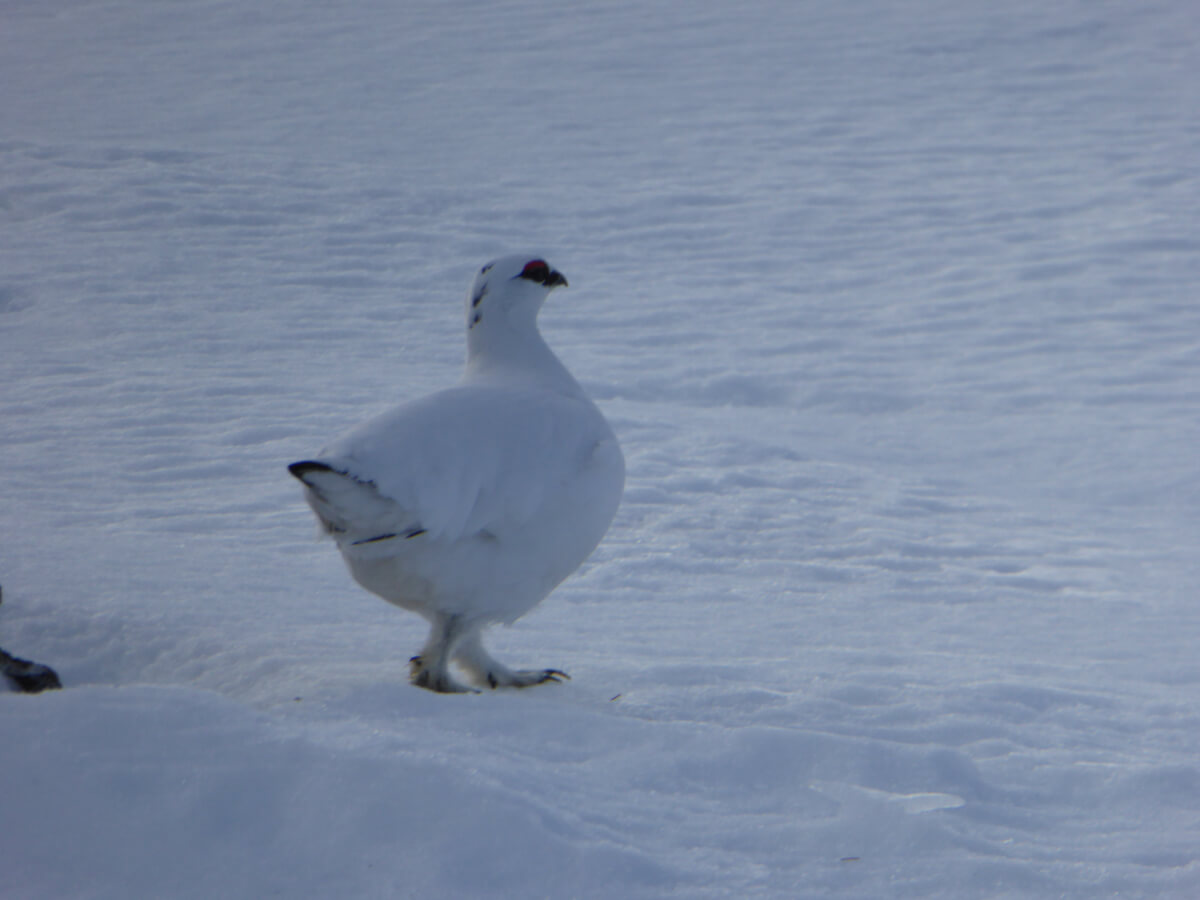
Sightings of ptarmigan became quite common place as the week went on. The first was exciting but by the end of the week, we’d had at least 5 sightings. Ptarmigan sightings were exciting for one of our guests whose young grandson (under 10 years old) is a keen birdwatcher, so it was something he could share with him.
We spotted golden eagle and mountain hare in the white winter plumage.
Many a hiker would love to be treated to a broken spectre. It adds a certain “je ne sais quoi” to the day and provides a talking point. Everyone wanted to see the pics (and it certainly proved popular on our social media.
https://www.instagram.com/p/BPhU-QVhzFg/?taken-by=scotmountainholidays
Panoramic photos courtesy of Claire Grogan
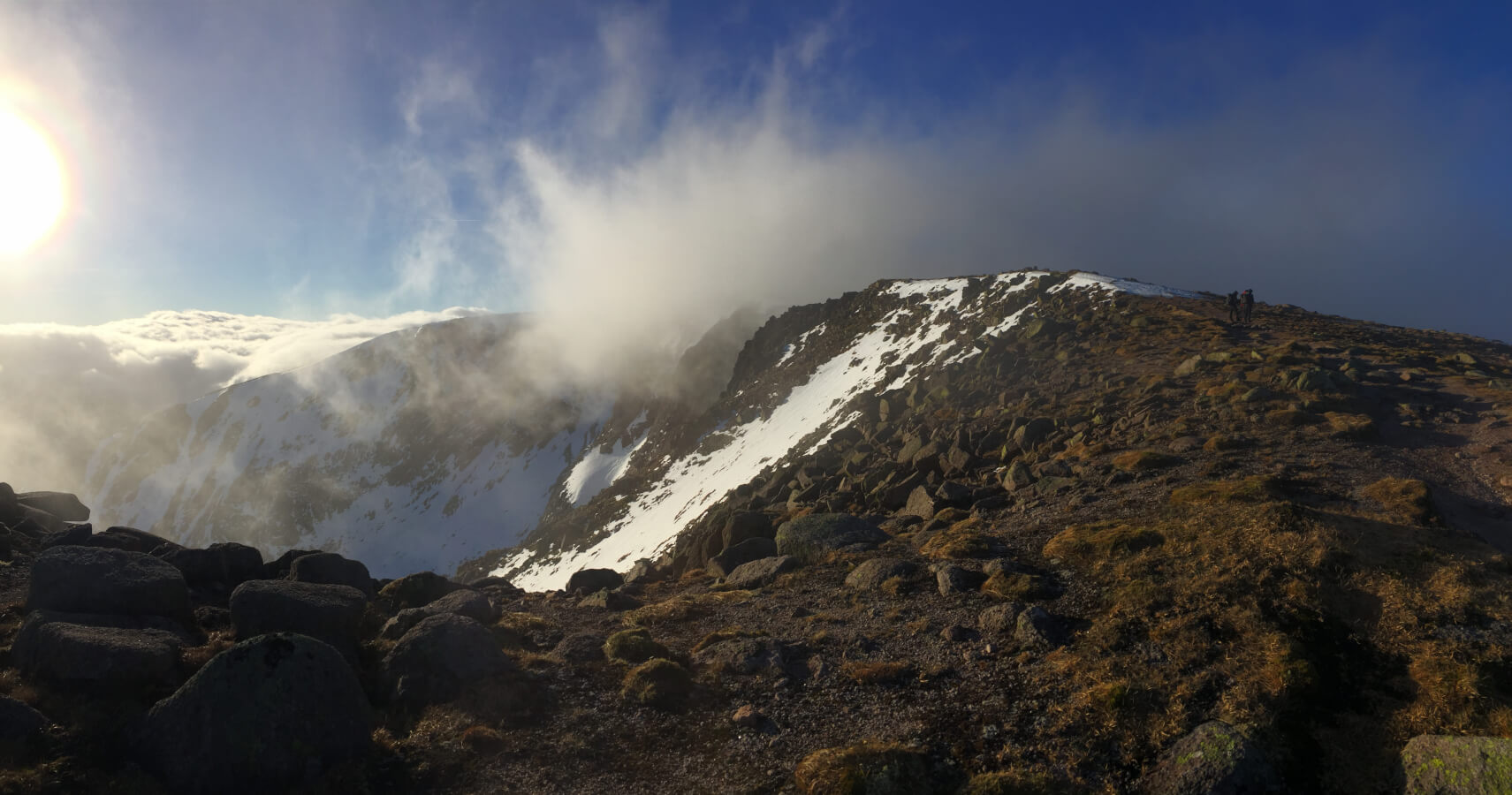
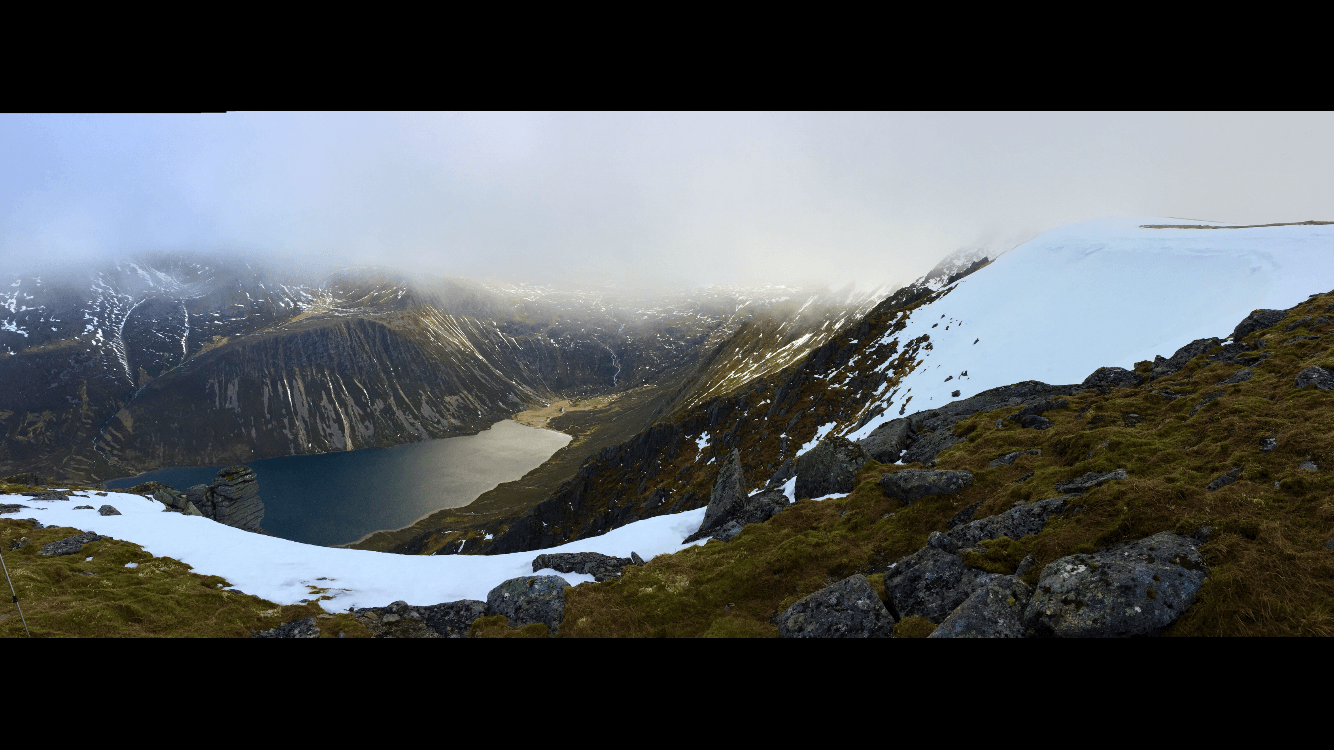
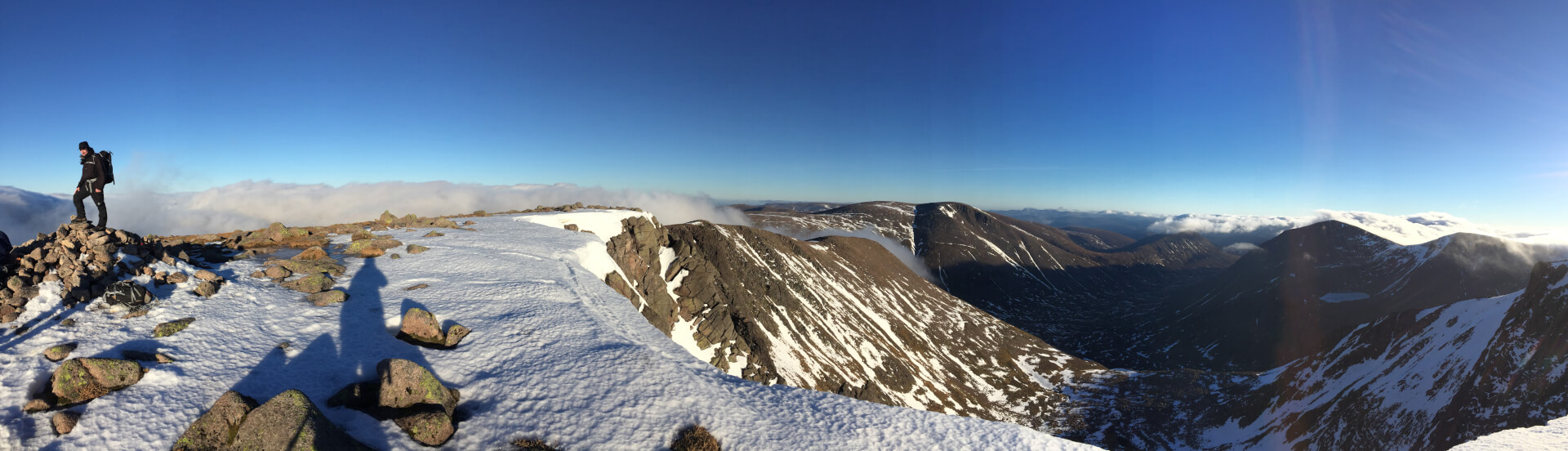
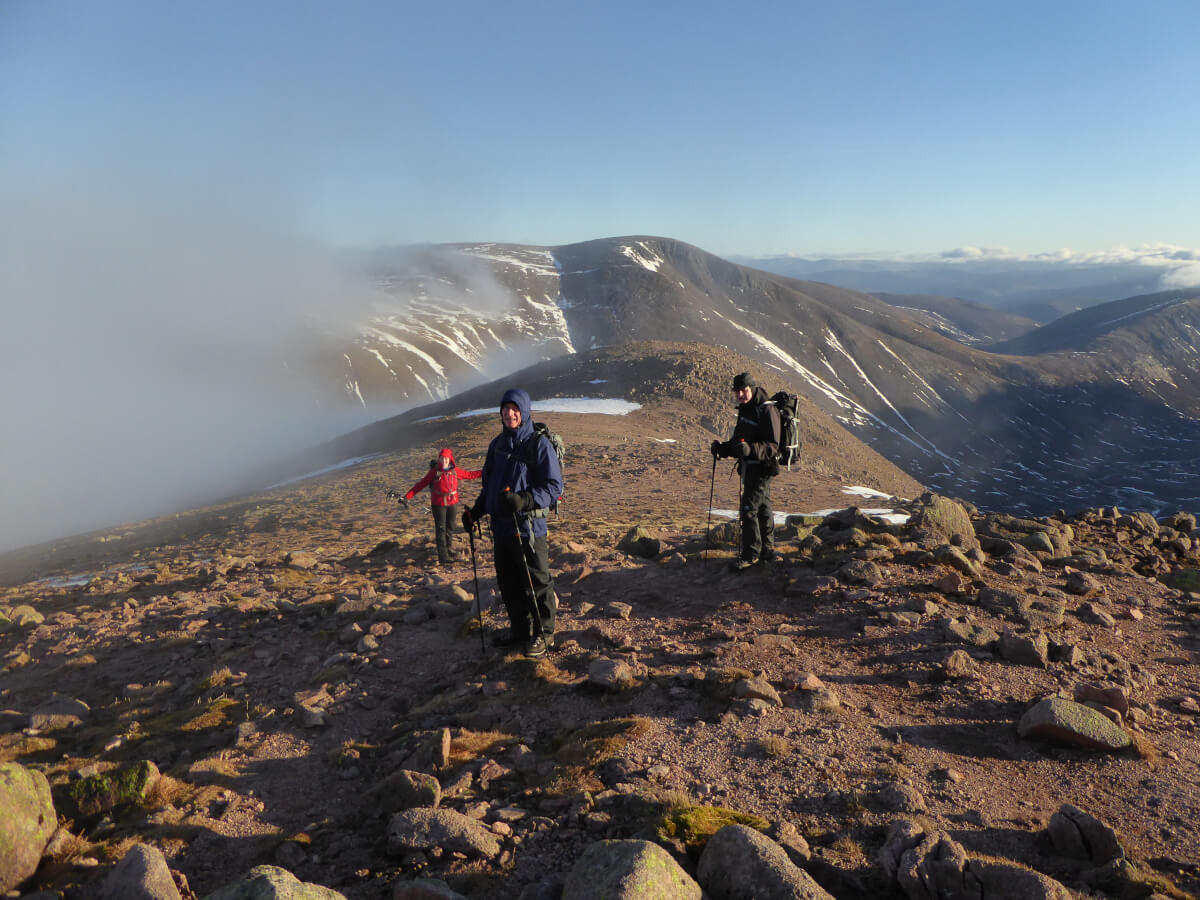
Check out our Facebook album for a fuller collection of the photos taken during our trip.
Lentil loaf – a great vegetarian recipe to have up your sleeve for parties/dinners with friends.
Other food: Recipes going live shortly:
Beetroot brownies
Banana and fruit loaf pudding
Grasmere gingerbread
Raspberry and pine nut bars
Tear and share tomato and cheese bread
A great group who enjoyed the variety of walking options during the week and did perhaps feel that they accomplished more in the week than they would have done without Andy’s guidance.
Winter is a time where people retreat inside and exercise unfortunately takes a backseat. Well not at Scot Mountain Holidays! With the gorgeous Scottish countryside transformed into a winter wonderland, the cooler season becomes one of our favourite. Winter walking also has many benefits. These include, staying active, clear winter views and a sense of accomplishment. So for winter walkers old and new; here are our top tips for winter walking.
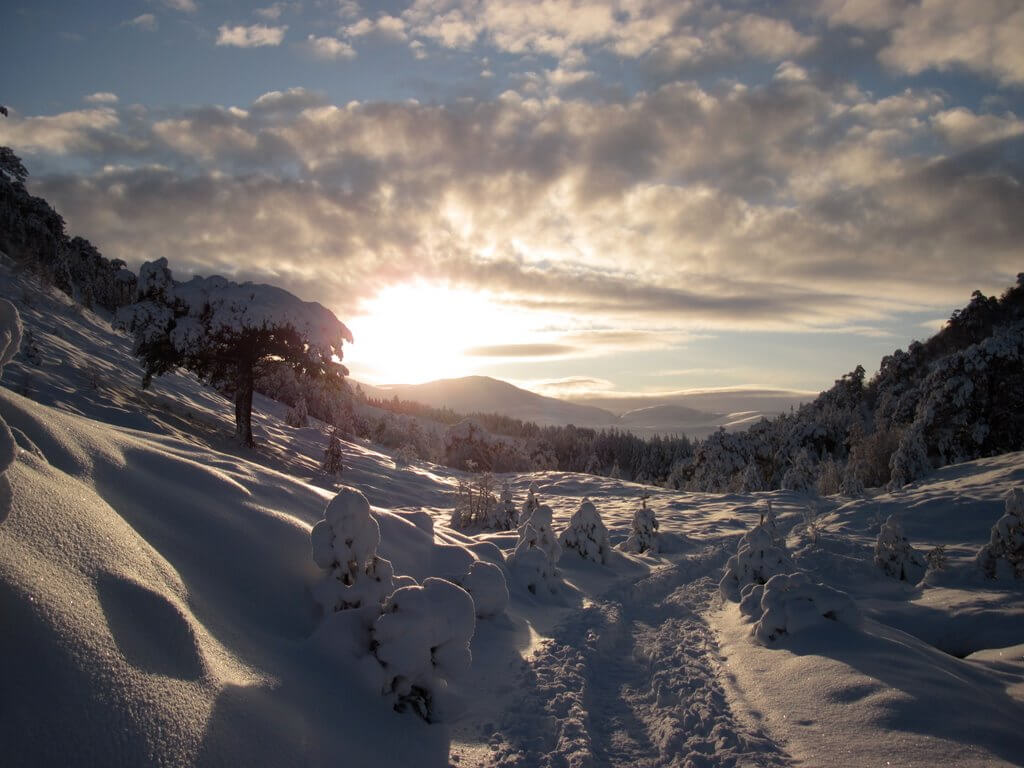
It makes sense that one of the most important things to consider for winter walking is your own comfort. Layering up is a great way to stay warm, and allows easy accessibility to avoid overheating. Avoid materials that will stick to your skin if wet and go for Thermals, fleeces and waterproof jackets.
Getting the right gear for winter walking is vital. Waterproof trousers and jackets are a must have to compete with the mist and snow you might experience. Goggles are a great idea for your face protection along with a buff. And of course, remember to protect your extremities with gloves and a warm hat. However, arguably the most important is boots. Invest in a good pair of hiking boots that have grip and ankle support. Keep in mind that boots, and gear is available for hire through Scot Mountain Holidays, so don’t despair if you don’t have everything you need.
Before heading out ensure you have a big warm breakfast of something substantial. This will keep you’re energy levels up, warm you up and be the right move in starting your day right.
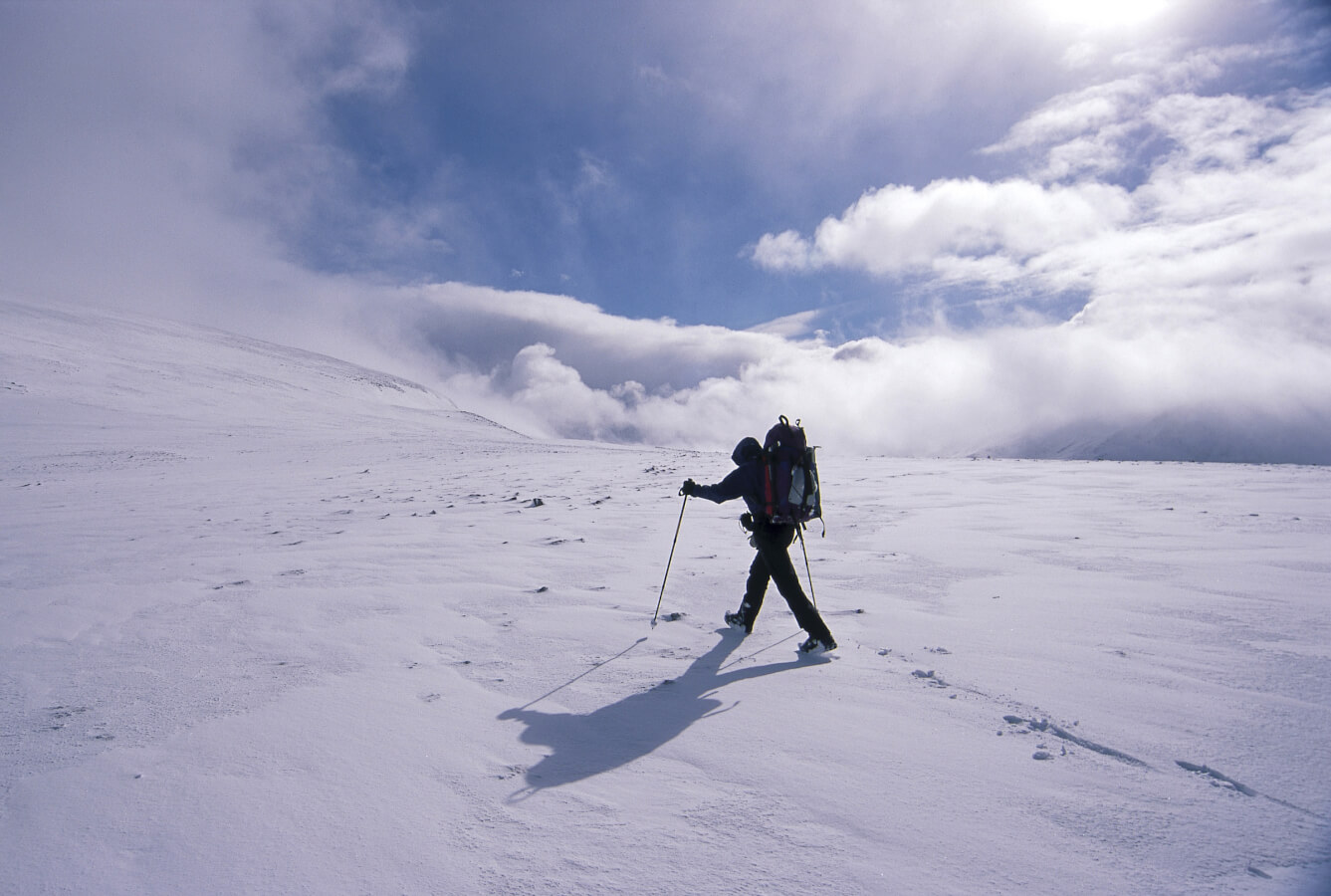
Whether you’re on a guided walking tour with Scot Mountain Holidays or a self guided tour, staying active in the elements is very important. Although you may be tired, remember hyperthermia can set in if you are stationary for too long. So keep your breaks to a maximum of ten minutes, and try to nibble on something every time you stop.
We know that keeping your fluids up in winter is harder than in summer. But, it is by no means less important. When winter walking it’s important to stay hydrated. So similar to eating, remember to hydrate every time you stop and keep your bottle somewhere warm to avoid freezing.
Winter has well and truly hit Scotland and now’s the time to join Scot Mountain Holidays on a winter walking tour. Our top tips for winter walking is just the thing to get you active and reap the rewards this winter.
With September now behind us and autumn storms bearing down, summer days are now a distant memory. Daylight is shortening and snow showers are forecasted for the high summits. And although it might be a few weeks yet before the ground is cold enough for snow to settle. Now’s the time to consider what extra items you’ll be carrying in your rucksack to hike through Scotland’s Autumn Mountains.
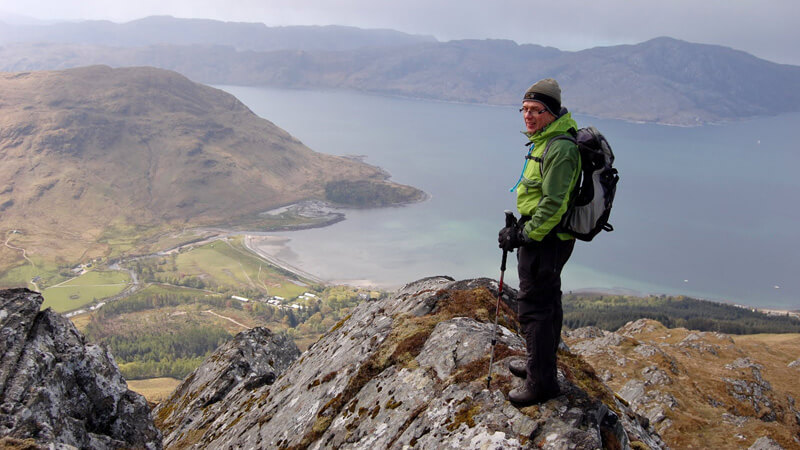
1. Headtorch
If you haven’t been carrying one up until now, now’s the time. Firstly, make sure the batteries are fresh and you’re carrying spares. What might appear as batteries with plenty of charge in a warm environment can quickly diminish in the cold of the mountains. Navigating in dark hill fog you’re bound to be using a head-torch on the highest beam. You’ll find this drains your power very quickly.
If your torch isn’t very powerful it may be worth thinking about upgrading. Don’t underestimate how much difference a quality torch can make to your journey when having to navigate. Your fingers will also thank you, as there is nothing worse then trying to change batteries and dealing with gloves in bad conditions.
2. Ski Goggles
There is now the chance of precipitation in the solid form on the wind both on fine and not so fine days. Remember, the wind doesn’t have to be too strong for drifting to occur. Do not underestimate how unpleasant it can be walking into the wind when snow, hail or spin-drifts are hitting you directly in the face.
Ski goggles are something you don’t want to skimp on either. Being able to see properly is of vital importance so make sure you get a decent pair of anti-fog (double lens) goggles. In a damp mountain climate you’ll find cheaper goggles will quickly fog up if they aren’t the right spec. A decent pair will also keep your face so much warmer in the biting Highland cold.
3. A warm hat
A warmer hat than you might carry in summer is both common sense, and of vital importance. We recommend one that pulls down over the ears!
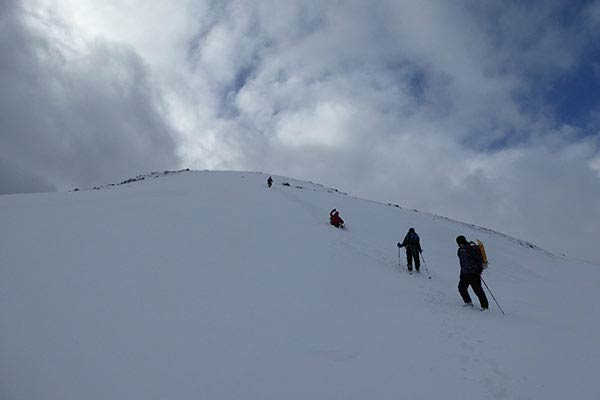
4. Warmer Gloves
If you have ever suffered from the pain of hot aches you’ll know investing in a pair of really warm gloves is a must-make purchase. A pair of light liners inside thicker gloves works well as there is a play-off between warmth and dexterity. Don’t fall into the trap of thinking you can get the best of both worlds with just one pair of gloves.
Gloves of adequate warmth for the coldest of Scottish winter days won’t have much dexterity left. So, it’s a case of whipping your hands out for fiddly activities and then putting them back into those cosy mitts. The liners also help to keep the gloves hygienic, making the task of cleaning your gloves so much easier.
5. An extra warm layer
Carry an extra warm layer for when you are immobile. By far the best way of keeping warm is to keep active but there will be times when you have to stop. Even a relatively short break of just ten minutes can mean you chill significantly.
In our damp and often cold and windy mountain environment, hypothermia is often an ever-present threat. But donning an extra thick fleece or even better, an overlay jacket will save you from the threat of a chill.
6. Get you navigational gear organised
This can pay handsome dividends and will mean less time hanging around immobile getting cold and more time on the move keeping warm.
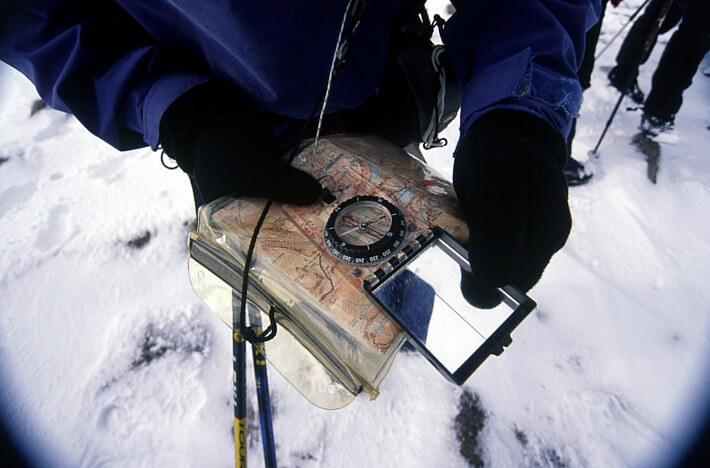
Navigational judgment can start to be one of the first casualties of being cold, so it’s important to have a map case. It not only protects the map but it also is a means you can anchor the map to yourself. Make sure you have a compass with a decent sized base plate…
More on this in a later blog!

In February we ran a snow hole expedition, the second of the year, in the Cairngorms.
The group was small but unusual.
Ian – our most frequent flier on the snow hole. This was his third snow hole trip. Ian first joined us in 2006 to attempt an overnight snow hole in the Cairngorms National park. The weather was against them on that trip and they had to turn back without reaching the snow hole site. The ski area wasn’t open and though the group attempted to ascend the hill they eventually had to turn back after being blown around a wee bit too much. There is video footage from their endeavours which makes for interesting viewing just to see the effect of nature, if nothing else. Ian returned again in 2007 with 90% of his group to try again – successfully
Andy – our oldest client to date on this trip – a celebration of his imminent 70th birthday.
Hui – our first guest from Singapore. A lone female traveller spending a few months in the UK on a sabbatical from her studies.
Read all about their experience in Andy’s words:

Late last year whilst at David Lloyd’s (gym), I said to my friend, Ian Thorpe, an experienced walker and climber, that I fancied carrying out some serious winter walking, but not climbing. Ian replied “Let me take you to the Cairngorms National Park, Scotland.” This was duly arranged by ian and off we set on 21st February at 10am, arriving at Fraoch Lodge in Boat of Garten, in the Cairngorms, at 16.15.
Rebecca, Andy and wee Gregor made us extremely welcome; dinner was baked salmon with a rich and wonderful sauce, followed by home made trifle containing shortbread and blackcurrants, wonderful.
Next morning, along with fellow trekker, Hui, a lady lone traveller from Singapore, we were fitted out with ice axe, crampons & helmets prior to spending our first day on the mountains practising ice axe arrest. This was a daunting experience for some one who has never even worn crampons let alone walked on ice.
Later that day we walked till late on Lurcher’s Crag and the Chalamain Gap, looking towards Corrie an Lochain, before returning to Fraoch Lodge for another wonderful dinner, having first stocked up on copious bottles of red and white wine from the local Tesco.
On Saturday 23rd February after a hearty breakfast at 7.30, we set off for the snow hole day. We arrived at Aviemore ski resort and walked in. At about 2pm we were ready to dig our snow hole. Andrew marked out 2 doorways on the ice covered mountain side. (We were about 3000ft up by now.) These door holes, roughly about 12ft apart, were then dug into using ice saws and snow shoverls. It took 2 hours to create a vertical face, then we had to further excavate in for about 5ft prior to turning inwards to join the 2 ends of the snow hole. This was particularly backbreaking work for Hui, thank God we had clear blue skies and sunshine. After about 4 more hours, the hole was completed. My feet were so cold I could hardly feel them.
Having put all our gear, including cooking utensils inside, Andrew started the evening meal. We had hot tea, followed by carrot and coriander soup, then a buckwheat and chorizo casserole. Dinner commenced about 10.30pm! Ouside the temperature was approx -9oC; inside however was relatively comfortable.

Stunning views from the “window” of your overnight accommodation deep in the heart of the Cairngorms
Next morning we woke up to a complete whiteout. My fear was how do we navigate to the summit of Cairngorm Mountain? Andrew explained that we take a direct compass bearing but because I was finding the walk hard he explained that provided we walked clearly up and around the pudding shaped mountain, we would by definition reach the summit and incidentally GB’s highest automatic weather station. After approx. 600m of ascent we duly found the summit at 1245m.
Roughly 4 hours later, we had descended back to the ski lodge. It was particularly hard going with Hui hanging on the to back of Ian’s rucksack most of the way. We had the pleasure of seeing a Ptarmigan and 2 white hares.
Overall a fabulour experience which I will not be repeating, but one to tick off. Andrew’s knowledge of the terrain, geology, weather conditions, and navigation skills were par excellence.
Having successfully returned to Fraoch Lodge, we were treated once again to an excellent farewell dinner. Many thanks Ian, Andrew and Rebecca for a memorable trip which i will not forget for a long time.
Andrew Palliser
PS My 70th Birthday on March 12th 2013 – what a perferct birthday treat to myself!
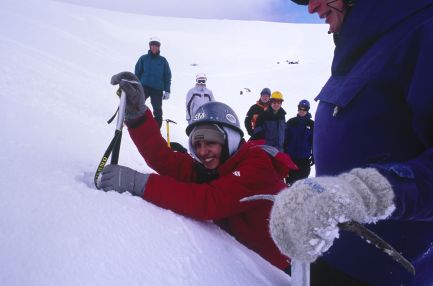
Many gear shops will automatically sell you a leash as an essential and permanent accompaniment to your ice axe. Here we look at the pro’s and con’s of having a leash on your walking/general mountaineering axe. We discuss when and where it is appropriate to use one.
There is at least one recorded instance where loosing grip of the axe during a sliding fall resulted in head injuries due to the axe flailing uncontrollably at the end of a leash. Rather than relying on a leash to retain possession of your axe, the emphasis is on instilling the mental capacity of not letting go. The hand holding the head of the axe can pivot around the head but the grasp should remain the same. It’s also about developing that mental ability of properly securing your axe should you need to put it down.
Except when cutting steps down slope, you should always carry the axe in the up hill hand. On a zig-zag ascent or descent, the axe is repeatedly swapped from one hand to the other to maintain it in the uphill hand. Having to swap the leash from one wrist at every turn is cumbersome and time consuming. Wrapping the leash around the head of the axe isn’t a secure solution either. There is the risk it can start to dangle with resultant hazard of a crampon point catching and causing a trip.

Photo caption: cutting steps in the Cairngorms on a winter skills course with Scot Mountain Holidays
This is where a leash is desirable especially if you are cutting into hard snow or ice. Wet gloves, cutting the steps too vigorously, etc can all increase the chance of loosing grasp and this is where a leash comes into its own.
For winter hill walking, a leash should be minimalist, light weight and quickly attached and detached from the head of the axe. The simplest way is to make a loop in the attachment end of the leash. Thread the loop though the hole in the head of the axe. The other end of the leash is then threaded through the loop (Larks footed) and pulled tight. Store the leash in an easily accessible place like a jacket pocket and attached to the head of the axe when required.
Have fun in the snow: http://www.wikihow.com/Have-Fun-in-the-Snow
Snow related activities for kids: http://www.parents.com/fun/activities/outdoor/snow-activities-kids/#page=7
Family fun in the snow: http://powertochange.com/family/snow/
Free mountain weather service: Mountain Weather Information Service
Met Office forecast for the hills: Met Office Mountain Forecast
Scottish Avalanche Information service: Scottish Avalanche Information Service
How to ice axe arrest: https://scotmountainholidays.com/blog/skills-how-ice-axe-arrest/
Best practice: how to build a snow hole in Scotland: https://scotmountainholidays.com/blog/best-practice-building-snow-hole-scotland/
How not to get lost – the art of navigation: https://scotmountainholidays.com/blog/hiking-how-not-get-lost-art-navigation/
Top 10 winter skills tips (for Scotland): https://scotmountainholidays.com/blog/top-10-winter-skills-tips/
How to prepare for a mountain challenge: https://scotmountainholidays.com/blog/classic-ridges-and-horseshoes-hiking-tips/
Which boots to choose for winter: https://scotmountainholidays.com/blog/which-boots-choose-winter-walking/
How to choose a walking ice axe: https://scotmountainholidays.com/blog/how-choose-walking-ice-axe/
How to predict snow: https://scotmountainholidays.com/blog/how-predict-snow-uk/
EXPEDITIONS FROM SCOT MOUNTAIN HOLIDAYS: https://scotmountainholidays.com/activities/mountain-challenges/
SKILLS COURSES FROM SCOT MOUNTAIN HOLIDAYS: https://scotmountainholidays.com/activities/mountain-skills-courses/
WINTER WALKING HOLIDAYS FROM SCOT MOUNTAIN HOLIDAYS: https://scotmountainholidays.com/activities/walking-holidays-uk/
Words of wisdom from the Met Office and the BMC.
Our instructors:
Andy Bateman, our company director, is the main guide for Scot Mountain Holidays. He is a qualified winter mountain leader with 15 years experience instructing in the Cairngorms. He says there is nothing like local knowledge for being aware of the avalanche hotspots and how to avoid them. He keeps a very close eye on the weather from this time of year (November) until winter passes towards the end of April and is out on the snowpack so frequently that he has almost as good an eye for predicting the avalanche weaknesses as the SAIS team.
We also work with experienced mountain instructors who deliver mountaineering and climbing courses for us. The instructors live in the area and have in many cases instructed for the RAF outdoor centres when they were based in Grantown on Spey. All instructors who work for us have a wealth of local knowledge.
Winter courses offered by Scot Mountain Holidays
It is essential if you are planning to go out in the hills on your own or even with a small group of friends that you should all have had some formal training in personal safety skills so you know how to use your crampons & ice axe effectively and have all the gear necessary. Navigation is perhaps the least valued of these skills, but arguably the most valuable. We also offer training in winter navigation techniques.
Winter holidays offered by Scot Mountain Holidays (including expeditions)
If you would like to get out in the winter but are not confident of managing on your own, you might want to join an organised group. Take a look at our dates and see if we have anything which will suit your commitments.
USEFUL LINKS
Mountain Weather Information Service
Scottish Avalanche Information Service
A taster of winter skills, but the only way to really learn how to ice axe arrest is to do it yourself under the guidance of a winter mountain leader or other qualified instructor. Imagine taking a tablet or smartphone out in the snow to try and teach yourself … pretty much a lost cause at the end of the day and you’d be terrified of smashing your technology to pieces. Bit the bullet and book a course.
We found this video on YouTube, produced by the MCofS. Here Roger Wild introduces ice axe arrest and explains the basics which you’d learn on the hill with Andy (lead instructor with Scot Mountain Holidays). If you’re comtemplating a winter skills weekend, bear in mind that this is one of the core skills you’ll be learning, which many people have heard about before they book a skills weekend; however, as Roger Wild says: there’s a lot more to the full range of skills to keep you safe in winter and you should consider ice axe arrest to be the last in a series of skills aimed at preventing a sliding fall.
Check out our Top Ten Winter Skills tips: https://scotmountainholidays.com/blog/top-10-winter-skills-tips/
 Scot Mountain Holidays (Ltd),
Fraoch Lodge, Deshar Road,
Boat of Garten,
PH24 3BN
Scot Mountain Holidays (Ltd),
Fraoch Lodge, Deshar Road,
Boat of Garten,
PH24 3BN




All content © Copyright Scot Mountain Holidays 2026
Responsive web design by Summit Web Solutions
