








This website uses cookies to improve your experience. We\'ll assume you\'re ok with this, but you can opt-out if you wish. Read More
In case of sale of your personal information, you may opt out by using the link Do Not Sell My Personal Information
The Cairngorms are special. Anyone who has walked through ancient Caledonian pines; been lucky enough to spot a golden eagle, a capercaillie, a crested tit or a red squirrel; discovered our wild larder; or admired the stunning open views of peaks stretching as far as the eye can see definitely appreciate this. At Scot Mountain Holidays, we feel a deep responsibility to protect these landscapes—not only for today’s walkers, but for the generations who will follow.
Caring for the land isn’t a slogan we pin to the wall; it’s woven into everything we do, from how we run Fraoch Lodge to how we guide you on the hill. Here’s a look at the practical steps behind our “walk gently” ethos, and how these choices make your time here richer and more meaningful.
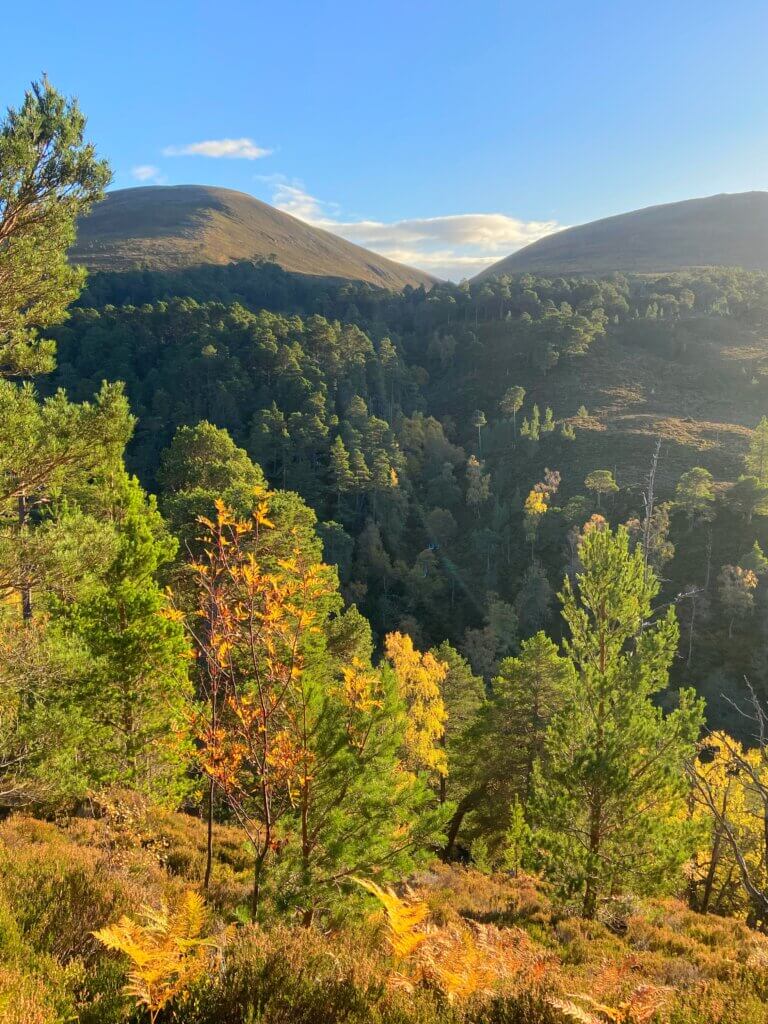
We strive to keep our footprint as light as possible. At Fraoch Lodge, composting, recycling, and smart menu planning ensure we minimise food waste. Purchasing in bulk, consciously choosing products with reduced packaging, and reusing wherever possible also helps us keep our waste stream small.
When we take the business mobile (on our trips to other regions in the Highlands, we take our composting ability with us as we’ve invested in a food waste recycler which dries, grinds and compacts all our food waste to be used in our home garden when we return).
These aren’t grand gestures—they’re simple, thoughtful routines that collectively make a big difference over the course of a busy walking season.
Food is a big part of the Scot Mountain Holidays experience. Sourcing locally isn’t just good for the planet: it supports small farms, reduces food miles, and brings the freshest possible produce to the table.
Depending on the season, you might enjoy berries from nearby growers, meats from Highland producers, herbs from our garden, and homemade breads or preserves. Many guests tell us that meals at Fraoch Lodge become some of their standout memories—and the taste of place is a major reason why.
We invest in local meat producers like Lynbreck Croft and the Cairngorms Connect partnership. Their meat boxes will sell out in under 10 minutes there’s such a demand for good quality, wild meat which has not been medicated.

Spiced beef stuffed lettuce leaves
Our guiding philosophy is rooted in respect for the landscape. We choose routes to avoid erosion, guide groups at sizes that minimise impact, and adapt plans when we know a certain area needs a rest or is particularly sensitive during breeding seasons. We work as closely as we can with the RSPB and local estates to make sure we are working to achieve the same targets for the environment.
By moving with awareness, we can enjoy the wildness without contributing to its wear.
Many visitors are already nature-first in their thinking, but Scotland’s landscapes—especially the Cairngorms—have their own particular sensitivities. We believe education enhances the outdoor experience, so we always take time to share knowledge that helps you walk more mindfully.
We encourage walkers to use established paths where they exist, helping reduce erosion and protect surrounding vegetation. When paths don’t exist, we guide you on durable terrain—gravel, rock, short grass—so fragile mosses and heather aren’t trampled.
Our guests often come hoping to spot red squirrels, ptarmigan, mountain hare, or the elusive capercaillie. We support those opportunities while emphasising the importance of giving animals space, particularly during nesting or winter stress periods.
Even small acts—like pausing quietly instead of approaching for a better photo—help keep wildlife wild.
From carrying out litter (including the tiny bits) to responsible toileting in remote areas, we share practical Leave No Trace guidance throughout our trips. These habits not only protect the land, they help ensure the next walker feels the same sense of wonder you did.
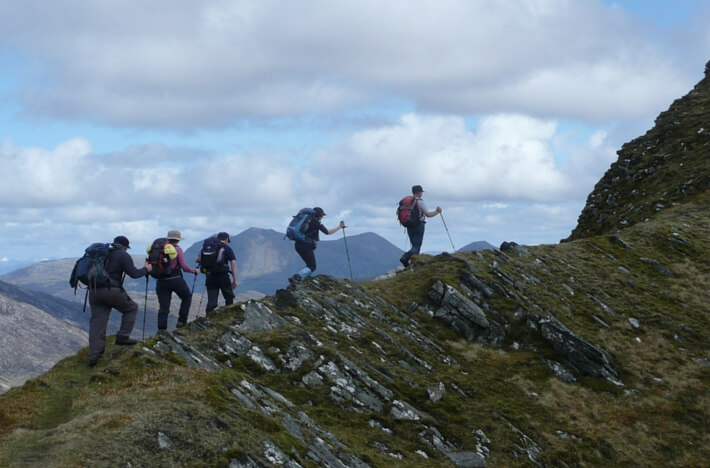
Guided walking in Knoydart
Caring for the Cairngorms extends beyond land management—it’s about supporting the community that helps steward it.
We work closely with local producers, accommodation partners, artisan makers, guides, and activity providers. Whether it’s sourcing ingredients for dinner, collaborating on outdoor skills training, or recommending local shops, we aim to keep tourism income circulating within the region.
By choosing to holiday with us, you’re contributing directly to the resilience of small Highland businesses.
Protecting Scotland’s wild places isn’t just the right thing to do; it profoundly enriches the walking experience. When paths are healthy, wildlife thrives, and communities are supported, the landscape feels more alive—and your connection to it deepens.
Walking gently allows space for discovery: a rare plant, a quiet glen, the sudden sweep of views when the mist lifts. It ensures the magic remains intact for you, and for those who will walk these hills long after we’re gone.
At Scot Mountain Holidays, our hope is that you leave not just refreshed and inspired, but also more connected to the environment that hosted you. Together, step by gentle step, we can keep Scotland’s wild places truly wild.
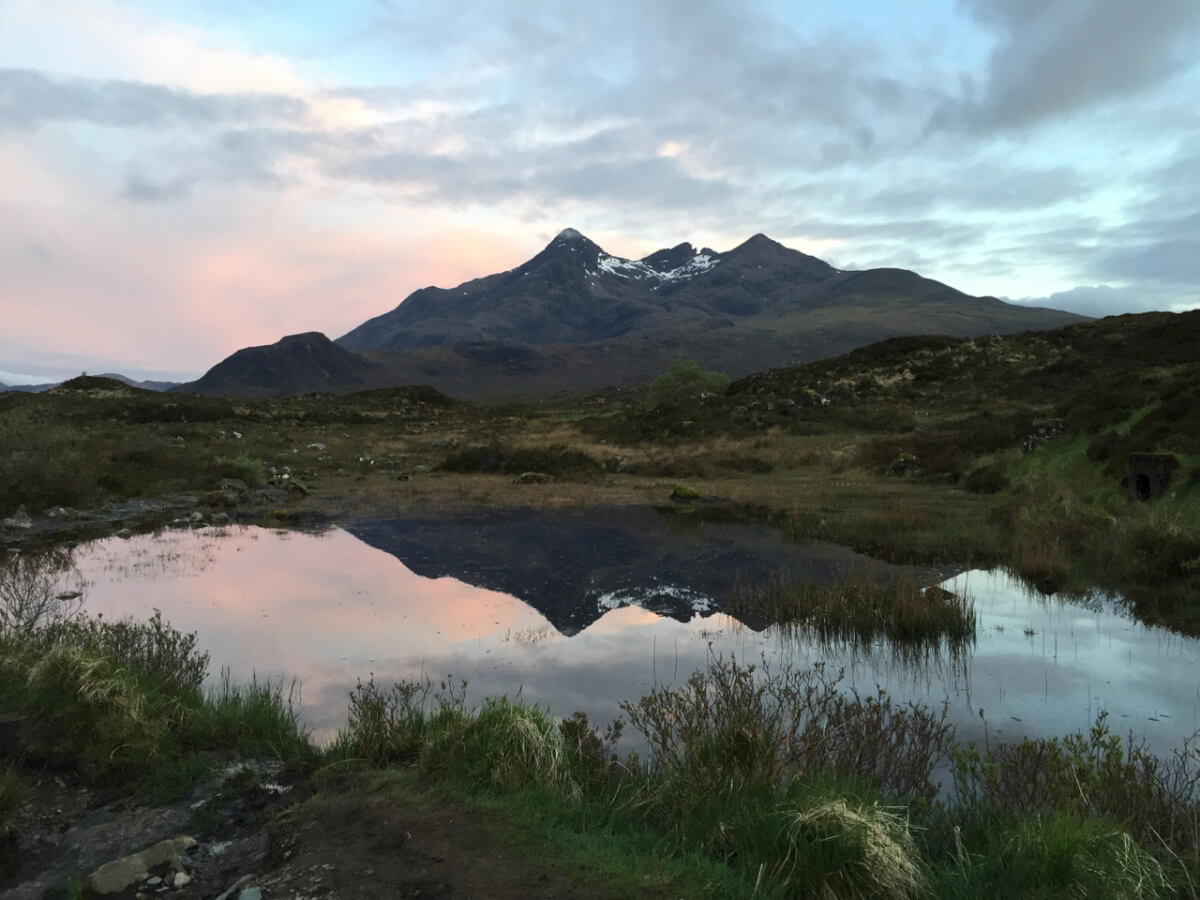
Winter in the Scottish Highlands offers some of the most extraordinary light of the year. With the sun hanging low in the sky and darkness arriving early, the season transforms the Cairngorms into a photographer’s dream — and a walker’s paradise for those who love quiet trails and dramatic skies.
In December, daylight in the Cairngorms lasts only about 6½ hours — roughly from 8:45 a.m. to 3:15 p.m. This low sun angle gives rise to long shadows and a beautifully soft light that seems to paint the hills in shades of gold, rose, and icy blue.
Because the sun never climbs higher than about 12° above the horizon (compared to over 50° in summer), even midday light has the warm, angled quality photographers call the “golden hour.”
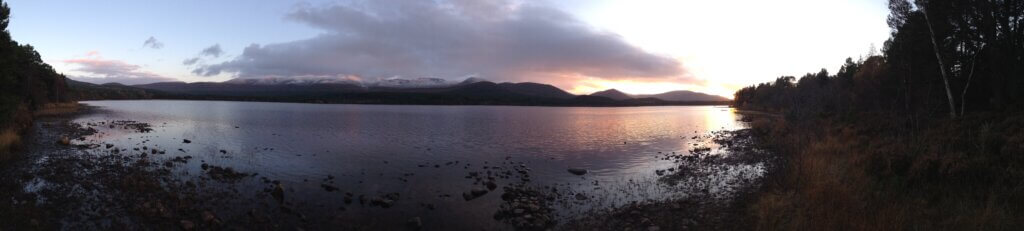
Best sunrise spots: Loch Morlich (for reflections of the Cairngorm plateau), Loch an Eilein (with its castle island framed by winter mist), and the summit of Meall a’ Bhuachaille (a short, rewarding climb near Glenmore).
Best sunset spots: The top of Craigellachie Nature Reserve above Aviemore, the shores of Loch Insh, or the moorlands around Dorback for open, west-facing views.

Sunset at Loch Morlich
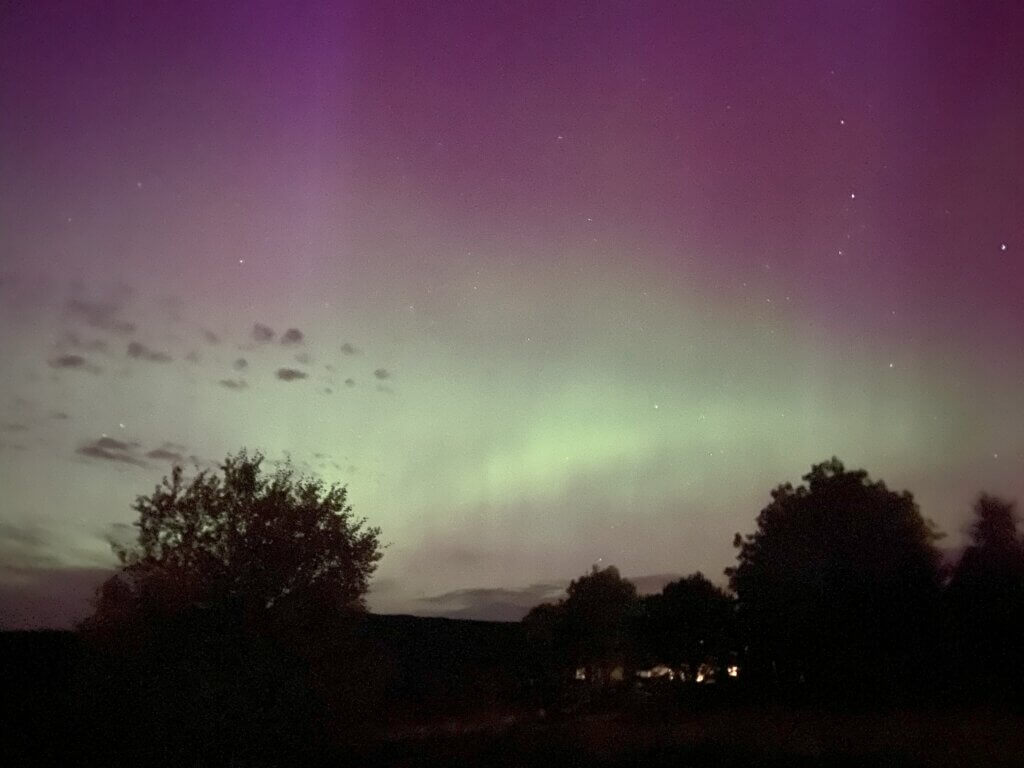
Once the sun dips below the horizon, the show continues overhead. The Cairngorms are part of a Dark Sky Park, one of the best stargazing areas in northern Europe. In winter, when skies are clearest, you can often see the Milky Way arching across the sky with the naked eye.
Best viewing months: November to February, when nights are longest and atmospheric moisture is lowest.
Where to go:
Loch Morlich Beach — wide open views with easy access from Glenmore.
Tomintoul & Glenlivet Dark Sky Park — designated observation areas with information panels and minimal light pollution.
Fraoch Lodge, Boat of Garten — step outside after dinner; on clear nights, Orion, Cassiopeia and the Pleiades are easily visible, and occasional aurora borealis displays can appear on the northern horizon.
The northern lights are never guaranteed, but Scotland averages around 15–20 aurora sightings per year visible from the Cairngorms area — particularly in late autumn and midwinter.
Use the low sun to your advantage. Light at this angle emphasises texture — perfect for snow-covered pines, frozen lochs, and moorland grasses.
Golden hours are longer. Around 45–60 minutes at sunrise and sunset, compared to 15–20 minutes in summer.
Bring a tripod. Light levels drop quickly; even phone cameras benefit from stability for sharp images.
Check the weather and apps. Use tools like Clear Outside for cloud cover forecasts and AuroraWatch UK for northern lights alerts.
Photographers love Loch Garten at first light and at the end of the day, where the mist often rises through Scots pines, and Ryvoan Bothy near An Lochan Uaine for its emerald water against pink skies.
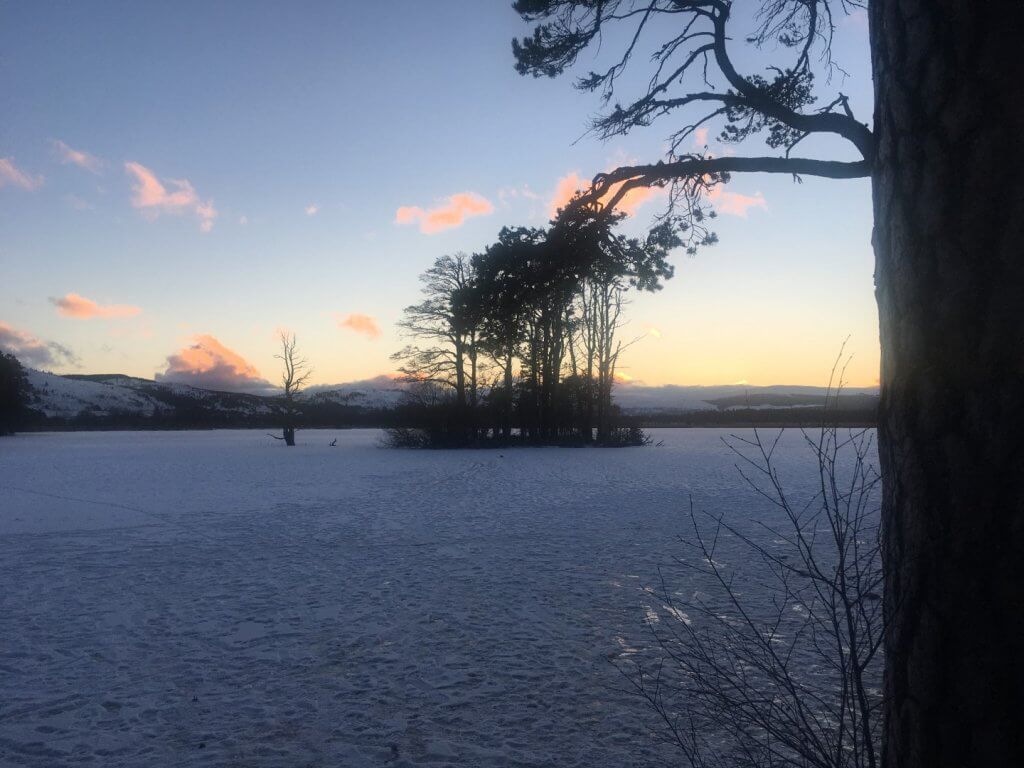
Lockdown winter explorations on Loch Mallachie, RSPB Loch Garten
Why Slower Winter Walking Rewards Careful Observation
Winter walking in the Highlands isn’t about ticking off peaks — it’s about immersion. Shorter days and variable conditions encourage slower, more mindful exploration. Temperatures often hover around –5°C to 5°C, and snow frequently transforms the hills from late November through March.
Guided winter walks with Scot Mountain Holidays focus on observation and safety — reading snow conditions, spotting wildlife tracks, and noticing how the light shifts through the glens. You might see:
Red deer grazing in the open,
Mountain hares in their white winter coats,
Or Ptarmigan blending into the snow near higher ridges.
Taking your time allows you to experience the landscape as it changes minute by minute — the sort of quiet beauty that photographs can’t fully capture.
Base yourself: Fraoch Lodge, Boat of Garten — ideal access to Glenmore, Rothiemurchus, and the Cairngorm plateau.
Don’t miss: Loch an Eilein at sunrise, the Cairngorm funicular for panoramic sunset views, and a starlit evening walk around Loch Garten.
Bring: Warm layers, insulated boots, and a thermos — plus a headtorch for those dusky afternoon descents.
Join Scot Mountain Holidays this winter for guided walks, photography-friendly itineraries, and cosy evenings by the fire. Discover how Scotland’s shortest days can offer its brightest moments.
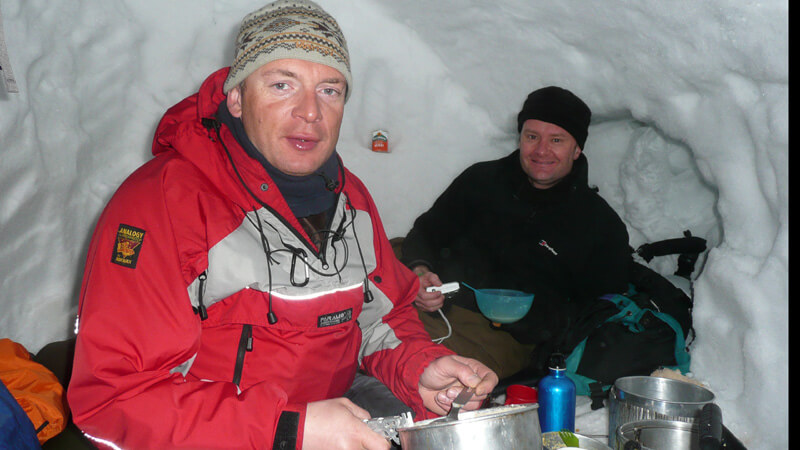
Snow-holing has a long and established tradition in Scotland’s winter mountains and in alpine and arctic regions worldwide. Vast amounts of snow still build up in sheltered lee areas on the high, wind-swept Cairngorm Plateau. Many snow-hole sites often hold snow into July, making this a sustainable winter mountaineering activity. However, as Andy Bateman* of Scot Mountain Holidays questions, it’s worth asking whether traditional snow-holing techniques remain appropriate for Scotland’s increasingly mild and variable winter climate. Do we stick with traditional and when it doesn’t work declare snow-holing “dangerous”, or do we prioritize safety and adapt?
Although the Scottish Highlands occasionally make headlines for extreme cold, mountain temperatures never reach true Arctic levels. Recorded lows of below –20°C occur in valley inversions, where cold air pools in glens while summits remain relatively warmer.
For example, Aviemore experiences a wider temperature range than the summit of Cairngorm, whose lowest recorded temperature is only –16.5°C (12 January 1987). By contrast, nearby Nethy Bridge reached an unofficial –31.3°C (10 January 1982)!
At around 1100 m — the typical altitude of many Cairngorm snow-hole sites — winter extremes tend to sit between –8°C and –10°C, with many days around –5°C or warmer. Scotland’s proximity to the North Atlantic Drift keeps conditions comparatively mild, yet still demanding enough to test even experienced snow-holers.
Traditional snow-hole design aims to capture warm air, using raised sleeping platforms, doorways lower than the living area, and cold air drains. Are these features appropriate when winter temperatures in Scotland approach the melting point of the very material providing shelter?
In conditions near 0°C, the focus should be on adequate ventilation to manage internal air temperature and maintain structural stability.
An important point to note is that it takes appreciable heat energy to convert snow at 0 deg C to water at 0 deg C. It means that whilst there may not be a rise in temperature, you may still be “injecting” appreciable heat energy into the snow pack around your snow-hole.
Snow-holing naturally occurs where snow collects deeply — often on steep slopes with the potential for avalanche release. Avalanche risk must therefore be the primary consideration when selecting a site.
If there is any uncertainty about snow-pack stability:
• Avoid slopes steeper than 30 degrees.
• Excavate horizontally from the top of the door at least 1.7 m for slopes of 30 degrees or less before widening the chamber to ensure a minimum 1 m-thick roof.
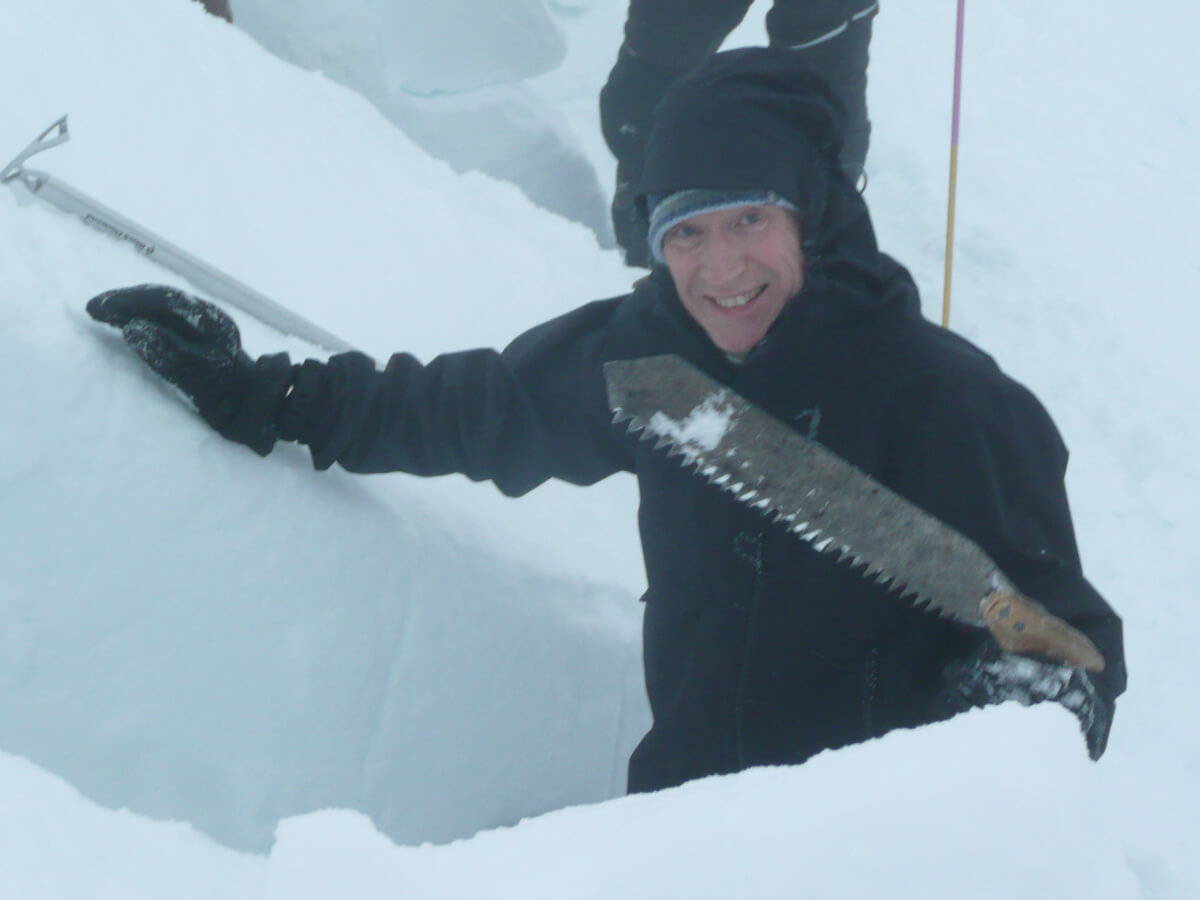
Scottish snow often becomes extremely hard after repeated cycles of wind, thaw, and refreeze, demanding robust equipment. Ensure you carry:
• A metal-bladed snow shovel – polycarbonate models are largely ineffective in dense, refrozen snow.
• A snow or “carpentry” saw capable of cutting blocks efficiently when snow is too hard to shovel. A number of dedicated snow saws falter when it comes to Scottish snow.
• A 3-metre avalanche probe to confirm adequate horizontal snow depth before excavation.
• A durable ground sheet or tarp for collecting and dragging excavated snow clear of the entrance.
The correct tools greatly improve both efficiency and safety, especially in hardened Scottish snow conditions.
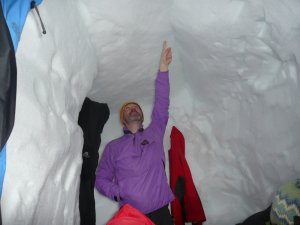
A snow-hole’s roof design is critical to both safety and durability. In Scottish conditions, attention to vault ceiling and load distribution is essential to minimize unsupported snow.
To achieve a stable structure:
• Keep the floor width to no more than two body widths (about 1.2 m) between the inner front and back walls.
• Excavate upward to form a steeply angled vaulted or apex ceiling, which removes large unsupported sections and promotes strength.
This design offers five major benefits:
1. Eliminates triangular sections of unsupported snow.
2. Prevents flat areas that become drip points.
3. Encourages melt water to drain with the snow pack.
4. Provides limited standing height without unnecessary excavation.
5. Directs warm air toward ventilation holes at the apex.
A properly shaped vaulted ceiling is the key to structural longevity. Reducing unsupported ceiling weight matters more than temperature alone. One snow-hole built by Andy Bateman on 25 March remained intact and safe when re-entered on 19 May after a prolonged thaw, with no roof deformation. Similarly, a BBC Travel Show snow-hole I built endured until late June; though its roof was only 30 cm above the floor, it never collapsed. Nearby structures that had become open hollows.
Roof thickness is equally important. When shaping the vault, avoid thinning the roof excessively — thicker is stronger.
• Minimum roof thickness: at least 1 m of snow overhead.
• Light test: blue light will penetrate up to 1m into the snow. If a pale blue glow is visible through the roof, it’s getting too thin.
• Front-wall strength: ensure the wall is no less than 1 m thick at its narrowest point to bear roof loads safely.
In Scottish snow-holing, roof geometry and thickness are the foundations of safety and endurance.
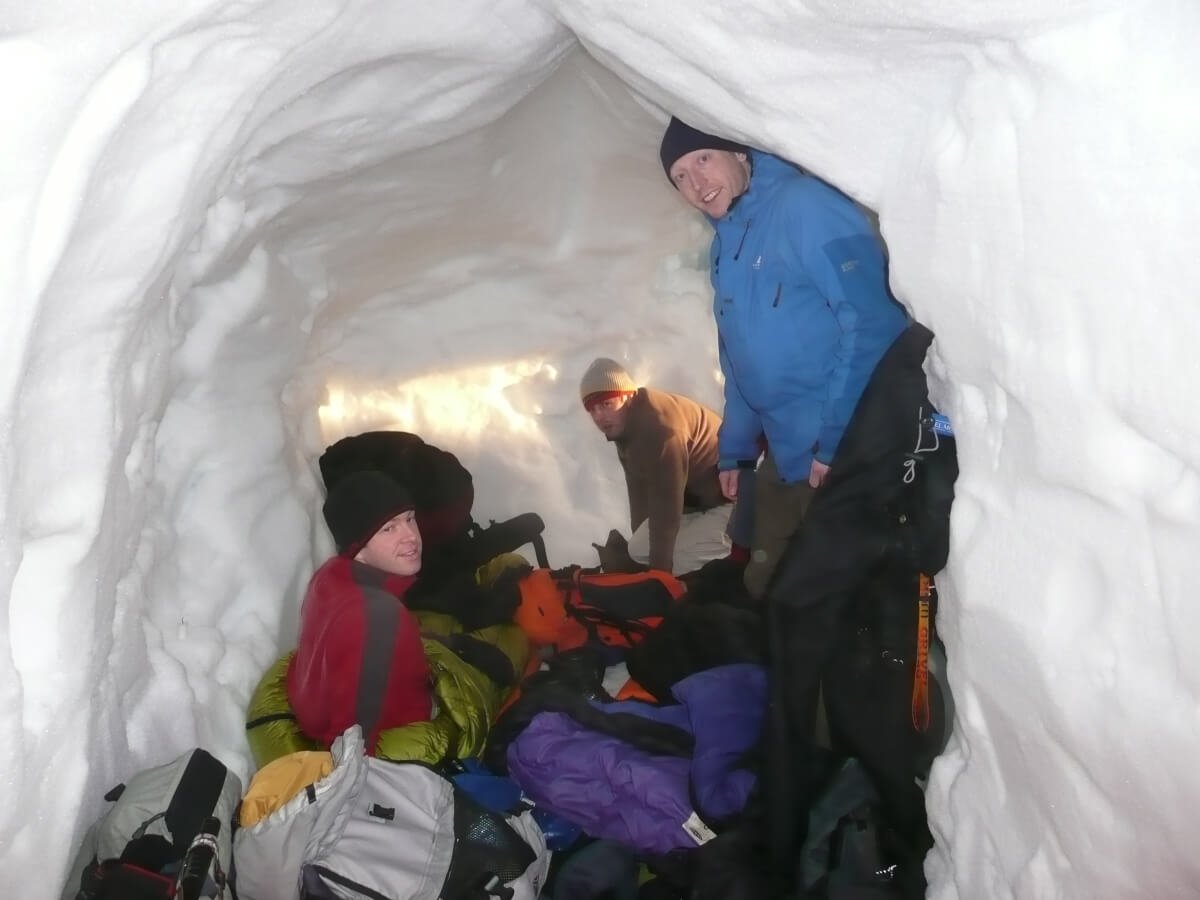
Effective ventilation is vital for safety in any snow-hole. Inadequate airflow when cooking, can lead to dangerous levels of carbon monoxide (CO) — a colourless, odourless gas produced by incomplete combustion.
All pressure stoves operate by first oxidising fuel to CO and then fully converting it to carbon dioxide (CO₂). Flame colour variations indicate this combustion process. When airflow is restricted, the secondary oxidation step fails, increasing CO production.
Simple ventilation test: exhale — if your breath drifts sideways, airflow is likely sufficient.
Even with good ventilation, a pan of icy water can quench the flame temperature, disrupting combustion and increasing CO output. Research by the British Antarctic Survey (BAS) found that raising pan supports slightly above the burner significantly reduced CO levels during snow melting. Snow-holers should understand the symptoms of CO poisoning, which can include headache, nausea, and dizziness.
While no recorded deaths from CO poisoning have occurred in Scottish snow-holes in recent years, some have reported headaches consistent with exposure. Carrying a small portable CO detector is strongly advised. Always extinguish candles before sleeping — they too emit small amounts of CO.
Key safety guidelines:
• Confirm adequate ventilation before lighting stoves.
• Be aware that even with airflow, cold pans increase CO output by cooling the flame.
• Add snow gradually when melting for water to prevent flame quenching.
• Use a compact CO detector for real-time monitoring.
Overnight snow drift can block entrances and reduce airflow. Studies indicate that with all flames extinguished, hypoxia is not a risk. Poor sleep quality will alert you to low oxygen levels, prompting you to reopen vents instinctively.
Maintaining clear ventilation routes and monitoring air quality are non-negotiable safety practices in winter snow-holing.
A larger snow-hole is safer. Not only are the ventilation characteristics better and but it also gives you space. One potential hazard of digging a small snow-hole is you don’t have enough room to put the snow after severe drifting. Do not underestimate how quickly the snow can drift into some of these snow-hole sites. 1 m per hour is not unusual. On one occasion I did have to tunnel out 1 ½ m before I hit the surface!
Many Scottish snow-hole sites are located near watercourses, and persistent snow cover slows natural decomposition. Managing human waste responsibly is essential to avoid contamination and maintain site sustainability.
Best practices:
• Use a carry-out system for all human waste.
• Participate in local initiatives such as Cairngorm Mountain’s Snow White Project, which supports sustainable snow-hole waste management.
Following these practices preserves the natural environment and ensures these snow-hole sites remain safe and viable for future mountain users.
All mountain adventure activities carry inherent hazards, and snow-holing in Scotland’s winter mountains is no exception. Instructors and guides must understand these hazards and apply appropriate techniques to reduce risk.
It’s been claimed that Snow-holing is dangerous. Compared with winter climbing (for which there is a whole qualification scheme) it isn’t, and mountain rescue statistics support this. However, attempting to snow-hole in Scotland using methods suited for Arctic conditions at -20°C is likely to cause problems in milder Scottish winters.
Structural integrity is critical. One of the most important factors for safety and longevity is avoiding large areas of unsupported roof or ceiling. A properly vaulted ceiling, sufficient roof thickness and ventilation, and careful internal design prevent collapse even as temperatures rise, whereas improperly supported snow-holes quickly lose their structural integrity. Put simply, if more than two people can sleep side by side, your ceiling is too wide!

* Andy holds the WML and IML awards and has over 20 years Mountain Leading experience. He has guided well over 30 commercial snow-holing trips in this time and although none of the mountaineering qualifications have a remit that covers snow-holing, he is one of the few guides deemed competent by HSE criteria of “relevant experience” to run snow-holing trips.
** British Antartic Survey helped in a BSc thesis. Available on request from andrew@scotmountainholidays.com
Medical references:
www.ncbi.nim.ni.gov/pubmed/18665947
www.ncbi.nim.ni.gov/pubmed/9340627
www.ncbi.nim.ni.gov/pubmed/8355417
www.ncbi.nim.ni.gov/pubmed/15265339
Walking in the Scottish Highlands during winter is one of the most exhilarating and rewarding outdoor experiences imaginable — glittering snowfields, crisp air, and breathtaking solitude. But winter in the mountains also brings challenges that require preparation, skill, and respect for the elements.
Whether you’re planning your first snowy hill walk or looking to build confidence in winter conditions, understanding a few essential winter skills can make all the difference between a magical day out and a risky adventure gone wrong.
At Scot Mountain Holidays, our Winter Skills Courses are designed to give walkers the practical knowledge, confidence, and safety awareness they need to enjoy Scotland’s winter landscapes to the fullest.
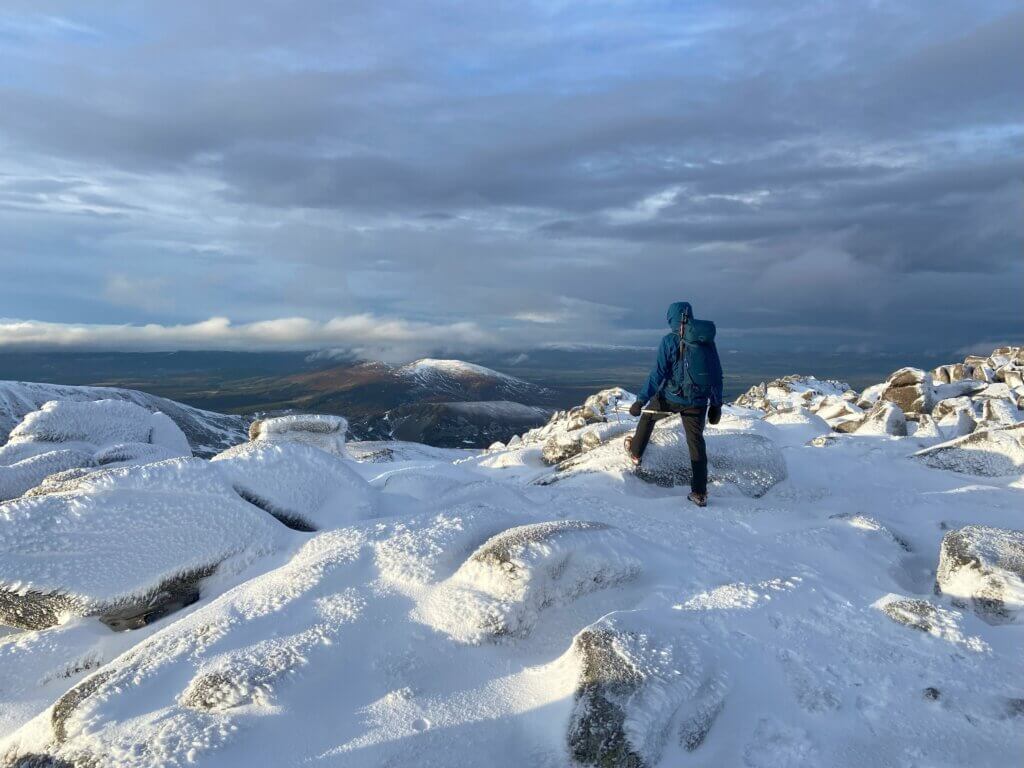
Checking out the view over Glenmore – New Year Winter Walking 2022 – 2023
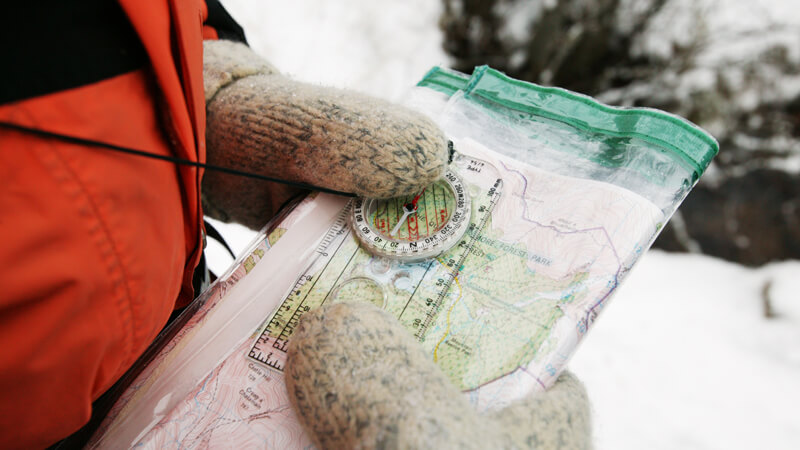
In winter, clear views can disappear in seconds. Whiteouts and low cloud can make even well-known routes confusing. Traditional navigation skills — using a map, compass, and pacing — become essential.
GPS and digital apps can be helpful tools, but batteries drain quickly in the cold, so a strong foundation in traditional navigation is vital. Our guided winter skills training helps you practise navigation techniques in real Highland conditions, learning how to stay calm and orient yourself when visibility drops.
The way you walk changes dramatically in winter. Efficient movement on snow and ice means adjusting your balance, planting your feet securely, and using poles for stability.
You’ll also learn how to kick steps, assess snow conditions, and move safely on frozen ground. Under professional guidance, you’ll gain the confidence to recognise when snow is firm, soft, or unstable — an essential judgement for mountain safety.
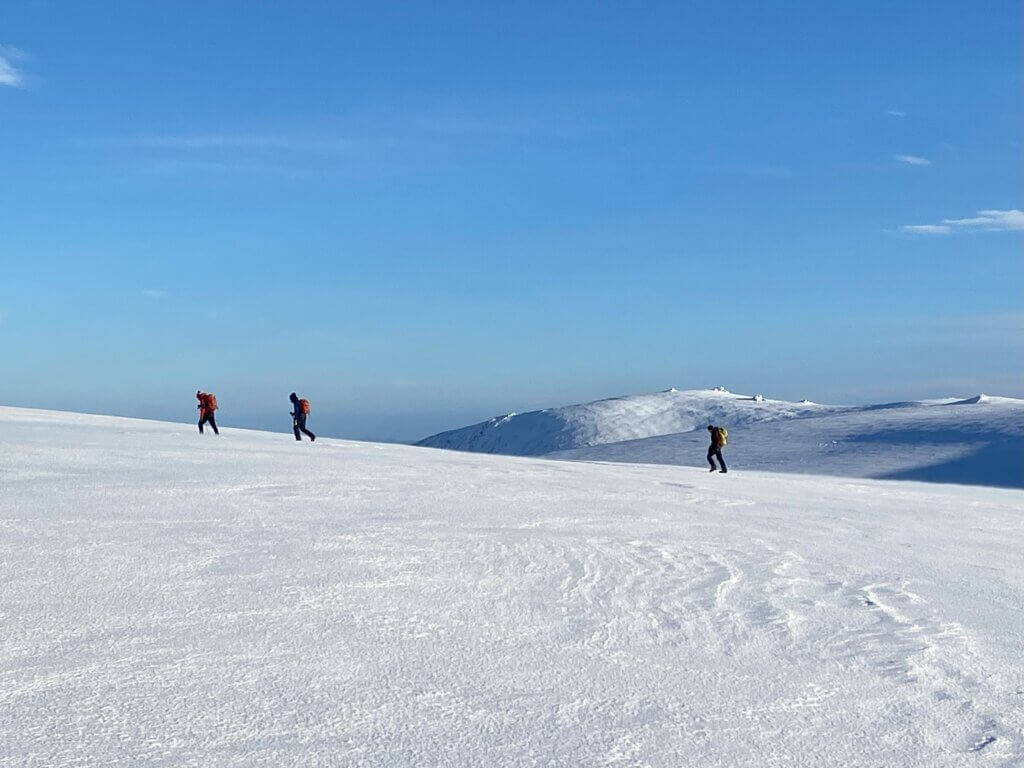
What a view! – New Year Winter Walking 2022 – 2023
Even with the best preparation, mountain weather can turn fast. Knowing how to respond to emergencies — from a simple slip to deteriorating weather — is crucial.
Winter skills training teaches you how to recognise early signs of hypothermia, build an emergency shelter, and make informed decisions about when to turn back. Having these skills doesn’t just protect you; it helps safeguard others you’re walking with too.
The right equipment isn’t just about comfort; it’s about safety.
During our courses, you’ll learn how and when to use:
Crampons: For grip on icy paths and steep slopes.
Gaiters: To keep snow out of boots and prevent wet, cold feet.
Poles: To improve balance, reduce fatigue, and test snow stability.
Proper layering systems: How to manage body temperature to avoid both sweating and chilling.
Understanding your equipment — and practising with it — ensures you know exactly what to reach for when conditions change.
Learning winter skills on your own can be daunting and risky. Under the guidance of qualified instructors, you not only learn correct techniques, but also understand why and when to apply them.
At Fraoch Lodge, our base in the Cairngorms, you’ll benefit from:
Expert tuition from experienced mountain guides
Small group sizes for personal attention
A supportive, encouraging atmosphere
Real-world practice in Scotland’s most reliable winter conditions
Guided instruction removes guesswork, helping you build genuine competence — not just confidence.
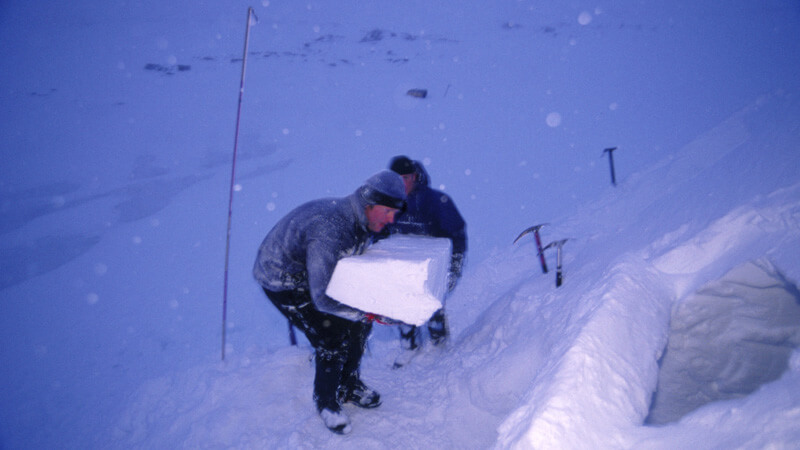
How heavy is snow?
Scotland’s winter mountains reward preparation and respect. Responsible walkers plan their routes, check avalanche forecasts, and understand their limits. Unfortunately, under-preparedness remains one of the leading causes of callouts for Mountain Rescue teams.
By investing in professional winter skills training, you’re choosing to explore responsibly. You’ll gain the ability to make good decisions, enjoy the beauty of winter safely, and become a more resilient and environmentally aware adventurer.
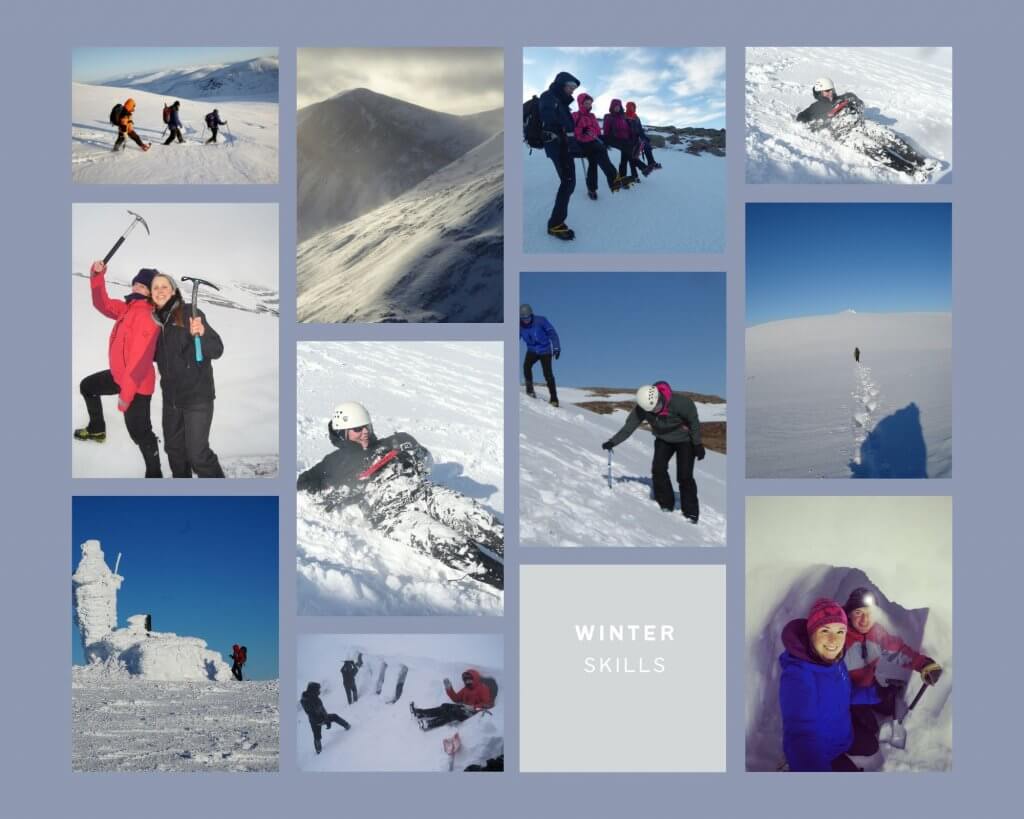
Join us at Fraoch Lodge in the Cairngorms for a fully inclusive winter skills weekend or multi-day course. You’ll stay in comfortable accommodation, enjoy home-cooked meals, and spend your days learning hands-on techniques in stunning mountain surroundings.
 Scot Mountain Holidays (Ltd),
Fraoch Lodge, Deshar Road,
Boat of Garten,
PH24 3BN
Scot Mountain Holidays (Ltd),
Fraoch Lodge, Deshar Road,
Boat of Garten,
PH24 3BN




All content © Copyright Scot Mountain Holidays 2026
Responsive web design by Summit Web Solutions
